Question 9
In Step 2 of angle bisection, if arcs of equal radius are drawn on the other side, as shown in the figure, will the line still be an angle bisector? Explore this through construction, and then justify your answer.
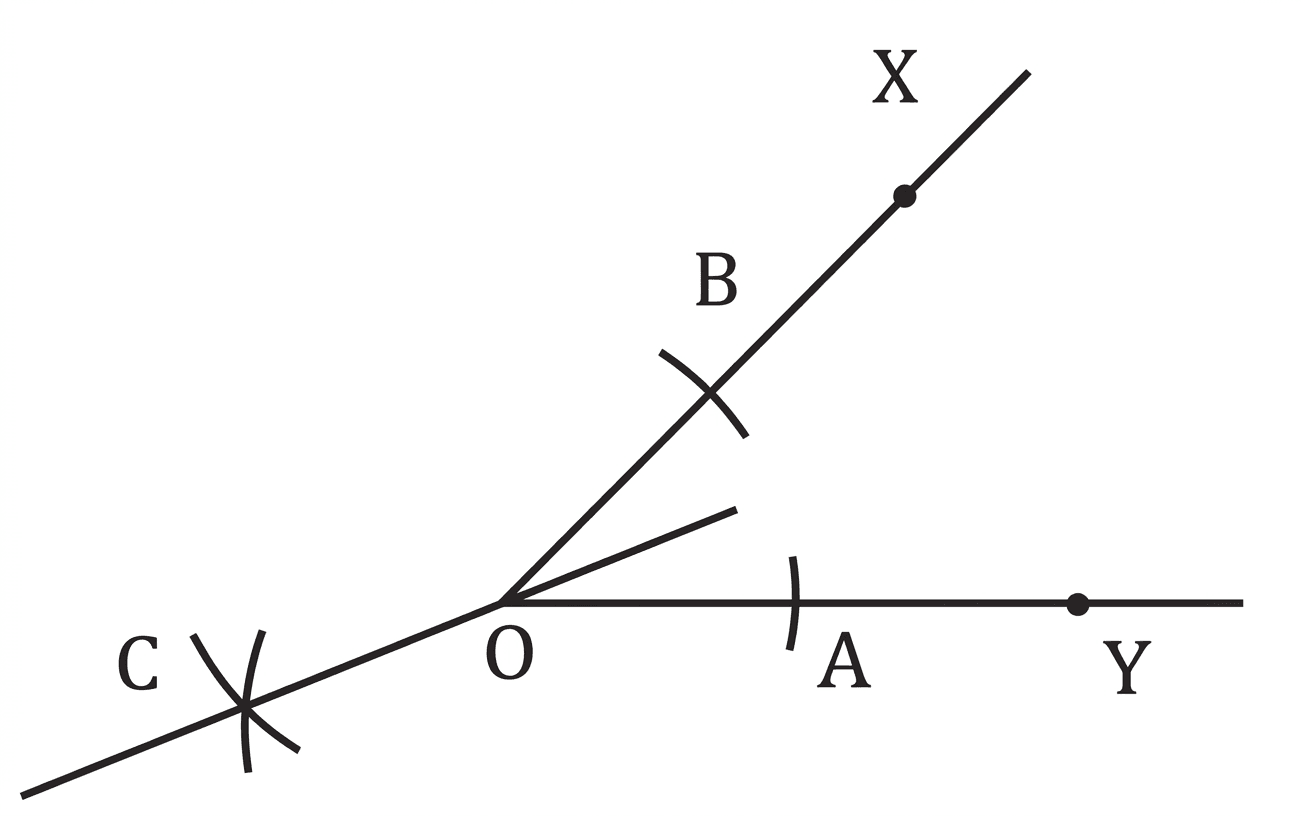
- In standard angle bisection, arcs of equal radius are drawn in the interior of the angle to intersect at a point.
- Drawing the intersecting arcs on the other side creates two triangles, and , that share the common side .
- By showing that using the SSS (Side-Side-Side) congruence criterion, we can prove that , meaning the ray still bisects .
Step 1 · Set Up the Construction
Let the given angle be with vertex .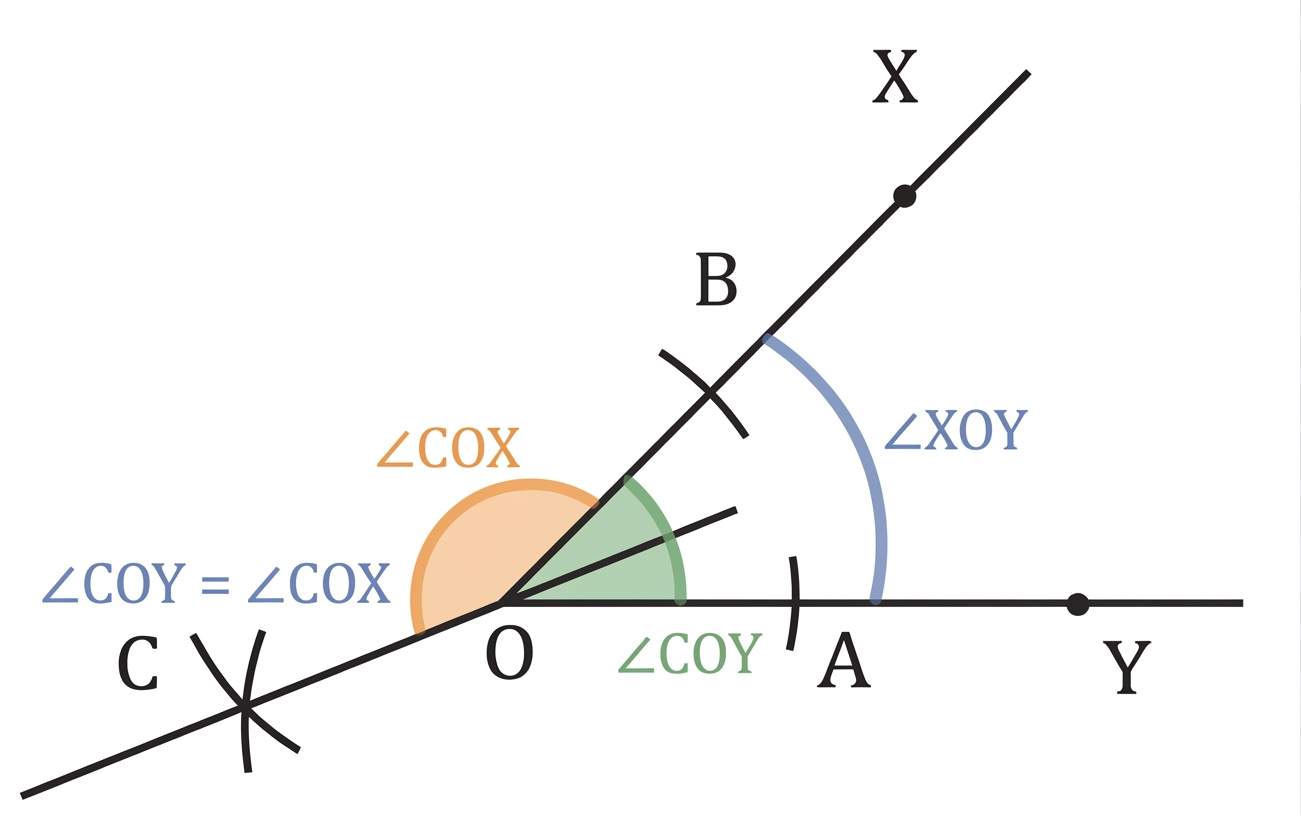
-
With as centre, draw an arc intersecting at and at , so:
-
With and as centres and with equal radii, draw arcs intersecting at point on the other side, so:
-
Join .
Step 2 · Prove Bisection Using Triangle Congruence
In and :
By SSS congruence criterion:
Since corresponding parts of congruent triangles are equal (CPCT):
Therefore, the line bisects .
Yes, the line will still be an angle bisector because by the SSS congruence criterion, which gives .
- Assuming Arcs Must Be in the Interior: Thinking the intersection point must lie inside the angle. The geometric congruence holds regardless of which side the arcs intersect.
- Incorrect Congruence Rule: Using the SAS rule when angles are unknown. Since all three pairs of corresponding sides (, , ) are known to be equal, the SSS criterion must be used.
More questions in FIO
When constructing the perpendicular bisector, is it necessary to have the same radius for the arcs above and below ? Explore this through construction, and then justify your answer.
[Hint 1: Any point that is of the same distance from and lies on the perpendicular bisector.
Hint 2: We can draw the whole line if any two of its points are known.]
Is it necessary to construct the pairs of arcs above and below ? Instead, can we construct both the pairs of arcs on the same side of ? Explore this through construction, and then justify your answer.
While constructing one pair of intersecting arcs, is it necessary that we use the same radii for both of them ? Explore this through construction, and then justify your answer.
Recreate this design using only a ruler and compass —
Justify why in Fig. 6.4 is the perpendicular bisector.
Can you think of different methods to construct a angle at a given point on a line using a rope?
Construct at least 4 different angles. Draw their bisectors.
Construct the 8-petalled figure shown in Fig. 6.5.
In Step 2 of angle bisection, if arcs of equal radius are drawn on the other side, as shown in the figure, will the line still be an angle bisector? Explore this through construction, and then justify your answer.
What are the other angles that can be constructed using angle bisection? Can you construct angle?
Come up with a method to construct the angle bisector using a rope.
Construct the following figure.
How do we construct the petals so that they are of the maximum possible size within a given square?
Construct at least 4 different angles in different orientations without taking any measurement. Make a copy of all these angles.
Construct the Fig. 6.6.
Construct 4 pairs of parallel lines in different orientations.
Construct the following figure.
Use support lines in Fig. 6.11 to construct a pointed arch. Make different arches, by changing the radius of the arcs.
Make your own arch designs.
Construct the following figures:
Optical Illusion: Do you notice anything interesting about the following figure? How does this happen? Recreate this in your notebook.
Construct this figure.
[Hint: Find the angles in this figure.]
Draw a line and mark a point anywhere outside the line. Construct a perpendicular to the given line through .
[Hint: Find a line segment on whose perpendicular bisector passes through .]
How can the tangram pieces be rearranged to form each of the following figures?
Are the following tilings possible?