Question 6
If the congruent polygons of a prism have 10 sides, how many faces, edges and vertices does the prism have? What if the polygons have sides?
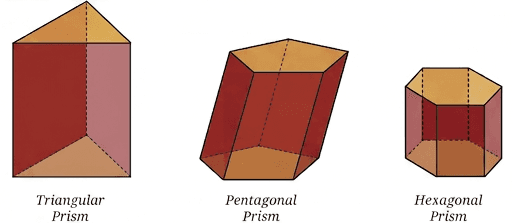
- A prism is a 3D solid with two identical, parallel polygonal bases (top and bottom) and flat rectangular or parallelogram side faces connecting them.
- For any prism whose base polygon has sides:
- Faces (): base faces + lateral side faces
- Edges (): edges on top base + edges on bottom base + vertical connecting edges
- Vertices (): vertices on top base + vertices on bottom base
(i) If the congruent polygons of a prism have 10 sides, how many faces, edges and vertices does the prism have?
Step 1 · Calculate Faces, Edges, and Vertices for a 10-Sided Base
Let be the number of sides of the base polygon. Here, .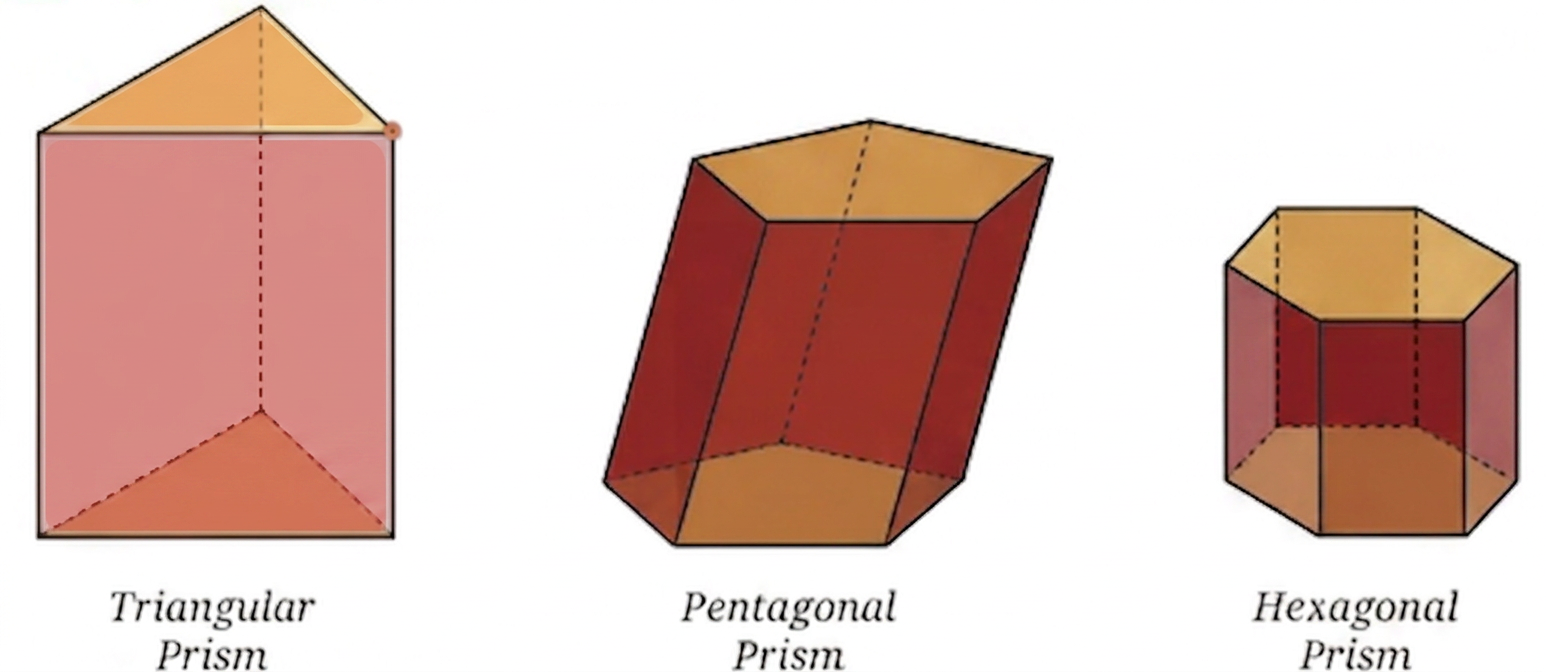
1. Number of Faces:
2. Number of Edges:
3. Number of Vertices:
(i) Faces , Edges , Vertices
(ii) What if the polygons have sides?
Step 1 · Generalise for an -Sided Base Polygon
For a prism where each base polygon has sides:
1. Number of Faces:
2. Number of Edges:
3. Number of Vertices:
(ii) Faces , Edges , Vertices
- Forgetting the Two Base Faces: Counting only the lateral side faces and missing the top and bottom bases, resulting in faces instead of .
- Confusing Prisms with Pyramids: Applying pyramid formulas (, , ) instead of prism formulas (, , ).
- Verifying with Euler's Formula: Always check that . For an -sided prism: .
More questions in IT
Draw the initial few steps (at least till Step 2) of the shape sequence that leads to the Sierpinski Carpet.
By its construction, each step in the sequence has (i) squares of the same size that remain in the figure, and the size of these squares becomes smaller and smaller as the step number increases, and (ii) square holes that are formed by removing square pieces.
Show that by joining the midpoints of an equilateral triangle, we divide it into 4 identical equilateral triangles.
[Hint: Note that the corner triangles are isosceles.]
This fractal is called the Sierpinski Triangle/Gasket.
In previous classes, you've seen solids that are much simpler than an elephant or cat, such as cubes, spheres, cylinders, and cones. What would the profiles of these look like, from different viewpoints?
Can you describe a solid and a viewpoint that would result in each of the following cases? If it helps, you can imagine the solid passing through a wall like Tom did, and leaving a hole of the appropriate shape.
- A solid whose profile has a square outline
- A solid whose profile has a circular outline
- A solid whose profile has a triangular outline
As we saw with the elephant, a given solid might have very different profiles from different viewpoints. Can you visualise solids that have the following contrasting profiles?
Spend some time on this, and if you are finding it difficult to visualise, you may look around and use objects that are around you, or that you will make in the next section. Feel free to consider viewpoints from any direction, including directly above the object.
- A solid with a rectangular profile from one viewpoint and a circular profile from another viewpoint
- A solid with a circular profile from one viewpoint and a triangular one from another viewpoint
- A solid with a rectangular profile from one viewpoint and a triangular one from another viewpoint
- A solid with a trapezium shaped profile from one viewpoint and a circular one from another viewpoint
- A solid with a pentagonal profile from one viewpoint and a rectangular one from another viewpoint
Are there unique solids for each of the conditions, or can you come up with multiple possibilities?
If the congruent polygons of a prism have 10 sides, how many faces, edges and vertices does the prism have? What if the polygons have sides?
If the base of a pyramid has 10 sides, how many faces, edges and vertices does the pyramid have? What if the base is an -sided polygon?
What is a net of a cube?
Visualise how it can be folded to form a cube.
What is a net of a regular tetrahedron? Which of the following are nets of a regular tetrahedron?
Are there any other possible nets?
Draw a net with appropriate measurements that can be folded into a regular tetrahedron. Verify if it works by making an actual cutout.
Draw a net with appropriate measurements that can be folded into a square pyramid. Verify if it works by making an actual cutout.
What is the net of a cylinder?
If the circular faces of a cylinder are unfolded, and if a cut is made along the height of the cylinder, as shown in the figure below, then we get
What are the sidelengths of the rectangle obtained?
How will the net of a cone look?
If the cone is slit open along the line and then unrolled, what will we get?
Observe that all the points on the boundary of the base circle are at equal distances from . So after unrolling the cone, the boundary of the net will be a portion of a circle with centre .
What surface do you construct by using the above net, in which is not the centre of the boundary circle? Make a physical model to help you answer this question!
Draw a net with appropriate measurements that can be folded into a triangular prism. Verify that it works by making an actual cutout.
Taking all the triangles in the net to be equilateral, make a cutout of the net and fold it to form an octahedron.
What is the shortest path for the ant to reach the laddu?
What about in the following case?
If we think that a certain path is the shortest, how can we be sure that it truly is, among all the infinite possibilities?
For example, are either of these the shortest path?
What does this show?
Have we now completely analysed the problem of finding the shortest path between two points on a cuboid?
What is the length of the shortest path between the ant and the laddu?
What happens to the length of a line in its projection?
Can you now compare the lengths and ?
When is the length of the projected line equal to its actual length?
What do you think are the different possible projections of a square that we get based on its orientation?
What do you think is the projection of a parallelogram under different orientations?
Can this ever be a quadrilateral that is not a parallelogram? As a starting point, you could think about the projection of a pair of parallel lines.
What can you say about the projection of an -sided regular polygon?
[Hint: Projection of a polygon is composed of the projections of its sides.]
How would the projections of a cube and a cone look?
See Figures 4.2–4.5. In each case, see if you can visualise another object that gives the same projection.
Find another object that makes the same projection as that of a given cone.
Have you played Tetris? There are five basic shapes in Tetris, corresponding to the different ways of arranging four squares.
Context: In Fig. 4.8, there are five basic shapes in Tetris, corresponding to the different ways of arranging four squares.
Q. Imagine these are cubes, not squares. Draw each of these on your isometric paper (you can find it at the end of the book).
Why is this correspondence between directions on isometric paper and axes of the solid so effective for communicating the shape of the solid?
Can you try drawing the other tetris shapes on isometric paper?