Question 5
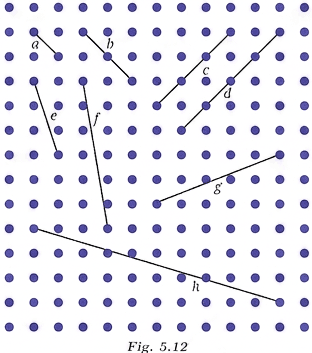
Using your sense of how parallel lines look, try to draw lines parallel to the line segments on this dot paper.
(a) Did you find it challenging to draw some of them? (b) Which ones? (c) How did you do it?
- Parallel lines maintain the exact same distance from each other and have identical slopes (steepness).
- On a dot grid or lattice, the slope of a line segment is determined by counting the vertical change (rise) and the horizontal change (run) between its endpoints:
- To draw a line parallel to a given segment, pick any new starting dot and move by the exact same vertical and horizontal units to mark the endpoint.
(a) Did you find it challenging to draw some of them?
(a) Yes, drawing steep, shallow, or very long line segments accurately by visual estimation alone can be challenging.
(b) Which ones?
(b) Segments with steep slopes or long spans across dots, such as lines , , and .
(c) How did you do it?
Step 1 · Determine the Rise and Run for Each Line Segment
Count the vertical change (dots up/down) and horizontal change (dots left/right) between the endpoints of each segment: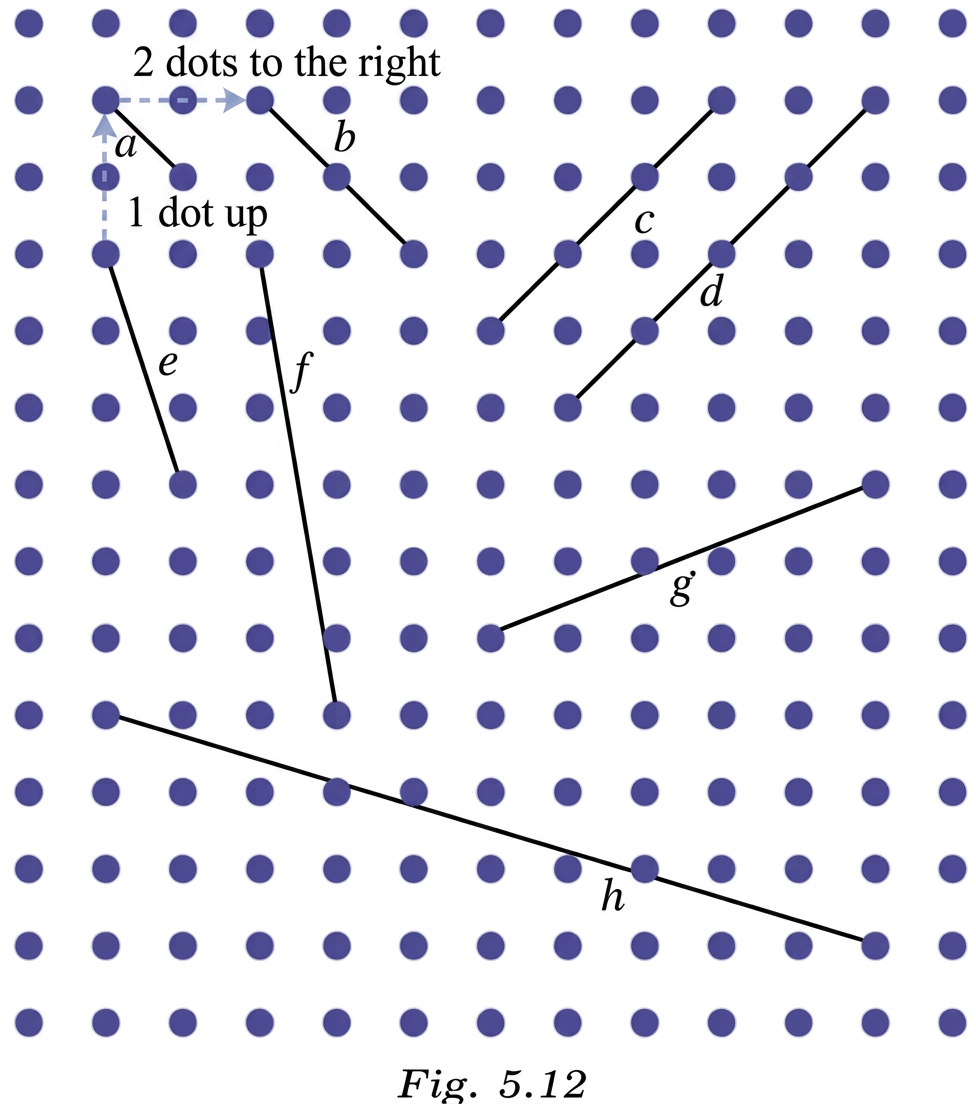
- Line : dot up, dots right
- Line : dots down, dot right
- Line : dots up, dots right
- Line : dots up, dots right
- Line : dots down, dot right
- Line : dots down, dots right
- Line : dot up, dots right
- Line : dots down, dots right
Step 2 · Construct the Parallel Segments
To draw a parallel line for any given segment:
- Choose any new starting dot on the paper.
- From this starting dot, apply the exact same vertical (rise) and horizontal (run) count to locate the second dot.
- Connect the two dots with a straight line segment.
(c) Count the vertical change (rise) and horizontal change (run) between the endpoints of each segment, then apply the exact same step counts from a new starting dot to mark and connect the endpoints.
- Visual Guessing: Relying only on visual estimation instead of counting grid units (rise and run), which often leads to lines that are not truly parallel.
- Inverting Rise and Run: Swapping the horizontal and vertical step counts (e.g., moving dots up and dot right instead of dot up and dots right for line ).
- Ignoring Sign/Direction: Moving in the opposite vertical direction (up instead of down) for negatively sloped lines like , , , and .
More questions in FIO
List all the linear pairs and vertically opposite angles you observe in Fig. 5.3:
Draw some lines perpendicular to the lines given on the dot paper in Fig. 5.10.
In Fig. 5.11, mark the parallel lines using the notation given above (single arrow, double arrow etc.). Mark the angle between perpendicular lines with a square symbol.
(a) How did you spot the perpendicular lines?
(b) How did you spot the parallel lines?
In the dot paper following, draw different sets of parallel lines. The line segments can be of different lengths but should have dots as endpoints.
Using your sense of how parallel lines look, try to draw lines parallel to the line segments on this dot paper.
(a) Did you find it challenging to draw some of them? (b) Which ones? (c) How did you do it?
In Fig. 5.13, which line is parallel to line — line or line ? How do you decide this?
Can you draw a line parallel to , that goes through point ? How will you do it with the tools from your geometry box? Describe your method.
Find the angles marked below.
Find the angle represented by .
In the figures below, what angles do and stand for?
In Fig. 5.33, and . Find angles , ,
In Fig. 5.34, is parallel to and is parallel to . Also, is perpendicular to . If , find the values of and .
What is the measure of angle in Fig. 5.35?
[Hint: Draw lines parallel to LM and PQ through points N and O.]