Question 6
In Fig. 5.13, which line is parallel to line — line or line ? How do you decide this?
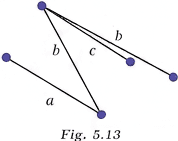
- Parallel lines are lines in a plane that never meet or intersect, no matter how far they are extended in either direction.
- The perpendicular distance between two parallel lines remains constant everywhere.
- To determine which line is parallel to line , we check which line remains at a constant distance from line and will never intersect it when extended.
Step 1 · Compare Line with Line
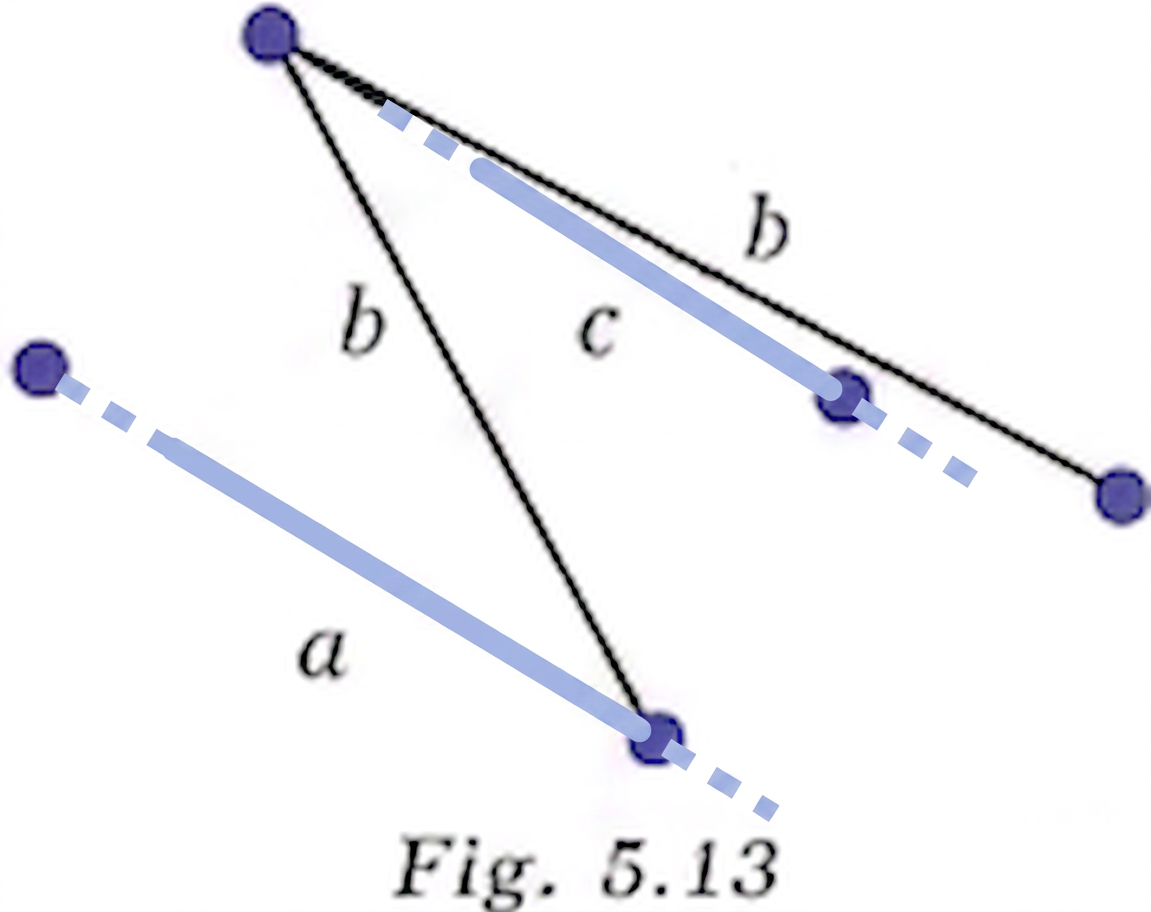
- The distance between line and line is not constant.
- If line and line are extended, they will eventually intersect.
- Therefore, line is not parallel to line .
Step 2 · Compare Line with Line
- The perpendicular distance between line and line remains constant everywhere.
- Even if extended infinitely in both directions, line and line will never meet.
- Therefore, line is parallel to line ().
Line is parallel to line () because the distance between them is constant and they will never meet, no matter how far they are extended.
- Judging only visible segments: Assuming lines are parallel simply because their drawn segments do not touch within the frame of the diagram, without checking if they would intersect when extended.
- Ignoring constant distance: Forgetting that parallel lines must maintain an equal perpendicular distance at all points along their length.
More questions in FIO
List all the linear pairs and vertically opposite angles you observe in Fig. 5.3:
Draw some lines perpendicular to the lines given on the dot paper in Fig. 5.10.
In Fig. 5.11, mark the parallel lines using the notation given above (single arrow, double arrow etc.). Mark the angle between perpendicular lines with a square symbol.
(a) How did you spot the perpendicular lines?
(b) How did you spot the parallel lines?
In the dot paper following, draw different sets of parallel lines. The line segments can be of different lengths but should have dots as endpoints.
Using your sense of how parallel lines look, try to draw lines parallel to the line segments on this dot paper.
(a) Did you find it challenging to draw some of them? (b) Which ones? (c) How did you do it?
In Fig. 5.13, which line is parallel to line — line or line ? How do you decide this?
Can you draw a line parallel to , that goes through point ? How will you do it with the tools from your geometry box? Describe your method.
Find the angles marked below.
Find the angle represented by .
In the figures below, what angles do and stand for?
In Fig. 5.33, and . Find angles , ,
In Fig. 5.34, is parallel to and is parallel to . Also, is perpendicular to . If , find the values of and .
What is the measure of angle in Fig. 5.35?
[Hint: Draw lines parallel to LM and PQ through points N and O.]