Question 7
Why is a square? Why is its area half that of the original paper?
Explain by connecting and , finding the different angles formed, and then using tringle congruence.
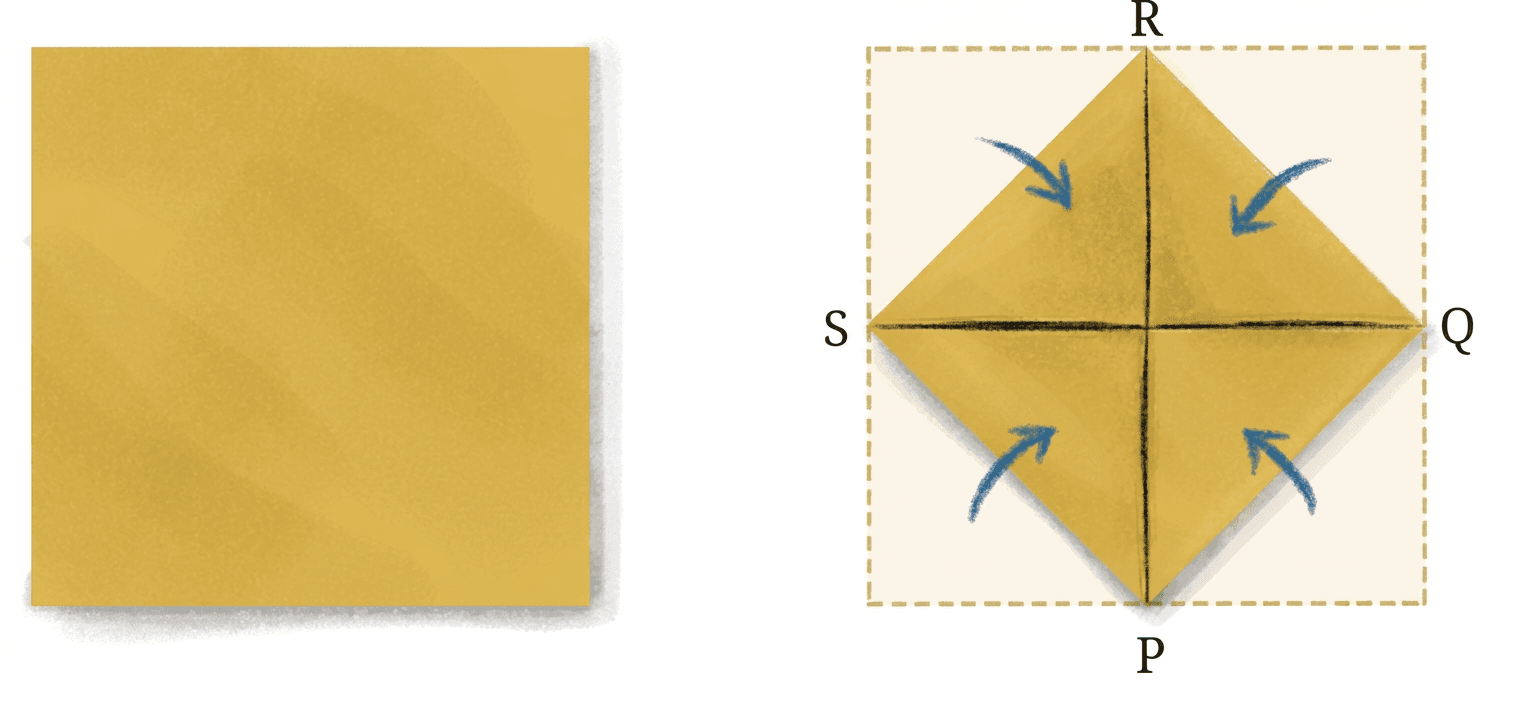
- A square sheet of paper with side length has midpoints on sides respectively.
- Connecting these midpoints creates quadrilateral inside the paper.
- To prove is a square, we:
- Use SAS triangle congruence on the four corner right-angled triangles to show all sides are equal ().
- Use the angle sum on a straight line to show each interior angle is .
- Verify with diagonals and that they are equal in length and perpendicular to each other.
- To find its area, we apply the Pythagoras theorem on one of the corner triangles to find , which is exactly half of the original area ().
(i) Why is a square?
Step 1 · Define the Squares and Side Lengths
Let the original square be with side length and area .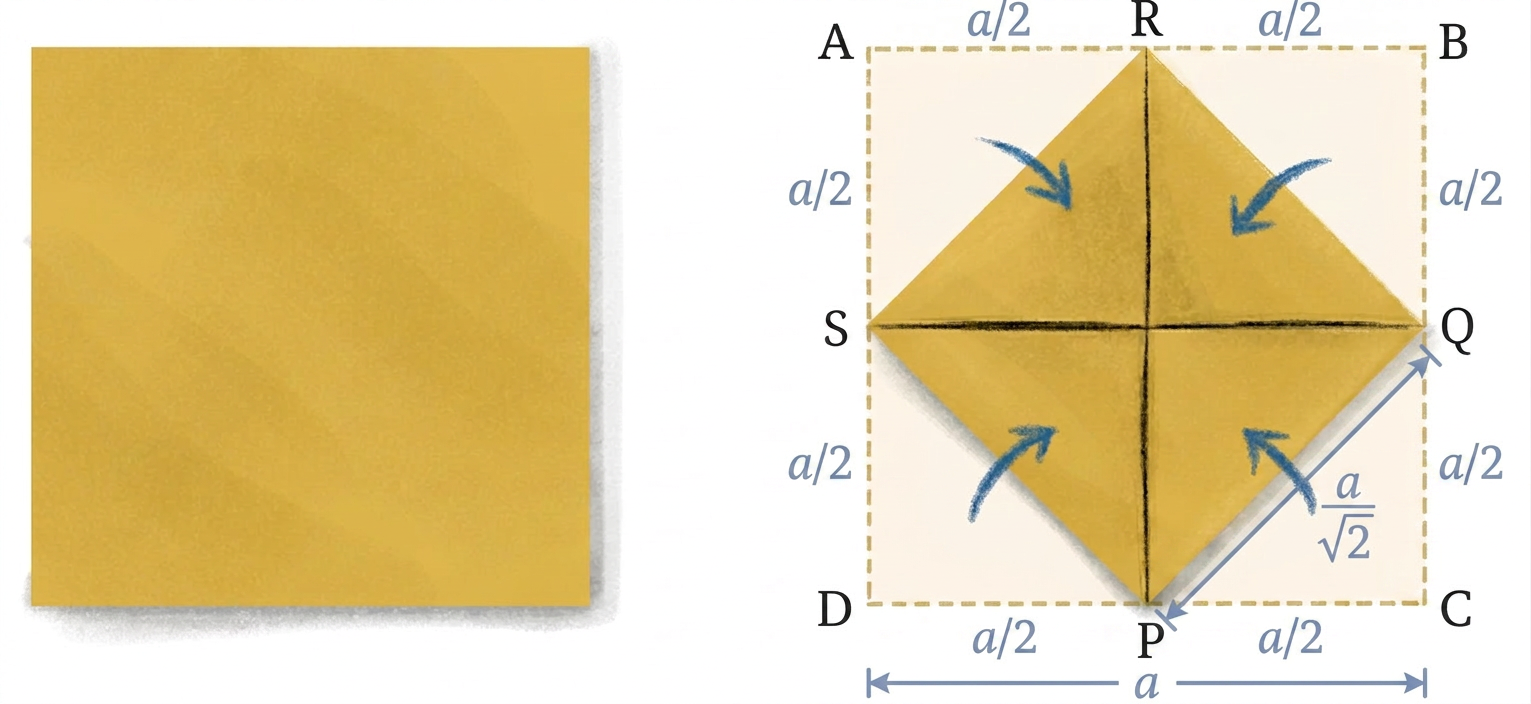
Since are the midpoints of respectively:
Step 2 · Prove is a Square Using Triangle Congruence and Angles
Consider the four corner right-angled triangles , , , and :
By the congruence rule:
Therefore, their corresponding hypotenuses are equal: Thus, is a rhombus.
In isosceles right-angled triangle , since and :
Similarly, in , .
Since is a straight line, the sum of angles at point is :
Since all four sides are equal and each interior angle is , is a square.
Step 3 · Confirm Using Diagonals and
Connect diagonals and .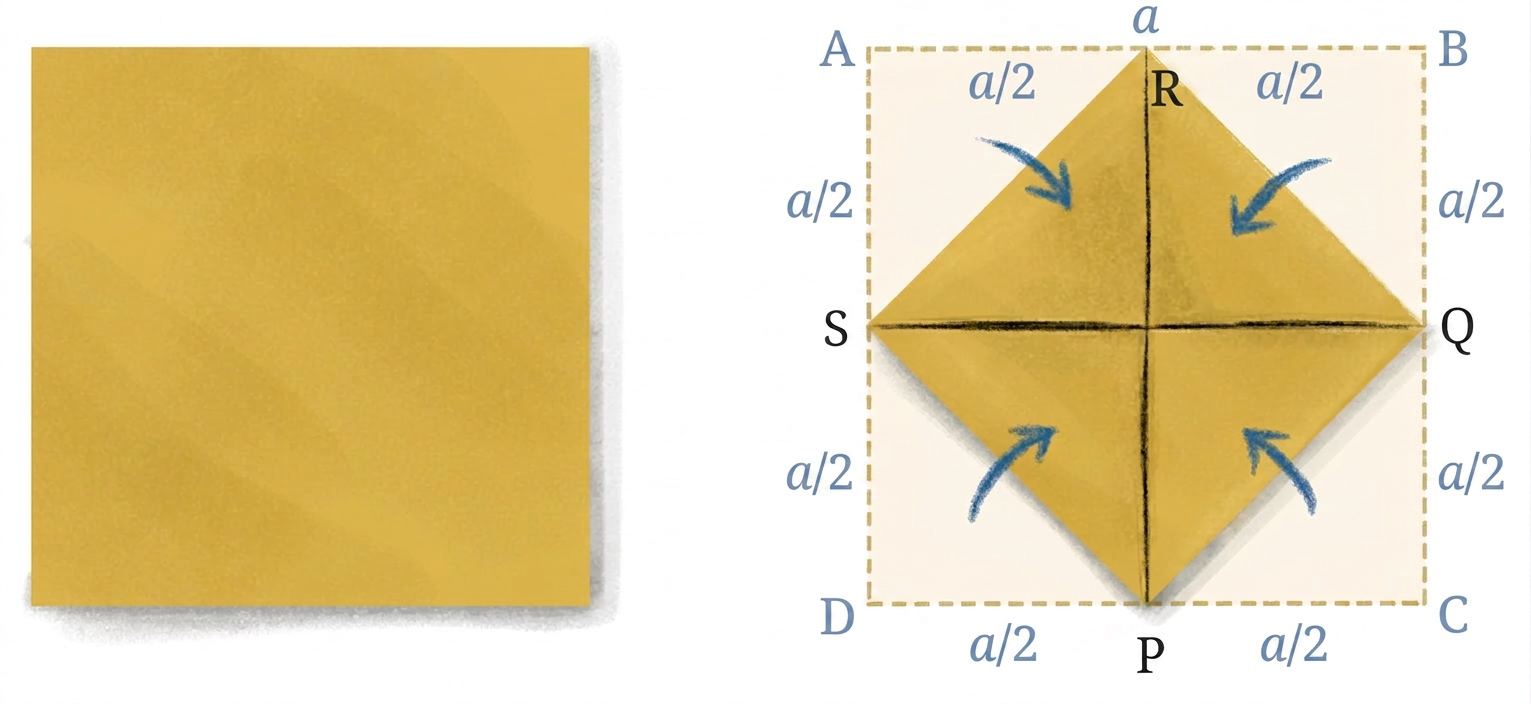
- connects midpoints of and , so and .
- connects midpoints of and , so and .
Therefore:
Since , it follows that:
The diagonals of are equal and perpendicular bisectors of each other, confirming is a square.
(i) is a square because its four sides are equal () and all its interior angles are .
(ii) Why is its area half that of the original paper?
Step 1 · Calculate the Area of
In right-angled triangle , by Pythagoras theorem:
The area of square is:
Comparing with the area of the original square ():
(ii)
- Rhombus vs. Square: Proving that all four sides are equal () only shows that is a rhombus. You must also prove that the interior angles are (or that diagonals are equal and perpendicular) to establish that it is a square.
- Side Length vs. Area: Halving the area does not mean the side length is halved. The side length of is (not ), which yields an area of .
More questions in IT
How can one construct a square having double the area of a given square?
Why does the new dotted square have double the area of the original square?
In many of the constructions in the Śulba-Sūtra, it is desirable to construct, where needed, what Baudhāyana calls ‘east-west’ and ‘north-south’ lines, i.e., horizontal and vertical lines that are perpendicular to each other. Can you draw some horizontal and vertical lines to see why the new square has double the area of the original square? You could draw some horizontal and vertical lines as shown on the right.
Why should the extension of the vertical and horizontal sides of the original square pass through the vertices of the dotted square?
[Hint: From the diagonal property of a square, the line that bisects an angle passes through the opposite vertex. Argue why the vertical and horizontal sides of the original square bisect the two angles of the dotted square.**]
Context: So, the new square has double the area of the original square, because the original square is made up of two small triangles, while the new square is made up of four small triangles.
Q. Moreover, all these small triangles are congruent to each other. Can you explain why?
Now suppose we are given a square, and we want to construct a square whose area is half that of the original square. How would you do it?
Why is the smaller inside square half the area of the larger square?
Again, adding some east-west and north-south lines can explain it:
Why is a square? Why is its area half that of the original paper?
Explain by connecting and , finding the different angles formed, and then using tringle congruence.
Find the hypotenuse of this isosceles right triangle.
What is the value of ?
Is less than or greater than 1?
Is less than or greater than 2?
Can we find closer bounds for ?
Will we ever get a number with a terminating decimal representation whose square is 2?
If there is such a terminating decimal starting with whose square is 2, then it must have a non-zero last digit. If this is the case, then the decimal representation of its square will also have a non-zero last digit after the decimal point. For example, if is of the form , then its square will be of the form—
Use this formula to check your answers in the Figure it Out on page 39.
What if we wish to combine two squares of 'different' sizes to make a large square whose area is the sum of the two smaller squares?
Why does Baudhāyana’s method work?
Can you see why the method works in the case where the two squares are the same size? Does it agree with the method we used earlier to combine two same sized squares into a bigger square?
Explain why all the angles of this new 4-sided figure are right angles and so it is a square.
List down all the Baudhāyana triples with numbers less than or equal to 20.
Is there an unending sequence of Baudhāyana triples?
Is a Baudhāyana triple?
Is a Baudhāyana triple?
Context: The list of Baudhāyana triples having numbers less than or equal to 20 contains the following triples — , , , .
Q. Do you see any pattern among them?
Context: All these triples can be obtained by multiplying each term of by a certain positive integer.
Q. Can we form a conjecture on Baudhāyana triples based on this observation?
Context: Conjecture: is a Baudhāyana triple, where is any positive integer.
Q. Is this true?
Is a primitive Baudhayana triple? What are the other primitive Baudhayana triples with numbers less than or equal to ?
Generate 5 scaled versions of each of these primitive triples. Are these scaled versions primitive?
If is non-primitive, and the integers have — greater than 1 — as a common factor, then is a Baudhayana triple? Check this statement for . Justify this statement.