Question 3
Find the area of the region remaining at the th step in each of the shape sequences that lead to the Sierpinski fractals. Take the area of the starting square/triangle to be 1 sq. unit.
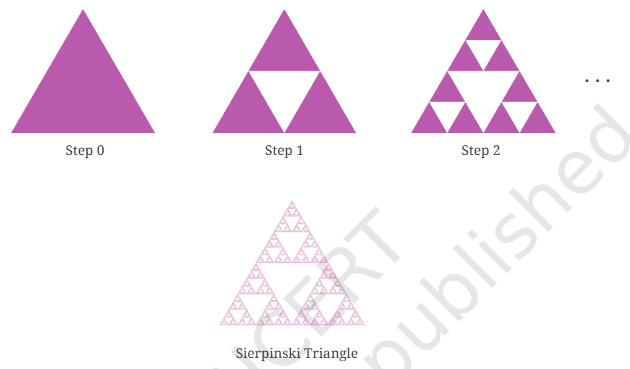
- In each fractal construction, we start with an initial shape of area at Step .
- At each subsequent step, the remaining shapes are subdivided, and a fixed fraction of the area is removed, keeping a constant fraction of the previous step's area.
- To find the area at the th step, we identify the fraction of area retained in one step and multiply it repeatedly times.
(a) Find the area of the region remaining at the th step for Sierpinski's Carpet.
Step 1 · Find the Remaining Area for Initial Steps
At each step, a square is divided into equal smaller squares and the central is removed, leaving of the area.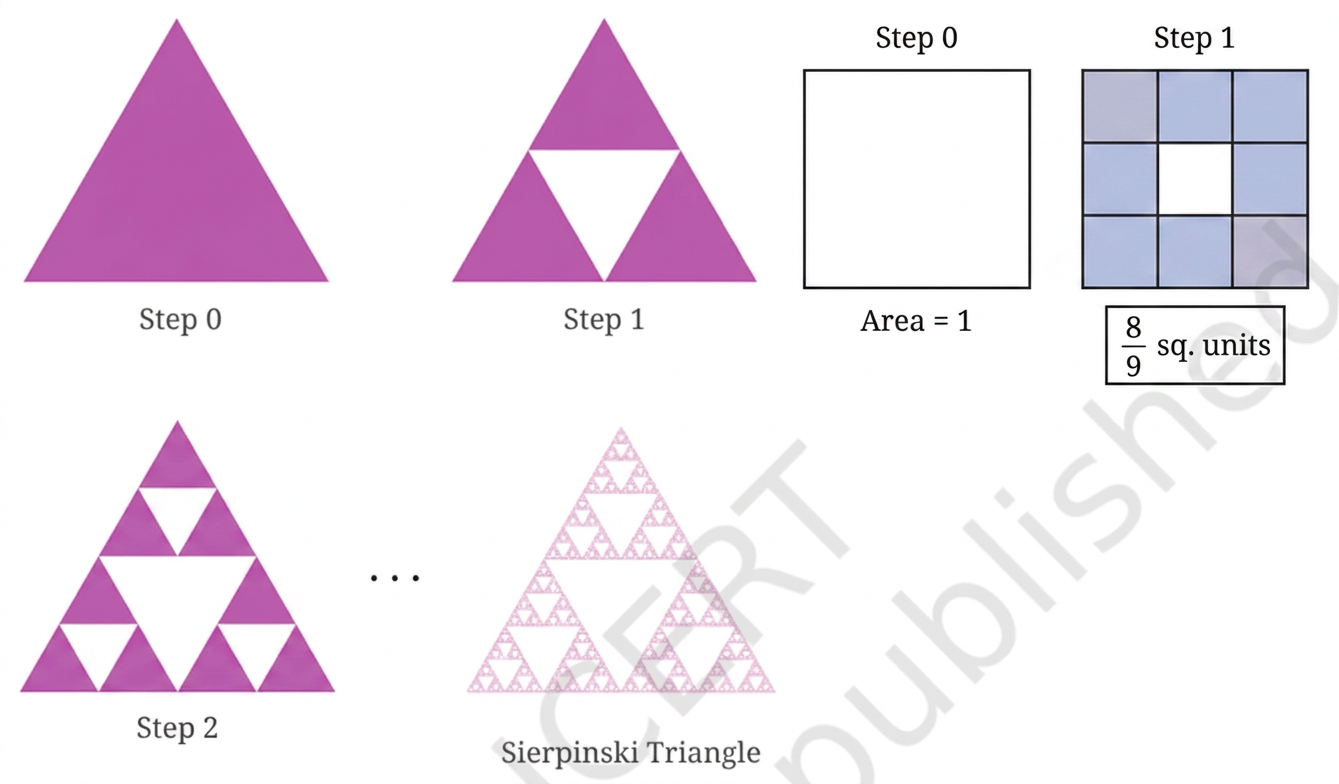
Step 2 · Generalize to the th Step
Since the remaining area is multiplied by at every step, the area at Step is:
(a)
(b) Find the area of the region remaining at the th step for Sierpinski's Gasket.
Step 1 · Find the Remaining Area for Initial Steps
At each step, connecting the midpoints of the sides divides each triangle into equal smaller triangles. Removing the central triangle leaves of the area.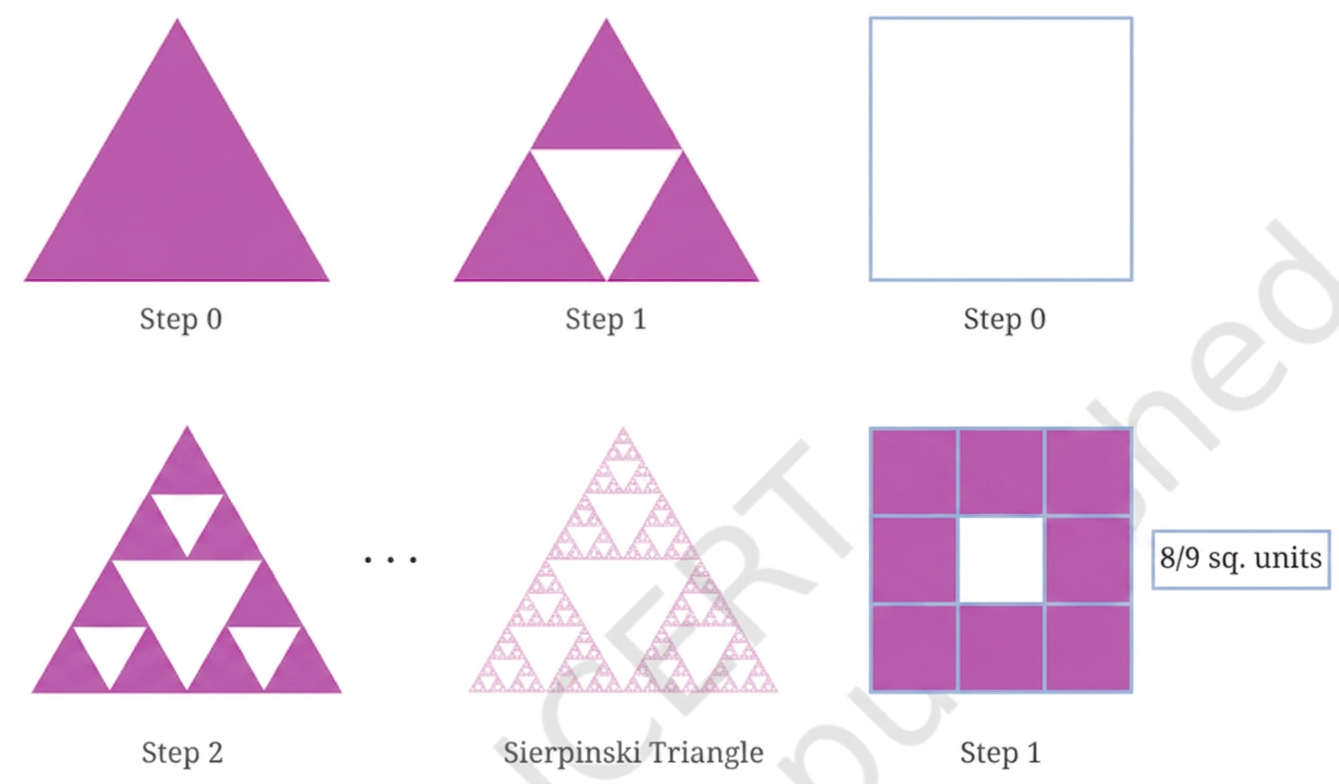
Step 2 · Generalize to the th Step
Since the remaining area is multiplied by at every step, the area at Step is:
(b)
- Removed vs. Remaining Area: Confusing the removed fraction ( for carpet, for gasket) with the remaining fraction ( and ). Make sure to use the portion that is kept.
- Off-by-One Exponent Error: Writing the power as or . Step has area , so Step directly corresponds to exponent .
More questions in FIO
Draw the initial few steps (at least till Step 2) of the shape sequence that leads to the Sierpinski Triangle.
Find the number of holes, and the triangles that remain at each step of the shape sequence that leads to the Sierpinski Triangle.
Find the area of the region remaining at the th step in each of the shape sequences that lead to the Sierpinski fractals. Take the area of the starting square/triangle to be 1 sq. unit.
Draw the initial few steps (at least till Step 2) of the shape sequence that leads to the Koch Snowflake.
Find the number of sides in the step of the shape sequence that leads to the Koch Snowflake.
Find the perimeter of the shape at the step of the sequence. Take the starting equilateral triangle to have a sidelength of 1 unit.
Figure it Out
- Which of the following are the nets of a cube? First, try to answer by visualisation. Then, you may use cutouts and try.
A cube has 11 possible net structures in total. In this count, two nets are considered the same if one can be obtained from the other by a rotation or a flip. For example, the following nets are all considered the same —
Find all the 11 nets of a cube.
Draw a net of a cuboid having sidelengths:
(i) , , and
(ii) , , and
Observe the front view, top view and side view of the different lines in Fig. 4.6. Is there any relation between their lengths?
Find the front view, top view and side view of each of the following solids, fixing its orientation with respect to the vertical, horizontal and side planes: cube, cuboid, parallelepiped, cylinder, cone, prism, and pyramid. If needed, see the next problem for clues.
Match each of the following objects with its projections.
Draw the top view, front view and the side view of each of the following combinations of identical cubes.
Imagine eight identical cubes, glued together along faces to form the letter 'C'.
Which solid corresponds to the given top view, front view, and side view?
Solids to choose from:
Using identical cubes, make a solid that gives the following projections:
Find the number of cubes in this stack of identical cubes.
What are the different shapes the projection of a cube can make under different orientations?
In addition to the 5 ways shown in Fig. 4.8, are there any additional ways of gluing four cubes together along faces? Can you visualise and draw these as well?
Draw the following figures on the isometric grid.
[Hint: It may be useful to determine whether the edge to be currently drawn — say, along the height — goes from down to up or up to down. Accordingly, draw the line segment on the grid either in the direction of the height axis or opposite to it.]
Is there anything strange about the path of this ball? Recreate it on the isometric grid.
[Hint: Consider a portion of this figure that is physically realisable and identify the 3 primary directions.]
Observe this triangle.
(i) Would it be possible to build a model out of actual cubes? What are the front, top, and side profiles of this impossible triangle? (ii) Recreate this on an isometric grid. (iii) Why does the illusion work?