Question 36
ZYXW is a trapezium with ZY || WX. A is the midpoint of XY. Show that the area of the trapezium ZYXW is equal to the area of .
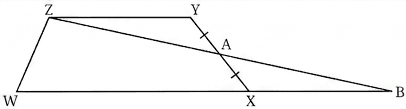
The key idea is to show that two small triangles, and , have the same area, and then use this to relate the areas of the trapezium and the larger triangle.
Step 1 — Identify congruent triangles
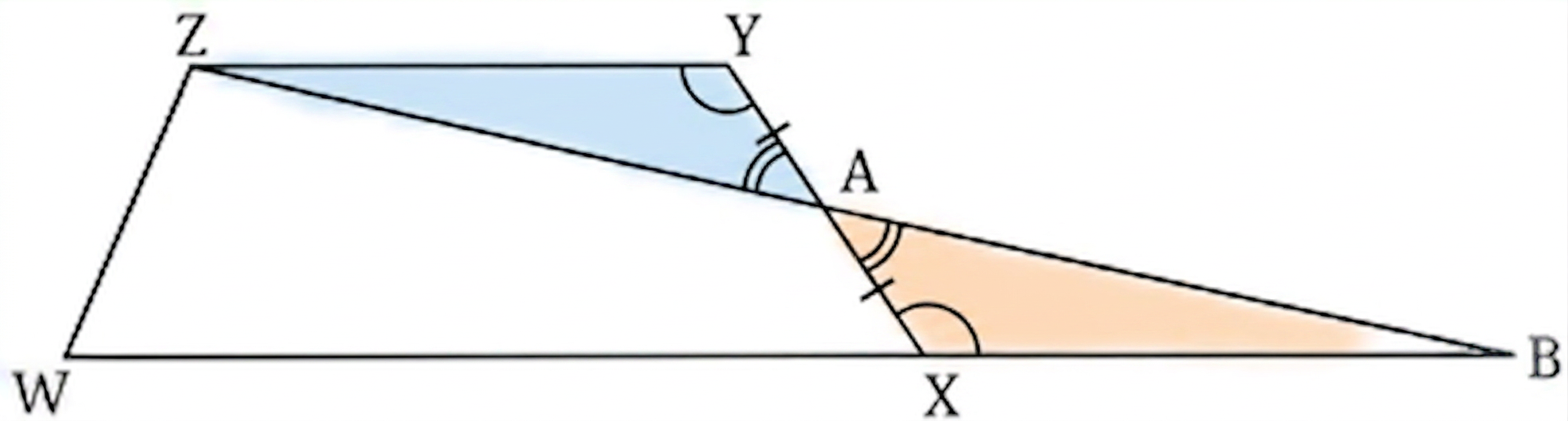
Let us look at the two triangles, and .
We are given that A is the midpoint of the line segment XY. This means that the length of AY is equal to the length of AX.
The lines ZY and WX are parallel because ZYXW is a trapezium. Since WX is part of the line WB, this means that ZY is parallel to XB. When two parallel lines (ZY and XB) are cut by a transversal line (XY), the alternate interior angles are equal. So, is equal to .
Also, when two straight lines (ZB and XY) intersect, the angles opposite to each other at the intersection point are called vertically opposite angles. These angles are always equal. So, is equal to .
Now we have two angles and the included side of equal to two angles and the included side of . This means that is congruent (exactly the same shape and size) to by the Angle-Side-Angle (ASA) congruence criterion.
Step 2 — Relate the areas of the trapezium and the triangle
Since and are congruent triangles, their areas must be equal.
Now, let us consider the area of the trapezium ZYXW. The trapezium ZYXW can be seen as the sum of the area of the quadrilateral ZWXA and the area of the triangle ZAY.
Next, let us consider the area of the large triangle . The triangle can also be seen as the sum of the area of the quadrilateral ZWXA and the area of the triangle BAX.
From the previous step, we know that . Let's substitute in place of in the equation for the trapezium's area.
Now, we can see that the expression for the area of the trapezium is exactly the same as the expression for the area of .
Answer
The area of the trapezium ZYXW is equal to the area of .
More questions in FIO
Identify the missing sidelengths.
The figure shows a path (the shaded portion) laid around a rectangular park EFGH.
(i) What measurements do you need to find the area of the path? Once you identify the lengths to be measured, assign possible values of your choice to these measurements and find the area of the path. Give a formula for the area.
An example of a formula — .
[Hint: There is a relation between the areas of EFGH, the path, and ABCD.**]
(ii) If the width of the path along each side is given, can you find its area? If not, what other measurements do you need? Assign values of your choice to these measurements and find the area of the path. Give a formula for the area using these measurements.
[Hint: Break the path into rectangles.**]
(iii) Does the area of the path change when the outer rectangle is moved while keeping the inner rectangular park EFGH inside it, as shown?
The figure shows a plot with sides 14m and 12m, and with a crosspath. What other measurements do you need to find the area of the crosspath? Once you identify the lengths to be measured, assign some possible values of your choice and find the area of the path. Give a formula for the area based on the measurements you choose.
Find the area of the spiral tube shown in the figure. The tube has the same width throughout.
[Hint: There are different ways of finding the area. Here is one method.]
What should be the length of the straight tube if it is to have the same area as the bent tube on the left?
In this figure, if the sidelength of the square is doubled, what is the increase in the areas of the regions 1, 2 and 3? Give reasons.
Divide a square into 4 parts by drawing two perpendicular lines inside the square as shown in the figure.
Rearrange the pieces to get a larger square, with a hole inside.
You can try this activity by constructing the square using cardboard, thick chart paper, or similar materials.
Find the areas of the following triangles:
Find the length of the altitude BY.
Find the area of SUB, given that it is isosceles, SE is perpendicular to UB, and the area of SEB is 24 sq. units.
[Śulba-Sūtras] Give a method to transform a rectangle into a triangle of equal area.
[Śulba-Sūtras] Give a method to transform a triangle into a rectangle of equal area.
ABCD, BCEF, and BFGH are identical squares.
(i) If the area of the red region is 49 sq. units, then what is the area of the blue region?
(ii) In another version of this figure, if the total area enclosed by the blue and red regions is 180 sq. units, then what is the area of each square?
If M and N are the midpoints of XY and XZ, what fraction of the area of XYZ is the area of XMN? [Hint: Join NY]
Gopal needs to carry water from the river to his water tank. He starts from his house. What is the shortest path he can take from his house to the river and then to the water tank? Roughly recreate the map in your notebook and trace the shortest path.
Find the area of the quadrilateral ABCD given that AC = 22 cm, BM = 3 cm, DN = 3 cm, BM is perpendicular to AC, and DN is perpendicular to AC.
Find the area of the shaded region given that ABCD is a rectangle.
What measurements would you need to find the area of a regular hexagon?
What fraction of the total area of the rectangle is the area of the blue region?
Give a method to obtain a quadrilateral whose area is half that of a given quadrilateral.
Observe the parallelograms in the figure below.
(i) What can we say about the areas of all these parallelograms?
(ii) What can we say about their perimeters? Which figure appears to have the maximum perimeter, and which has the minimum perimeter?
Find the areas of the following parallelograms:
Find QN.
Consider a rectangle and a parallelogram of the same sidelengths: 5 cm and 4 cm. Which has the greater area? [Hint: Imagine constructing them on the same base.]
Give a method to obtain a rectangle whose area is twice that of a given triangle. What are the different methods that you can think of?
[Śulba-Sūtras] Give a method to obtain a rectangle of the same area as a given triangle.
[Śulba-Sūtras] An isosceles triangle can be converted into a rectangle by dissection in a simpler way. Can you find out how to do it?
[Hint: Show that triangles ΔADB and ΔADC can be made into halves of a rectangle. Figure out how they should be assembled to get a rectangle. Use cut-outs if necessary.]
[Śulba-Sūtras] Give a method to convert a rectangle into an isosceles triangle by dissection.
Which has greater area—an equilateral triangle or a square of the same sidelength as the triangle? Which has greater area—two identical equilateral triangles together or a square of the same sidelength as the triangle? Give reasons.
Find the area of a rhombus whose diagonals are 20 cm and 15 cm.
Give a method to convert a rectangle into a rhombus of equal area using dissection.
Find the areas of the following figures:
[Śulba-Sūtras] Give a method to convert an isosceles trapezium to a rectangle using dissection.
Here is one of the ways to convert trapezium ABCD into a rectangle EFGH of equal area —
Given the trapezium ABCD, how do we find the vertices of the rectangle EFGH?
[Hint: If ΔAHI ≅ ΔDGI and ΔBEJ ≅ ΔCFJ, then the trapezium and rectangle have equal areas.]
Using the idea of converting a trapezium into a rectangle of equal area, and vice versa, construct a trapezium of area .
A regular hexagon is divided into a trapezium, an equilateral triangle, and a rhombus, as shown. Find the ratio of their areas.
ZYXW is a trapezium with ZY || WX. A is the midpoint of XY. Show that the area of the trapezium ZYXW is equal to the area of .