Question 16
Give a method to convert a parallelogram into a rectangle of equal area.
You can try this using a cut-out of a parallelogram.
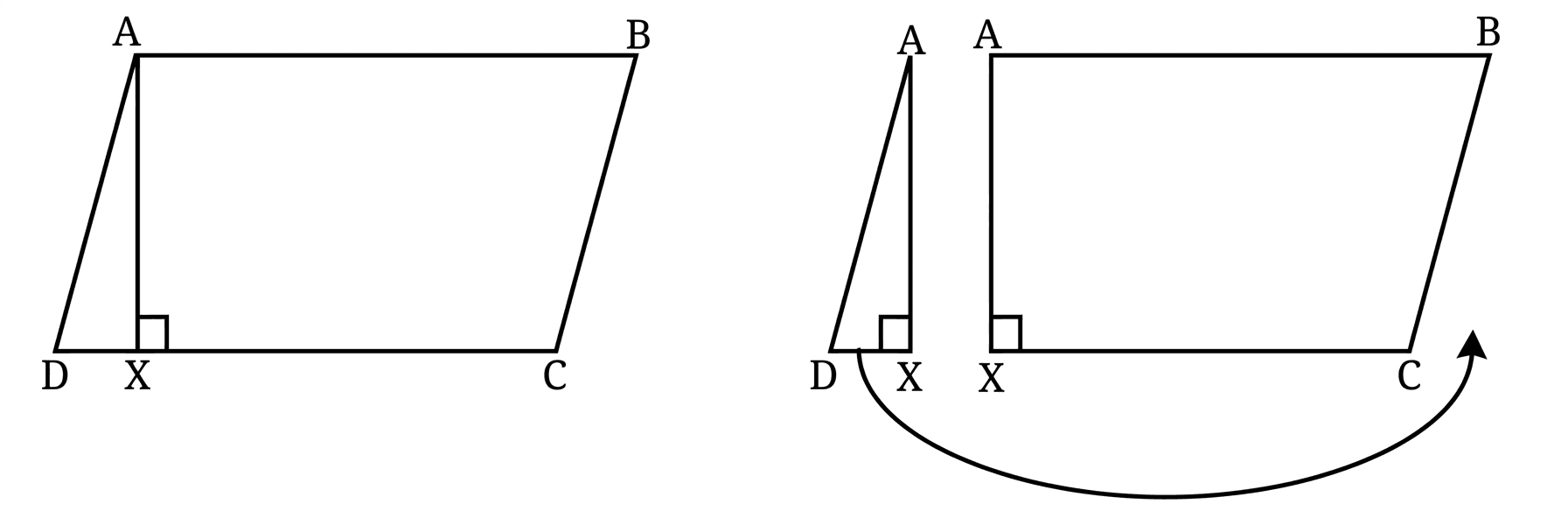
- A parallelogram can be converted into a rectangle of the same area by slicing off a right-angled triangle from one side along its altitude (height) and sliding it to the opposite side.
- Since no area is added or removed during the cutting and rearranging process, the total area remains conserved:
Step 1 · Draw the Altitude
Consider a parallelogram . Draw a perpendicular line from vertex to the base , meeting at point .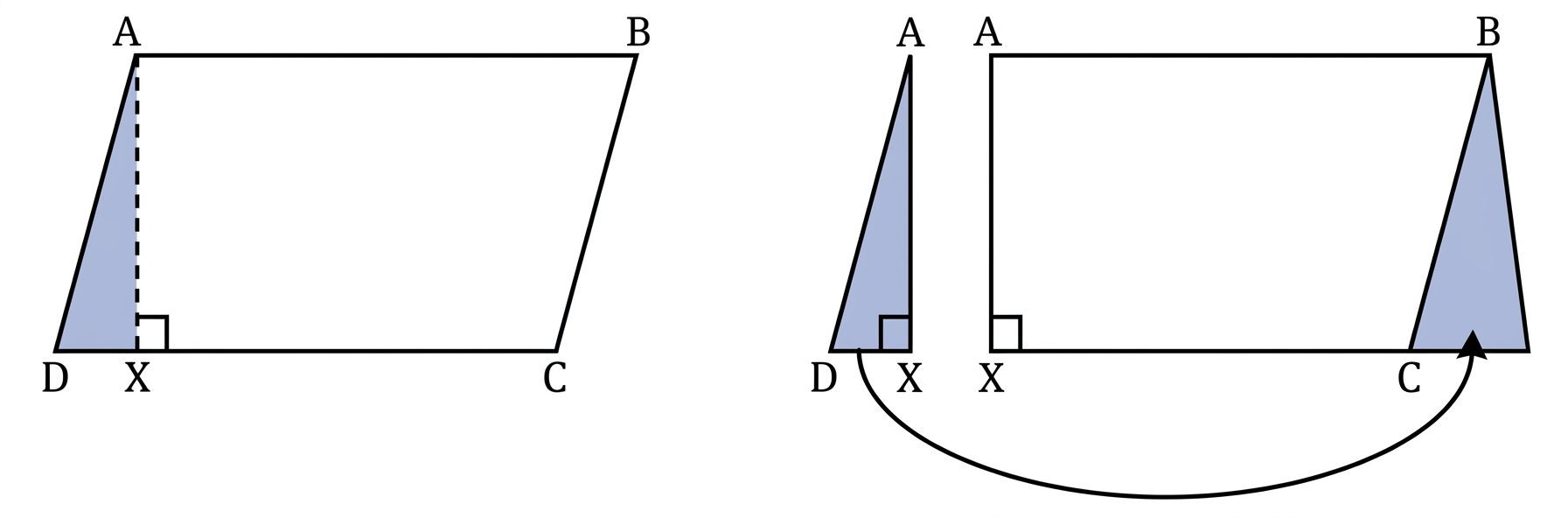
- represents the height of the parallelogram.
- represents the base of the parallelogram.
- forms a right-angled triangle.
Step 2 · Cut and Rearrange the Triangle
- Cut out the right-angled triangle from the left side of the parallelogram. The remaining figure is the trapezoid .
- Shift the triangle to the right side of the trapezoid.
- Align side with the opposite side (since ).
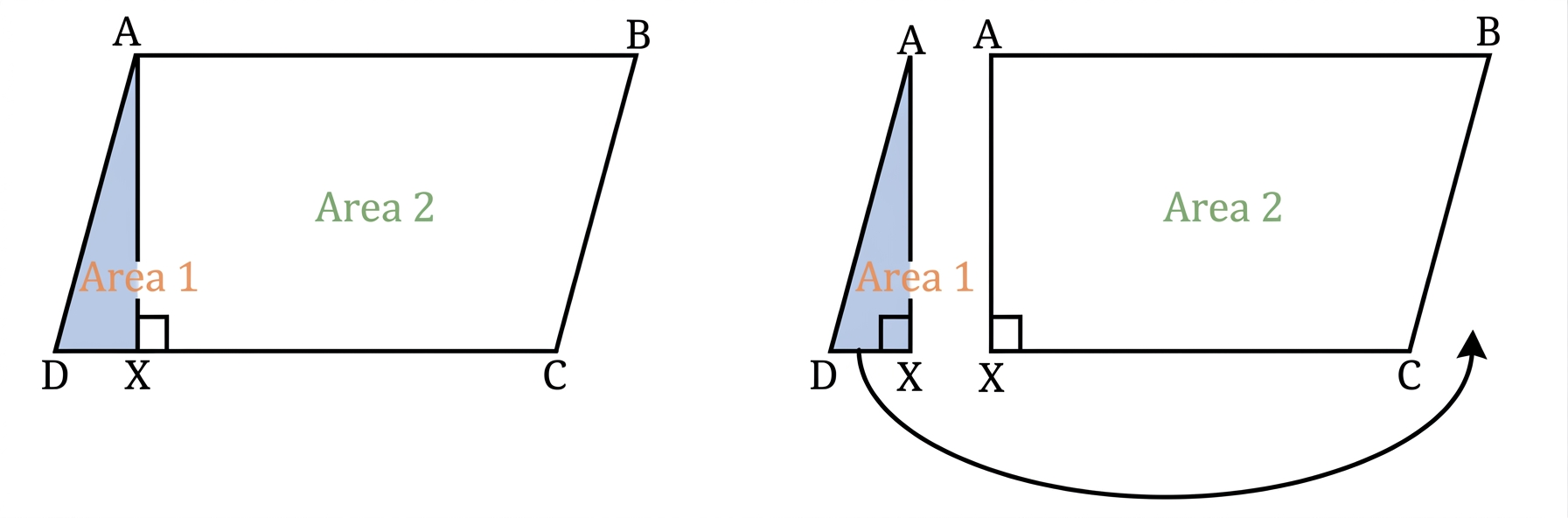
The newly formed figure is a rectangle with length equal to base and breadth equal to height .
Step 3 · Verify Equality of Area
The original parallelogram is made up of two parts:
The newly formed rectangle consists of the exact same two parts:
Therefore:
Cut the right-angled triangle along the height from one end of the parallelogram and attach it to the other end to form a rectangle of equal area ().
- Slant Height vs Perpendicular Height: Cutting along an arbitrary or slanted line instead of a perpendicular altitude will not produce the angles required to form a rectangle.
- Incorrect Side Alignment: When shifting the cut triangle, its hypotenuse () must align with the parallel opposite side () so that the vertical altitude becomes the breadth of the rectangle.
More questions in IT
Try to think of different creative ways to divide a square into 4 parts of equal area.
Why Can't Perimeter be a Measure of Area?
Why do we count the number of unit squares to assign measures for area? Couldn't we have just used the perimeter of a region, i.e., the length of its boundary as a measure of its area?
Context: Consider two regions, Region 1 and Region 2, such that , but .
Q. Find two rectangles that are examples of such regions. If needed, use a grid paper (given at the end of the book) for this.
Also give an example of two regions of other shapes, where the region with the larger perimeter has the smaller area! This property should be visually clear in your example.
In the given figure, which triangle has a greater area: or , if both the rectangles are identical?
In the given figure, which triangle has a greater area: or , if both the rectangles are identical?
Find the area of .
To find the area of a triangle, what measurements do we need?
How do we get the outer rectangle from the given triangle?
Will this formula hold for the kind of triangle, around which we cannot draw a rectangle with as the base?
Line . Consider the different triangles that have as their base, and with their third vertex lying anywhere on .
(i) Which of these triangles has the maximum area, and which has the minimum area?
(ii) Which of these triangles has the maximum perimeter, and which has the minimum perimeter?
Analyse whether lies on the perpendicular bisector of .
Area of any Polygon
How do we find the area of this quadrilateral? What measurements do we need for this?
How do we find the area of this pentagon?
Can any polygon be divided into triangles?
Give a method to convert a parallelogram into a rectangle of equal area.
You can try this using a cut-out of a parallelogram.
Can and fit together, as shown in the figure, to get a rectangle?
Try working this out!
What are the sidelengths of the rectangle ?
Area of rhombus ABCD can also be determined by finding the areas of and . What formula does this give us?
Context: The area of rhombus ABCD can be written as:
Q. Simplify the expression to show that we get the same formula for the area of a rhombus in terms of its diagonals.
Find the areas of the following trapeziums by breaking them into figures whose areas can be computed.
Will this formula hold for a trapezium that looks like this?
Will Approach 2 work for any type of trapezium?
What figure will we get when the two trapeziums are joined along ?
What type of a quadrilateral is this?
What do you think is the area of an A4 sheet? Its sidelengths are and . Now find its area.
What do you think is the area of the tabletop that you use at school or at home? You could perhaps try to visualise how many A4 sheets can fit on your table.
Express the following lengths in centimeters:
(i)
(ii)
Express the following lengths in inches:
(i)
(ii)
How many is ?
Context: Convert to . Every gives an . Hence, .
Q. Evaluate the quotient.
What do you think is the area of your classroom?
How many is ?
What do you think is the area of your school? Make an estimate and compare it with the actual data.
Find out the local unit of area measurement in your region.
What do you think is the area of your village/town/city? Make an estimate and compare it with the actual data.
How many is a ?
How many times is your village/town/city bigger than your school?
Find the city with the largest area in:
(i) India
(ii) the world
Find the city with the smallest area in:
(i) India
(ii) the world