Question 9
Represent the following numbers in the Egyptian system: 10458, 1023, 2660, 784, 1111, 70707.
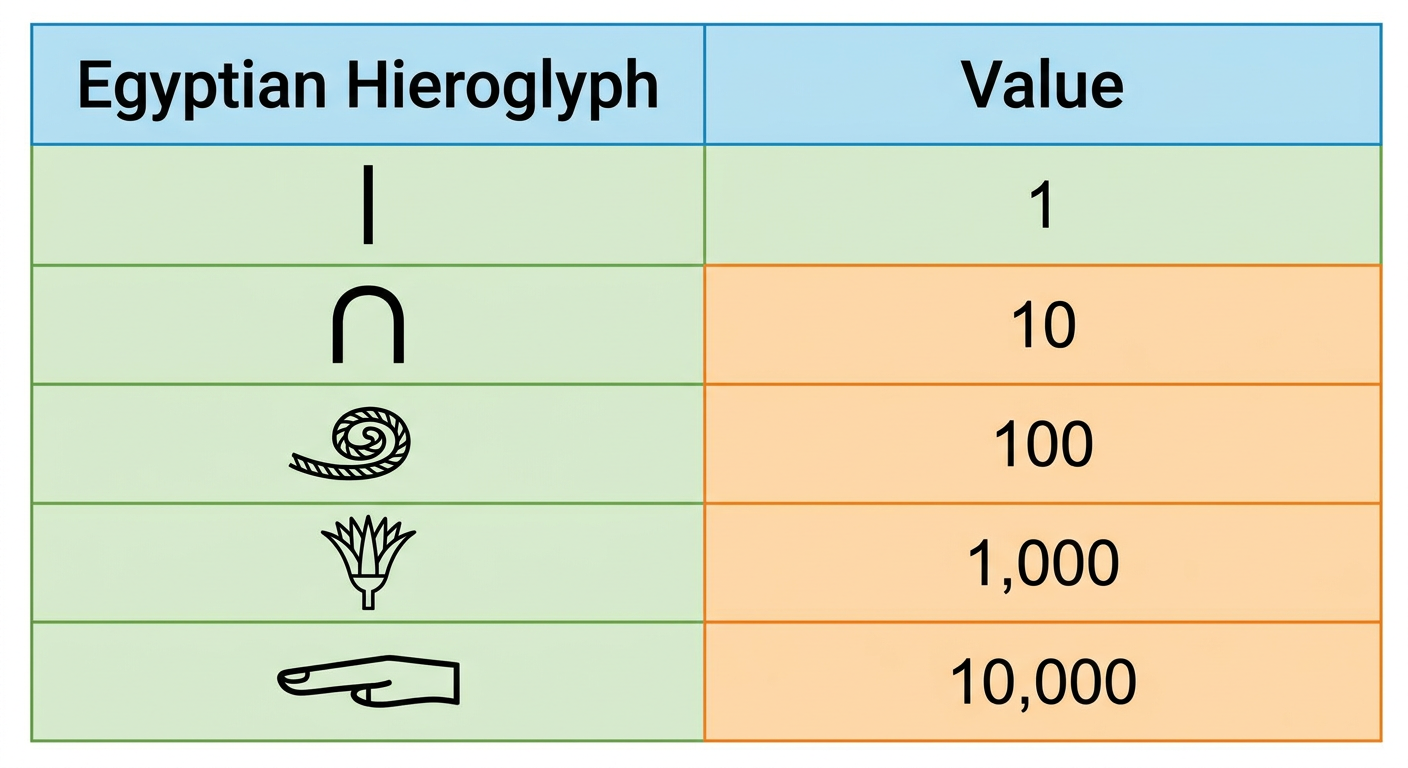
- The ancient Egyptian numeral system is an additive system where each symbol represents a power of :
- (Stroke):
- (Heel bone):
- (Coil of rope):
- (Lotus flower):
- (Pointing finger):
- To represent a number, write it in expanded place-value form and repeat the corresponding hieroglyphic symbols for each place value.
- Since there is no symbol for zero (), place values with zero are simply omitted.
(i) Represent in the Egyptian system.
Step 1 · Represent 10458
(i)
(ii) Represent in the Egyptian system.
Step 1 · Represent 1023
(ii)
(iii) Represent in the Egyptian system.
Step 1 · Represent 2660
(iii)
(iv) Represent in the Egyptian system.
Step 1 · Represent 784
(iv)
(v) Represent in the Egyptian system.
Step 1 · Represent 1111
(v)
(vi) Represent in the Egyptian system.
Step 1 · Represent 70707
(vi)
- Handling Zero (): The Egyptian numeral system did not have a symbol for zero. Do not invent a symbol for digits with a value of (such as the hundreds in or tens/thousands in ); simply omit those place values.
- Counting Errors: Miscounting the number of repeated hieroglyphs (e.g., drawing heel bones instead of for ).
More questions in FIO
Suppose you are using the number system that uses sticks to represent numbers, as in Method 1. Without using either the number names or the numerals of the Hindu number system, give a method for adding, subtracting, multiplying and dividing two numbers or two collections of sticks.
One way of extending the number system in Method 2 is by using strings with more than one letter—for example, we could use 'aa' for 27. How can you extend this system to represent all the numbers? There are many ways of doing it!
Try making your own number system.
Represent the following numbers in the Roman system.
(i) 1222 (ii) 2999 (iii) 302 (iv) 715
A group of indigenous people in a Pacific island use different sequences of number names to count different objects. Why do you think they do this?
Consider the extension of the Gumulgal number system beyond 6 in the same way of counting by 2s. Come up with ways of performing the different arithmetic operations for numbers occurring in this system, without using Hindu numerals. Use this to evaluate the following:
(i)
(ii)
(iii)
(iv)
Identify the features of the Hindu number system that make it efficient when compared to the Roman number system.
Using the ideas discussed in this section, try refining the number system you might have made earlier.
Represent the following numbers in the Egyptian system: 10458, 1023, 2660, 784, 1111, 70707.
What numbers do these numerals stand for?
Write the following numbers in the above base-5 system using the symbols in Table 2: 15, 50, 137, 293, 651.
Is there a number that cannot be represented in our base-5 system above? Why or why not?
Compute the landmark numbers of a base-7 system. In general, what are the landmark numbers of a base- system?
Add the following Egyptian numerals:
Add the following numerals that are in the base-5 system that we created:
Remember that in this system, 5 times a landmark number gives the next one!
Can there be a number whose representation in Egyptian numerals has one of the symbols occurring 10 or more times? Why not?
Create your own number system of base 4, and represent numbers from 1 to 16.
Give a simple rule to multiply a given number by 5 in the base-5 system that we created.
Represent the following numbers in the Mesopotamian system —
(i) 63 (ii) 132 (iii) 200 (iv) 60 (v) 3605
Why do you think the Chinese alternated between the Zong and Heng symbols? If only the Zong symbols were to be used, how would 41 be represented? Could this numeral be interpreted in any other way if there is no significant space between two successive positions?
Form a base-2 place value system using 'ukasar' and 'urapon' as the digits. Compare this system with that of the Gumulgal's.
Where in your daily lives, and in which professions, do the Hindu numerals, and 0, play an important role? How might our lives have been different if our number system and 0 hadn't been invented or conceived of?
The ancient Indians likely used base 10 for the Hindu number system because humans have 10 fingers, and so we can use our fingers to count. But what if we had only 8 fingers? How would we be writing numbers then? What would the Hindu numerals look like if we were using base 8 instead? Base 5? Try writing the base-10 Hindu numeral 25 as base-8 and base-5 Hindu numerals, respectively. Can you write it in base-2?