Question 11
Given that and are parallel, and , what are the other equal parts in this figure? (Hint: When the lines are parallel, the alternate angles are equal. Are the two resulting triangles congruent? If so, express the congruence.)
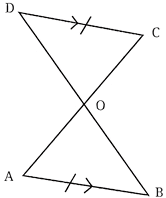
- Given that and , with line segments and intersecting at to form two triangles: and .
- When parallel lines are intersected by transversals ( and ), alternate interior angles are equal.
- Using the ASA (Angle-Side-Angle) congruence criterion, we can prove that .
- By CPCT (Corresponding Parts of Congruent Triangles), the corresponding sides and angles between the two triangles are equal.
Step 1 · Identify Equal Angles
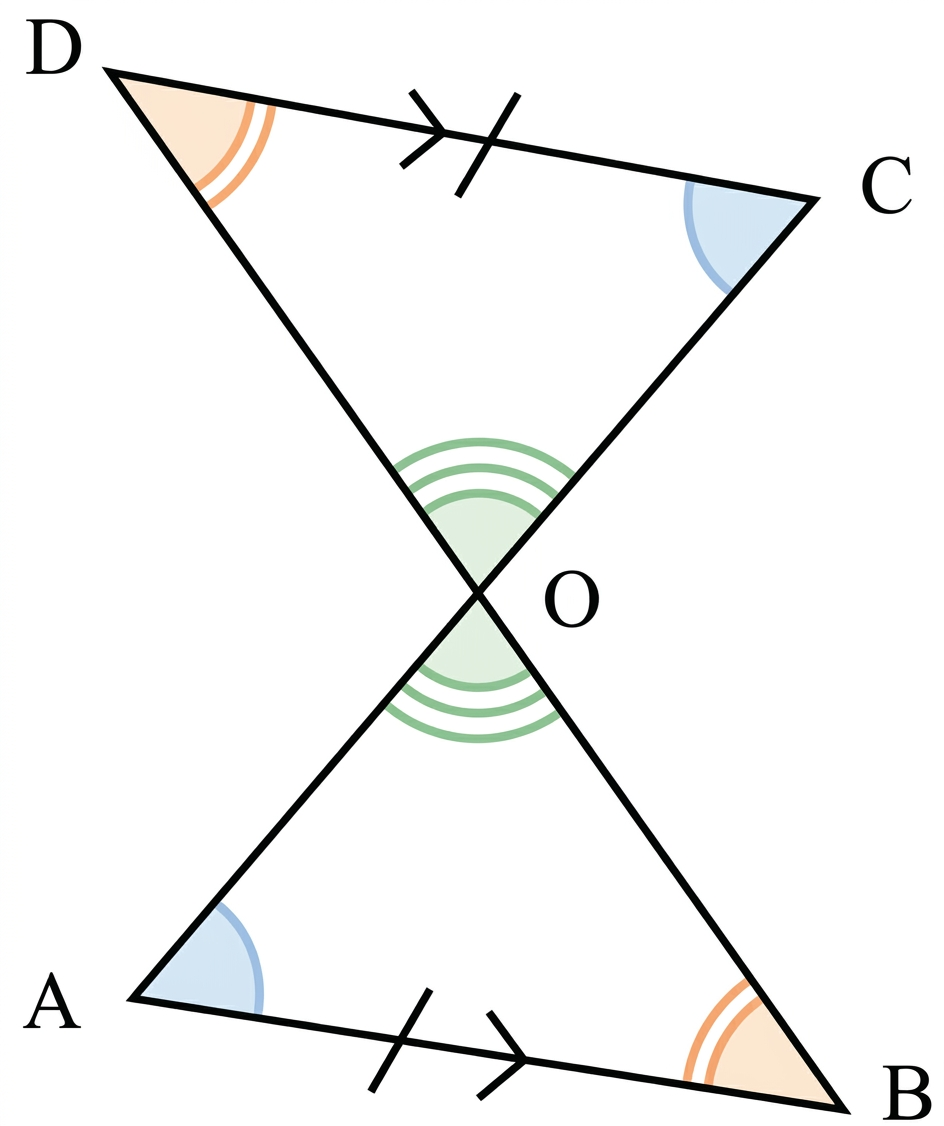
Given :
-
With transversal , alternate interior angles are equal:
-
With transversal , alternate interior angles are equal:
-
Since lines and intersect at point , vertically opposite angles are equal:
Step 2 · Prove Congruence of Triangles
In and :
- (Alternate interior angles)
- (Given)
- (Alternate interior angles)
By the ASA (Angle-Side-Angle) congruence criterion:
Step 3 · Find Remaining Equal Parts
Since , their corresponding parts (CPCT) are equal:
The two triangles are congruent:
The other equal parts are:
- Angles: , , and
- Sides: and
- Incorrect Vertex Correspondence: Writing instead of . Vertex corresponds to and vertex corresponds to due to alternate interior angles.
- Assuming Extra Symmetries: Incorrectly concluding that or . The triangles are congruent to each other, but not necessarily isosceles.
More questions in FIO
Check if the two figures are congruent.
Circle the pairs that appear congruent.
What measurements would you take to create a figure congruent to a given:
(a) Circle
(b) Rectangle
Using this, state how would you check if two —
(a) Circles are congruent?
(b) Rectangles are congruent?
How would we check if two figures like the one below are congruent?
Use this to identify whether each of the following pairs are congruent.
Suppose is congruent to . List all the other correct ways of expressing this congruence.
Determine whether the triangles are congruent. If yes, express the congruence.
In the figure below, , .
Can you identify any pair of congruent triangles? If yes, explain why they are congruent.
Does divide and into two equal parts? Give reasons.
In the figure below, are and congruent to each other? It is given that and .
Identify whether the triangles below are congruent. What conditions did you use to establish their congruence? Express the congruence.
Given that and are parallel, and , what are the other equal parts in this figure? (Hint: When the lines are parallel, the alternate angles are equal. Are the two resulting triangles congruent? If so, express the congruence.)
Given that and , show that . Are the two triangles congruent?
Identify the equal parts in the following figure, given that and .
. Identify the corresponding vertices, sides and angles.
Each of the following cases contains certain measurements taken from two triangles. Identify the pairs in which the triangles are congruent to each other, with reason. Express the congruence whenever they are congruent.
(a) , ,
(b) , ,
(c) , ,
(d) , ,
(e) , ,
It is given that , and . Show that is parallel to .
[Hint: is a transversal for these two lines. Are there any equal alternate angles?]
is a square. Show that . Is also congruent to ?
Give more examples of two triangles where one triangle is congruent to the other in two different ways, as in the case above. Can you give an example of two triangles where one is congruent to the other in six different ways?
Find and , if is the centre of the circle.
Find the missing angles. As per the convention that we have been following, all line segments marked with a single '|' are equal to each other and those marked with a double '|' are equal to each other, etc.