Geometric Twins | FIO

Question 19

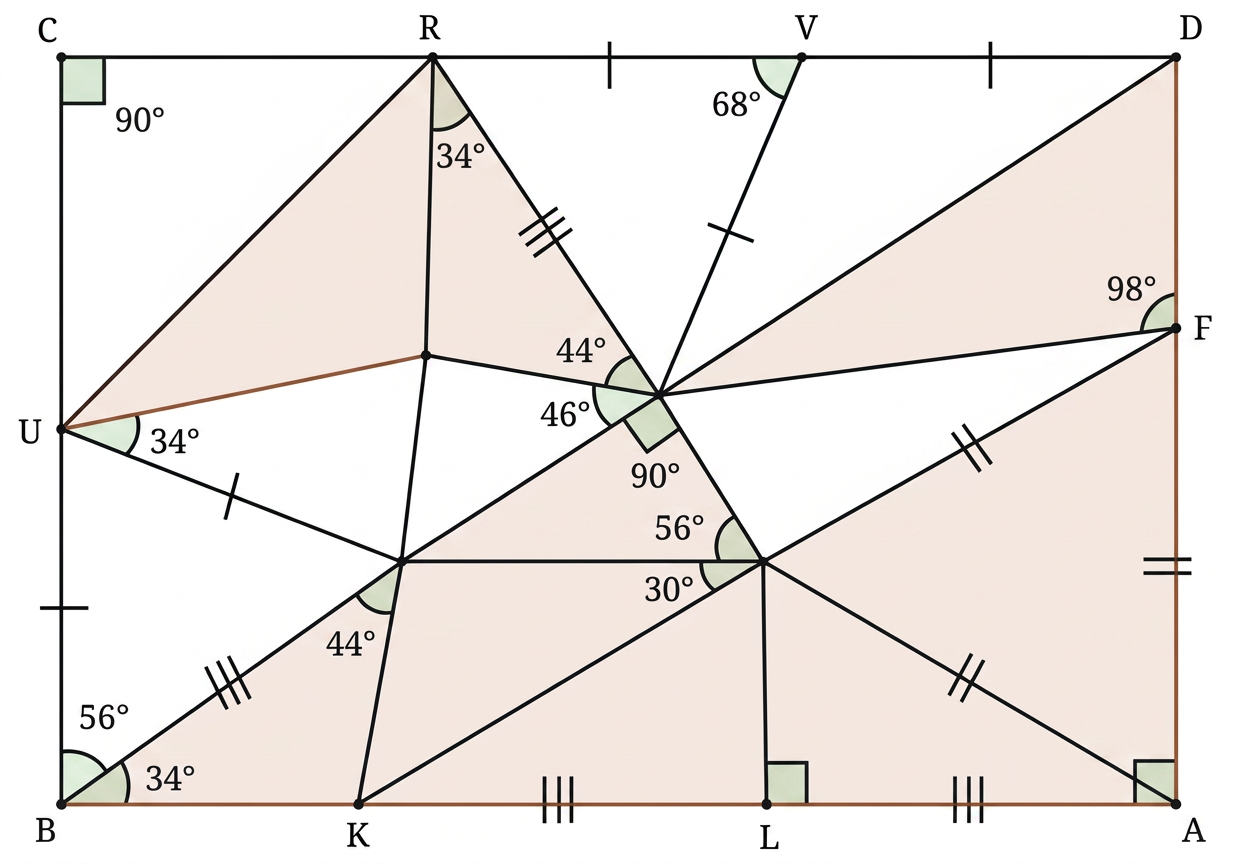
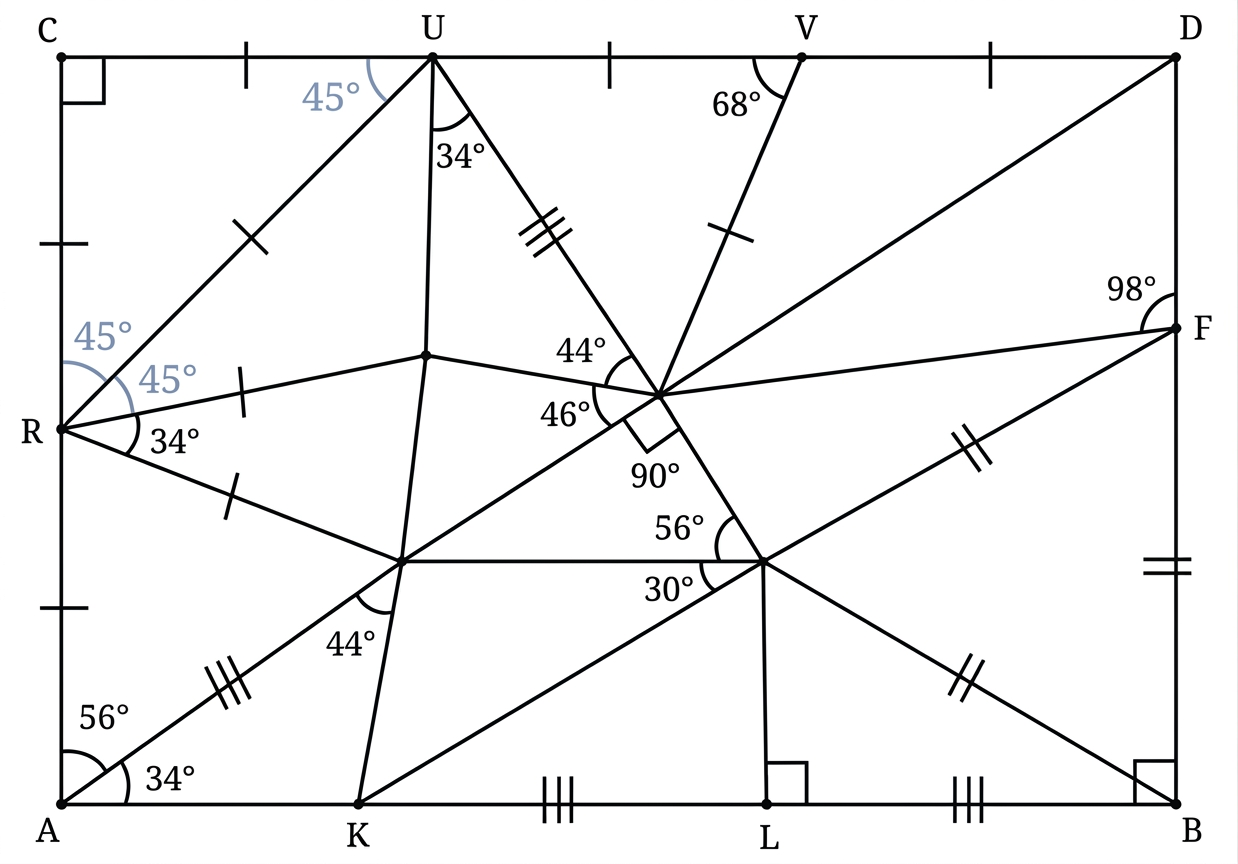
Find the missing angles. As per the convention that we have been following, all line segments marked with a single '|' are equal to each other and those marked with a double '|' are equal to each other, etc.
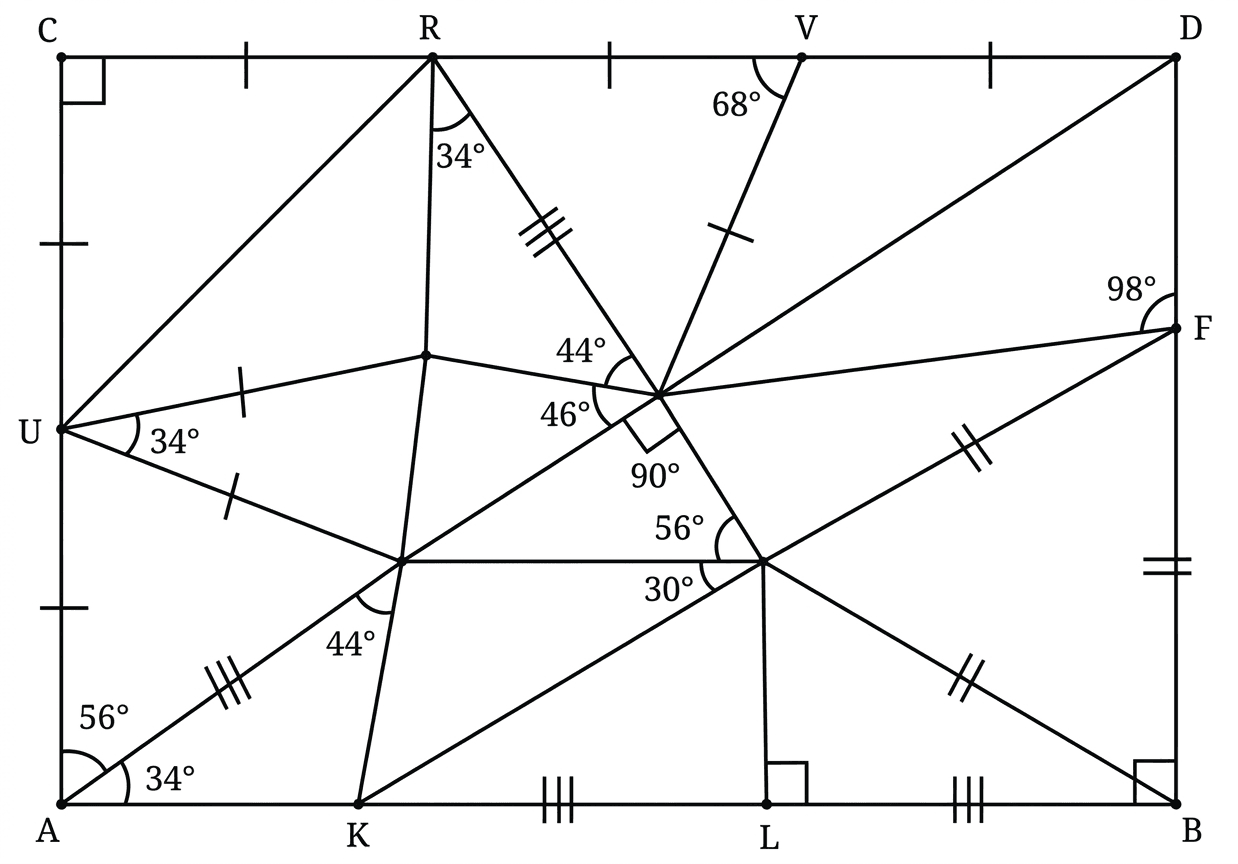
Question diagram 1
Check your answer with HomiSolve it yourself, then let Homi check your steps and spot mistakes.
Solution

Let us find the missing angles step-by-step using the given information and properties of triangles.

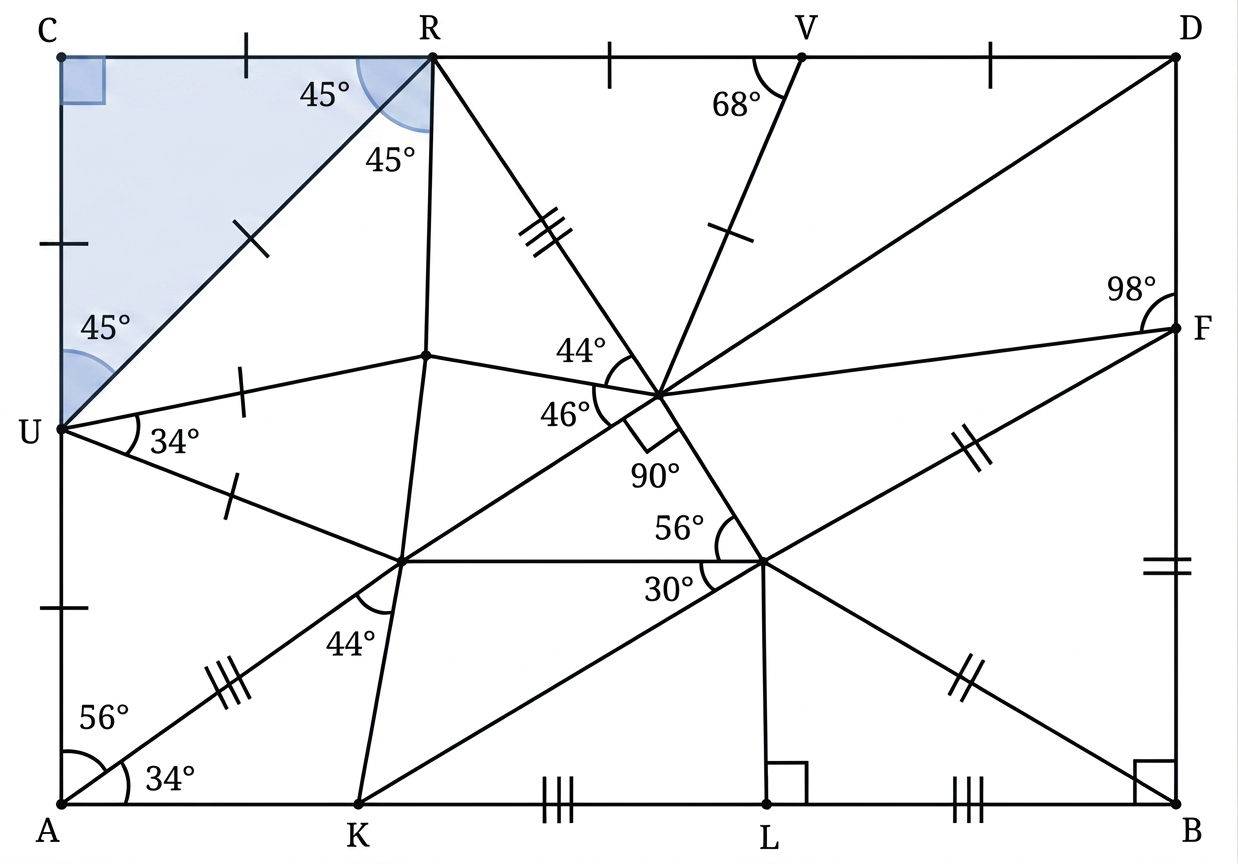
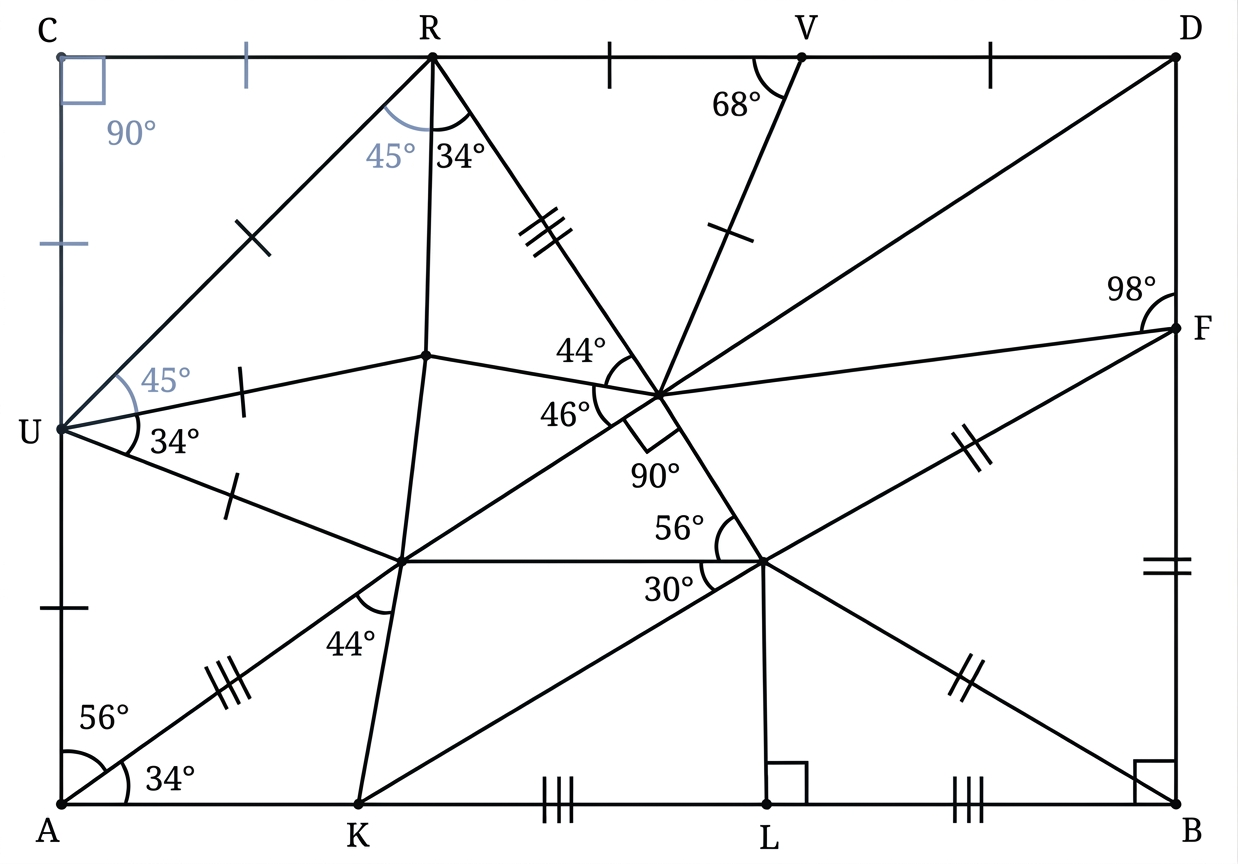
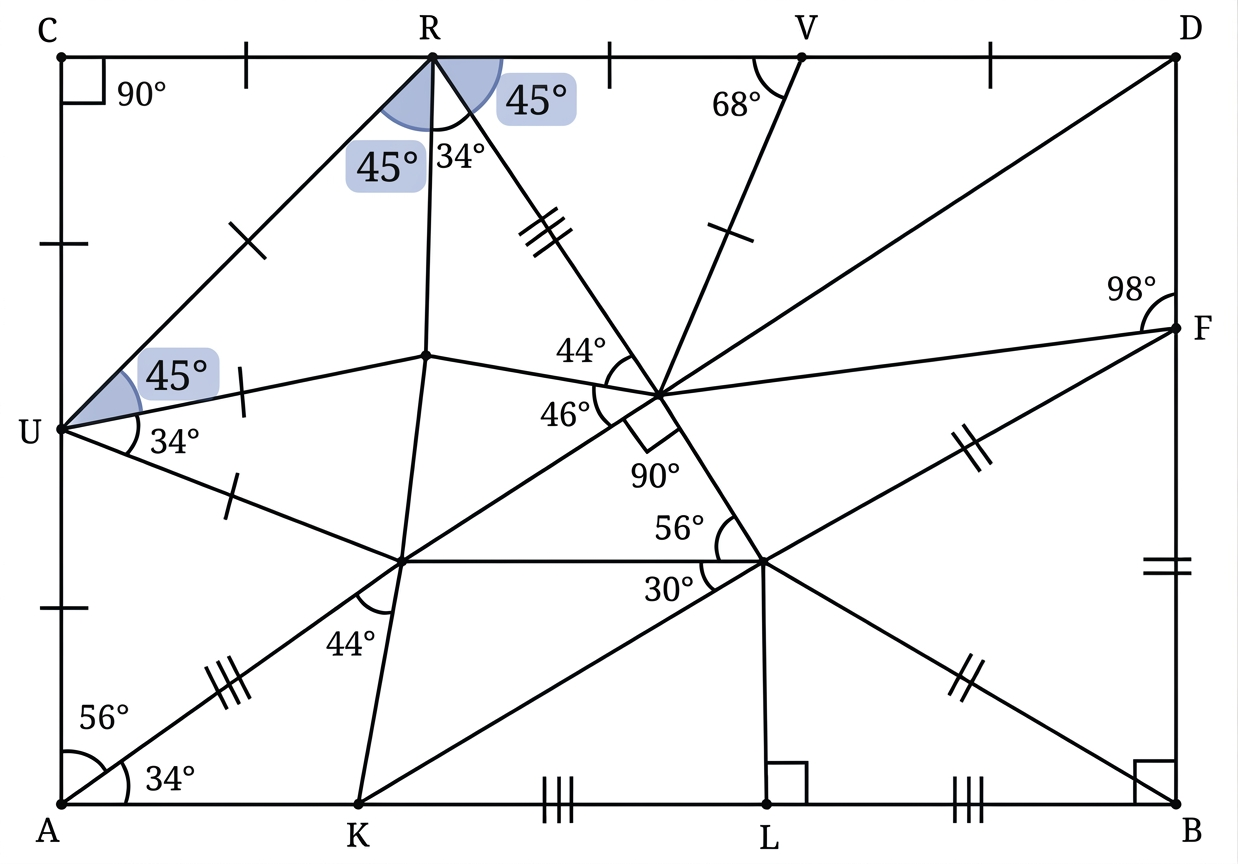
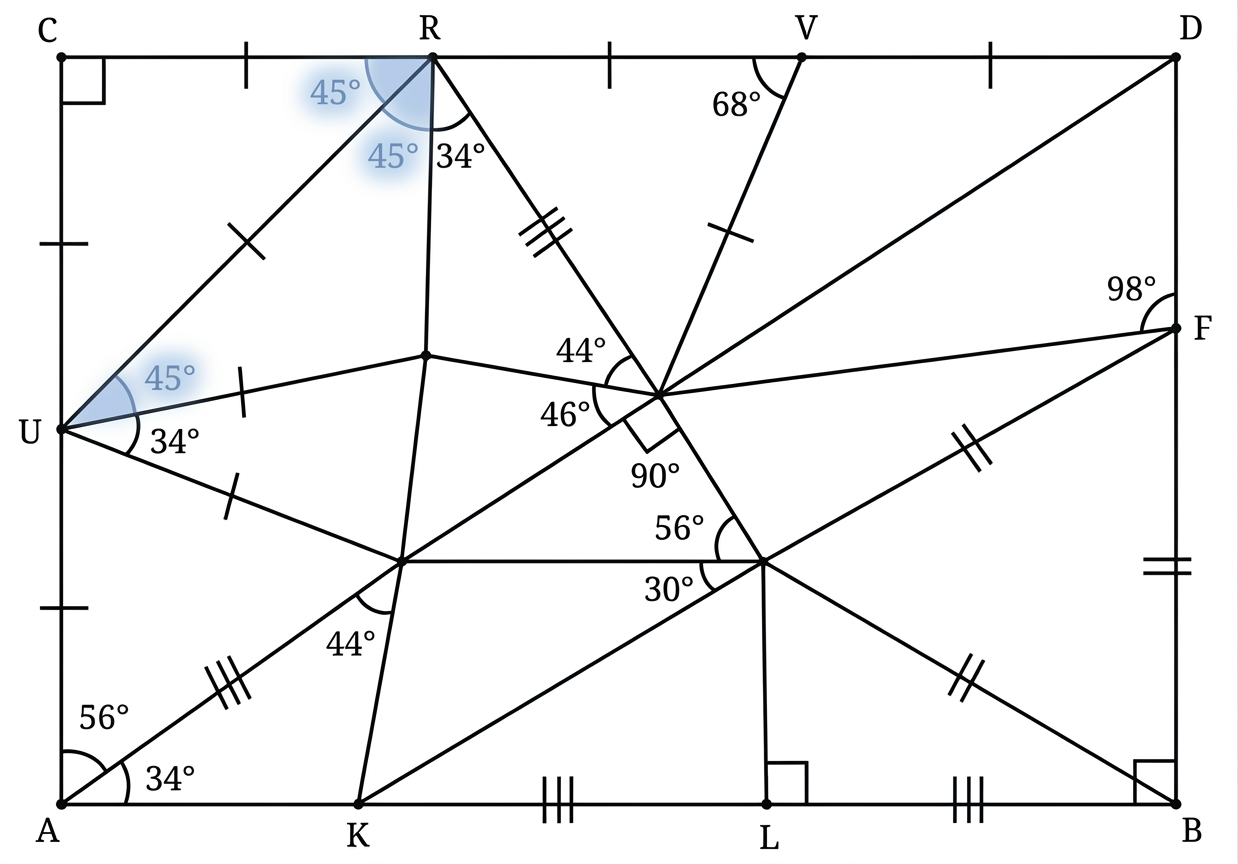
Step 1 — Angles in triangle CUR

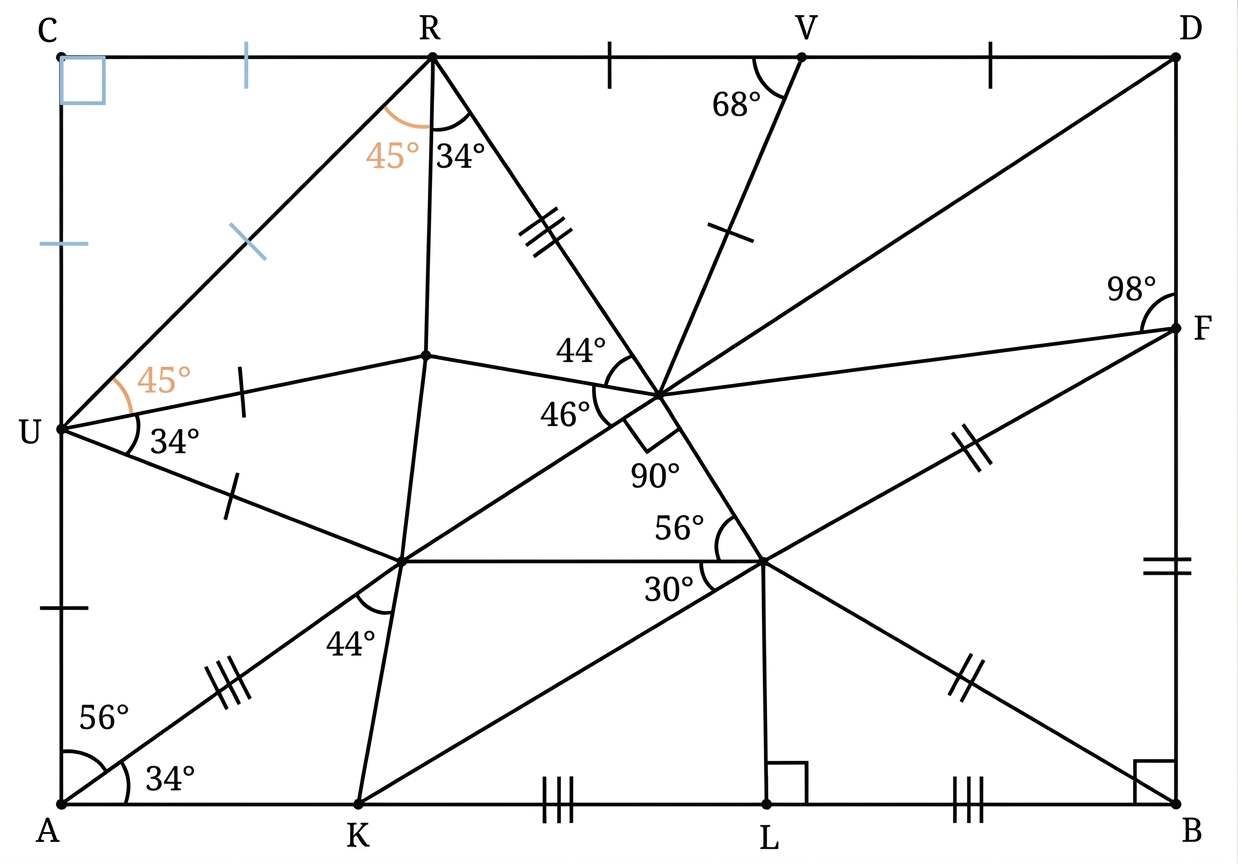
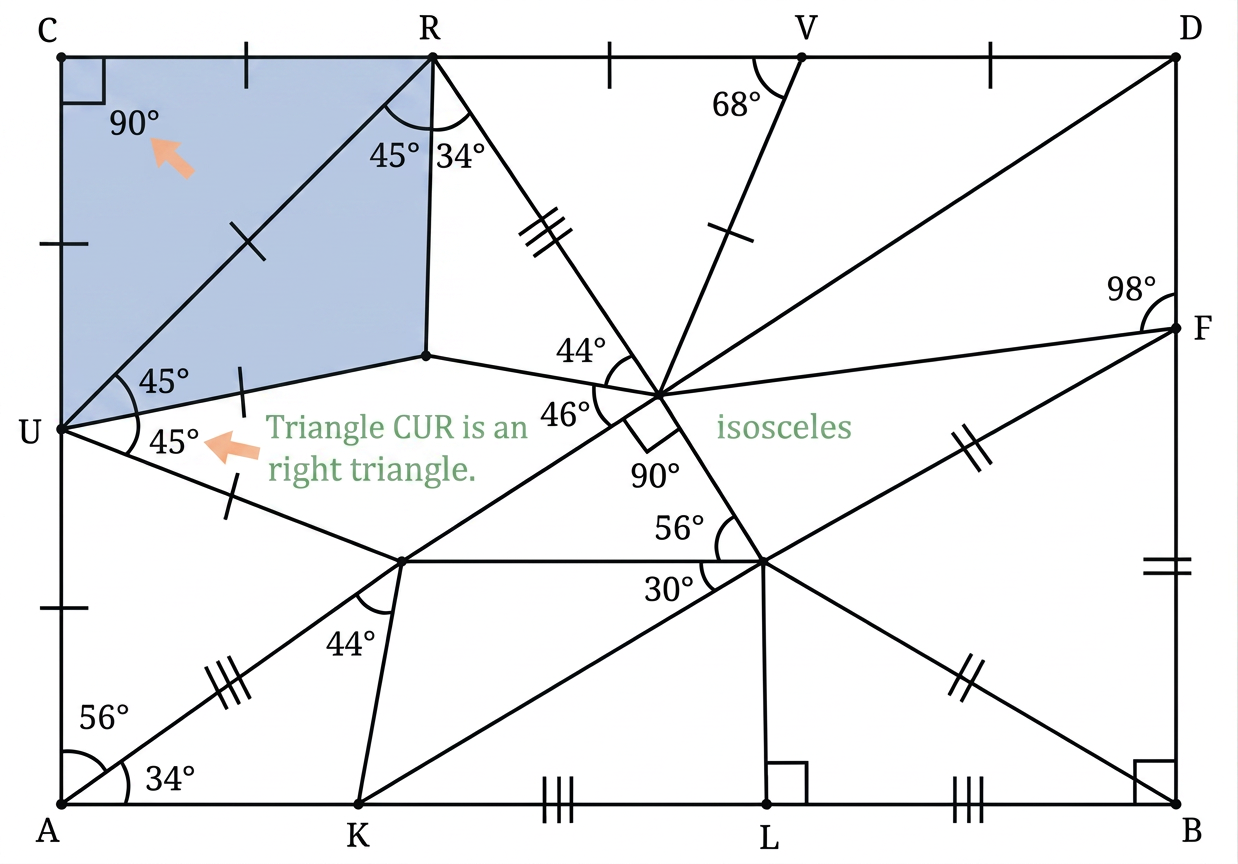
We know that C is a corner of the rectangle. So, angle C is 90 degrees. The diagram shows that segment CU and segment CR have a single tick mark. This means CU = CR. Since two sides are equal, triangle CUR is an isosceles triangle. The angles opposite to the equal sides are also equal. So, ∠CUR = ∠CRU. The sum of angles in any triangle is 180 degrees. Let us call ∠CUR and ∠CRU 'x'.

x+x+90=180x + x + 90^\circ = 180^\circ

2x=180902x = 180^\circ - 90^\circ

2x=902x = 90^\circ

x=902x = \frac{90^\circ}{2}

x=45\boxed{x = 45^\circ}

So, ∠CUR = 45° and ∠CRU = 45°.

Diagram 1

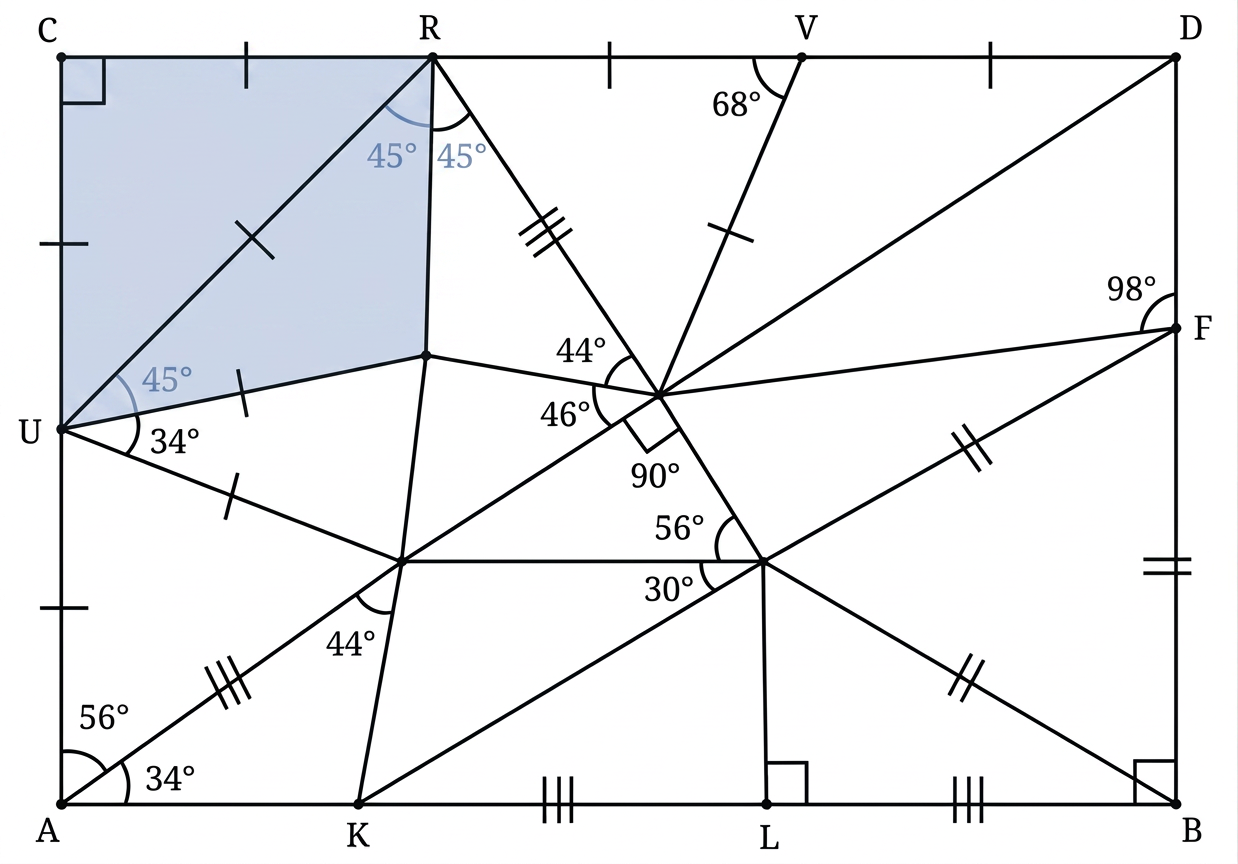
Step 2 — Angles in triangle AUP

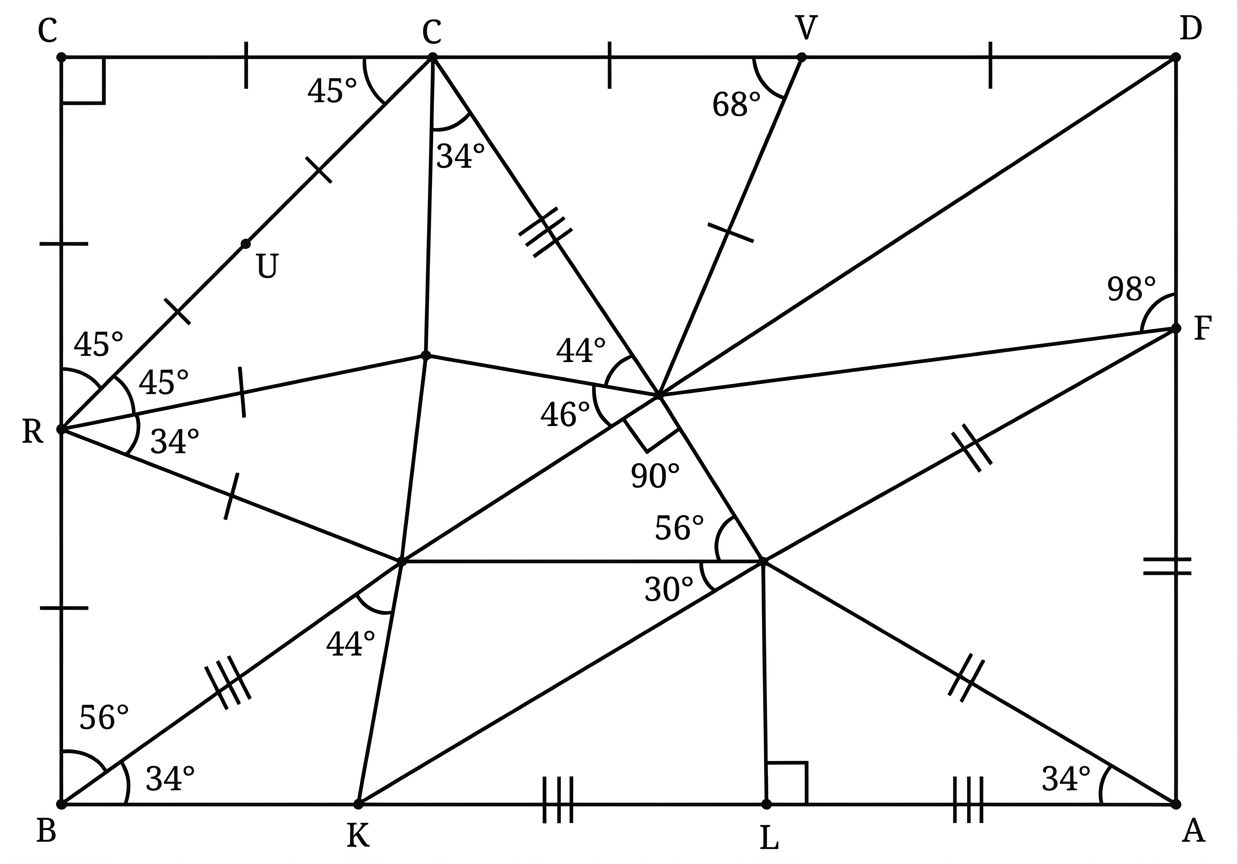
Let P be the point where the line from A meets the line from U. The diagram shows an angle of 56 degrees at A, which is ∠UAP. Segment AU has a single tick mark. We are given that AU = UP. So, UP also has a single tick mark. Since AU = UP, triangle AUP is an isosceles triangle. The angles opposite to the equal sides are equal. So, ∠UPA = ∠UAP. Thus, ∠UPA = 56°. The sum of angles in triangle AUP is 180 degrees.

AUP=180(UAP+UPA)\angle AUP = 180^\circ - (\angle UAP + \angle UPA)

AUP=180(56+56)\angle AUP = 180^\circ - (56^\circ + 56^\circ)

AUP=180112\angle AUP = 180^\circ - 112^\circ

AUP=68\boxed{\angle AUP = 68^\circ}

Diagram 2

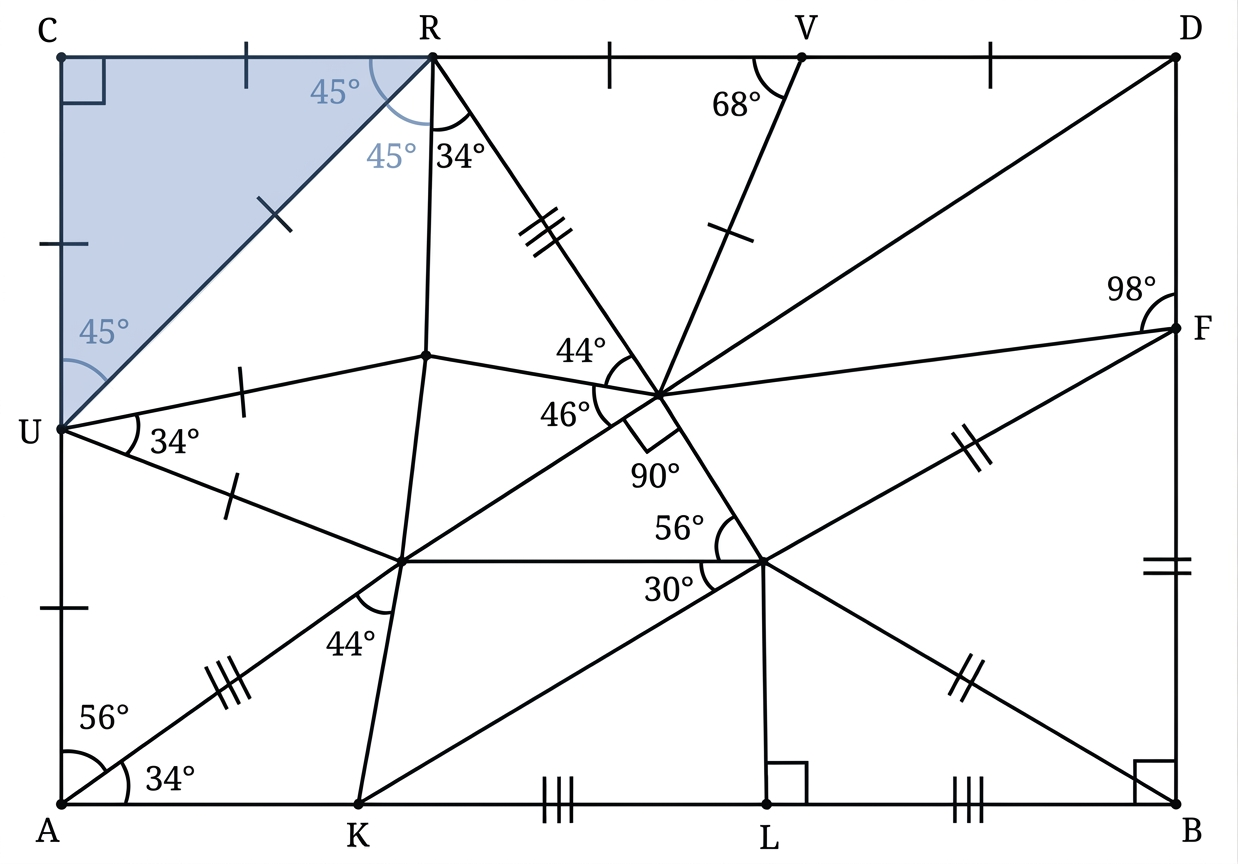
Step 3 — Angles related to points V, R, D, and N

Let N be the point where the line from R meets the line from V. The diagram shows an angle of 68 degrees at V, which is ∠RVN. Segment VR has a single tick mark. We are given that VR = VN. So, VN also has a single tick mark. In triangle RVN, since VR = VN, it is an isosceles triangle. The angles opposite to the equal sides are equal. So, ∠VNR = ∠VRN. The sum of angles in triangle RVN is 180 degrees. Let us call ∠VNR and ∠VRN 'a'.

a+a+68=180a + a + 68^\circ = 180^\circ

2a=180682a = 180^\circ - 68^\circ

2a=1122a = 112^\circ

a=1122a = \frac{112^\circ}{2}

a=56\boxed{a = 56^\circ}

So, ∠VNR = 56° and ∠VRN = 56°. Points R, V, D are on the straight line CD. So, ∠RVD is a straight angle, which is 180 degrees. ∠RVN and ∠DVN form a linear pair.

RVN+DVN=180\angle RVN + \angle DVN = 180^\circ

68+DVN=18068^\circ + \angle DVN = 180^\circ

DVN=18068\angle DVN = 180^\circ - 68^\circ

DVN=112\boxed{\angle DVN = 112^\circ}

Segment VD has a single tick mark. We are given that VN = VD. So, VN also has a single tick mark. This means VN = VR = VD. All segments with a single tick mark are equal. In triangle VND, since VN = VD, it is an isosceles triangle. The angles opposite to the equal sides are equal. So, ∠VND = ∠VDN. The sum of angles in triangle VND is 180 degrees. Let us call ∠VND and ∠VDN 'c'.

c+c+112=180c + c + 112^\circ = 180^\circ

2c=1801122c = 180^\circ - 112^\circ

2c=682c = 68^\circ

c=682c = \frac{68^\circ}{2}

c=34\boxed{c = 34^\circ}

So, ∠VND = 34° and ∠VDN = 34°.

Diagram 3

Step 4 — Angles in triangle BOF

Let O be the central point where the 90-degree angle is marked. We are given that triangle BOF is an equilateral triangle. This means all its sides are equal: OB = OF = BF. The diagram shows BF has double tick marks. So, OB and OF also have double tick marks. In an equilateral triangle, all angles are equal to 60 degrees.

FOB=FBO=OFB=60\boxed{\angle FOB = \angle FBO = \angle OFB = 60^\circ}

Diagram 4

Step 5 — Angles around point B and L

B is a corner of the rectangle, so angle B is 90 degrees. We found ∠FBO = 60° in Step 4. ∠OBL is the remaining part of ∠B.

OBL=BFBO\angle OBL = \angle B - \angle FBO

OBL=9060\angle OBL = 90^\circ - 60^\circ

OBL=30\boxed{\angle OBL = 30^\circ}

L is a point on AB. OL is perpendicular to AB (marked with a right angle symbol). So, ∠OLB = 90°. We are given that LO is parallel to BF. BO is a transversal line. When two parallel lines are cut by a transversal, alternate interior angles are equal. So, ∠LOB = ∠FBO. Since ∠FBO = 60°, then ∠LOB = 60°.

Diagram 5

Step 6 — Angles in triangle OPN

Let O be the central point. P and N are other points as defined in previous steps. We are given that ∠PON = 56° and ∠PNO = 90°. The sum of angles in triangle OPN is 180 degrees.

OPN+PON+PNO=180\angle OPN + \angle PON + \angle PNO = 180^\circ

OPN+56+90=180\angle OPN + 56^\circ + 90^\circ = 180^\circ

OPN+146=180\angle OPN + 146^\circ = 180^\circ

OPN=180146\angle OPN = 180^\circ - 146^\circ

OPN=34\boxed{\angle OPN = 34^\circ}

Diagram 6

Step 7 — Angles on a straight line at P

We are given that ∠APK, ∠KPO, and ∠OPN are angles on a straight line. This means their sum is 180 degrees. The diagram shows ∠APK = 44°. We found ∠OPN = 34° in Step 6.

APK+KPO+OPN=180\angle APK + \angle KPO + \angle OPN = 180^\circ

44+KPO+34=18044^\circ + \angle KPO + 34^\circ = 180^\circ

78+KPO=18078^\circ + \angle KPO = 180^\circ

KPO=18078\angle KPO = 180^\circ - 78^\circ

KPO=102\boxed{\angle KPO = 102^\circ}

Diagram 7

Step 8 — Angles in triangle KPO

Let O be the central point. P and K are other points. We are given that ∠POK = 30°. We found ∠KPO = 102° in Step 7. The sum of angles in triangle KPO is 180 degrees.

KPO+POK+PKO=180\angle KPO + \angle POK + \angle PKO = 180^\circ

102+30+PKO=180102^\circ + 30^\circ + \angle PKO = 180^\circ

132+PKO=180132^\circ + \angle PKO = 180^\circ

PKO=180132\angle PKO = 180^\circ - 132^\circ

PKO=48\boxed{\angle PKO = 48^\circ}

Diagram 8

Step 9 — Angles in triangle KAP

Let A be the bottom-left corner. P and K are other points. The diagram shows ∠KAP = 34°. We are given that ∠KPA = 44°. The sum of angles in triangle KAP is 180 degrees.

KAP+KPA+AKP=180\angle KAP + \angle KPA + \angle AKP = 180^\circ

34+44+AKP=18034^\circ + 44^\circ + \angle AKP = 180^\circ

78+AKP=18078^\circ + \angle AKP = 180^\circ

AKP=18078\angle AKP = 180^\circ - 78^\circ

AKP=102\boxed{\angle AKP = 102^\circ}

Diagram 9

Step 10 — Angles on a straight line at K

We are given that ∠AKP, ∠PKO, and ∠OKL are angles on a straight line. This means their sum is 180 degrees. We found ∠AKP = 102° in Step 9. We found ∠PKO = 48° in Step 8.

AKP+PKO+OKL=180\angle AKP + \angle PKO + \angle OKL = 180^\circ

102+48+OKL=180102^\circ + 48^\circ + \angle OKL = 180^\circ

150+OKL=180150^\circ + \angle OKL = 180^\circ

OKL=180150\angle OKL = 180^\circ - 150^\circ

OKL=30\boxed{\angle OKL = 30^\circ}

Diagram 10

Step 11 — Angles in triangle KOL

Let O be the central point. K and L are other points. We found ∠OKL = 30° in Step 10. L is a right angle (∠OLK = 90°). The sum of angles in triangle KOL is 180 degrees.

OKL+OLK+KOL=180\angle OKL + \angle OLK + \angle KOL = 180^\circ

30+90+KOL=18030^\circ + 90^\circ + \angle KOL = 180^\circ

120+KOL=180120^\circ + \angle KOL = 180^\circ

KOL=180120\angle KOL = 180^\circ - 120^\circ

KOL=60\boxed{\angle KOL = 60^\circ}

Diagram 11

Step 12 — Congruence of triangles OKL and OBL

We are given that triangle OKL is congruent to triangle OBL by SAS condition. Let's check the conditions:

  1. KL = LB: The diagram shows KL and LB both have single tick marks. So, they are equal.
  2. ∠OLK = ∠OLB = 90°: L is on AB, and OL is perpendicular to AB. So, both angles are 90 degrees.
  3. OL is common: OL is a side shared by both triangles. Since these three conditions are met, ΔOKL ≅ ΔOBL by SAS (Side-Angle-Side). This congruence confirms the angles we found: ∠OKL = ∠OBL = 30°. (Matches our calculations). ∠KOL = ∠BOL = 60°. (Matches our calculations).

Answer

(i) ∠CUR = 45° (ii) ∠CRU = 45° (iii) ∠VRN = 56° (iv) ∠VNR = 56° (v) ∠AUP = 68° (vi) ∠FOB = 60° (vii) ∠FBO = 60° (viii) ∠OFB = 60° (ix) ∠DVN = 112° (x) ∠VND = 34° (xi) ∠VDN = 34° (xii) ∠OBL = 30° (xiii) ∠LOB = 60° (xiv) ∠OPN = 34° (xv) ∠KPO = 102° (xvi) ∠PKO = 48° (xvii) ∠AKP = 102° (xviii) ∠OKL = 30° (xix) ∠KOL = 60°

More questions in FIO

Q1

Check if the two figures are congruent.

Q2

Circle the pairs that appear congruent.

Q3

What measurements would you take to create a figure congruent to a given:

(a) Circle

(b) Rectangle

Q4

Using this, state how would you check if two —

(a) Circles are congruent?

(b) Rectangles are congruent?

Q5

How would we check if two figures like the one below are congruent?

Use this to identify whether each of the following pairs are congruent.

Q6

Suppose ΔHEN\Delta\text{HEN} is congruent to ΔBIG\Delta\text{BIG}. List all the other correct ways of expressing this congruence.

Q7

Determine whether the triangles are congruent. If yes, express the congruence.

Q8

In the figure below, AB = AD, CB = CD.

Can you identify any pair of congruent triangles? If yes, explain why they are congruent.

Does AC divide ∠BAD and ∠BCD into two equal parts? Give reasons.

Q9

In the figure below, are ΔDFE and ΔGED congruent to each other? It is given that DF = DG and FE = GE.

Q10

Identify whether the triangles below are congruent. What conditions did you use to establish their congruence? Express the congruence.

Q11

Given that CD and AB are parallel, and AB = CD, what are the other equal parts in this figure? (Hint: When the lines are parallel, the alternate angles are equal. Are the two resulting triangles congruent? If so, express the congruence.)

Q12

Given that ABC=DBC\angle ABC = \angle DBC and ACB=DCB\angle ACB = \angle DCB, show that BAC=BDC\angle BAC = \angle BDC. Are the two triangles congruent?

Q13

Identify the equal parts in the following figure, given that ABD=DCA\angle ABD = \angle DCA and ACB=DBC\angle ACB = \angle DBC.

Q14

ΔAIRΔFLY\Delta\text{AIR} \cong \Delta\text{FLY}. Identify the corresponding vertices, sides and angles.

Q15

Each of the following cases contains certain measurements taken from two triangles. Identify the pairs in which the triangles are congruent to each other, with reason. Express the congruence whenever they are congruent.

(a) AB = DE, BC = EF, CA = DF

(b) AB = EF, \angleA = \angleE, AC = ED

(c) AB = DF, \angleB = \angleD = 90°, AC = FE

(d) \angleA = \angleD, \angleB = \angleE, AC = DF

(e) AB = DF, \angleB = \angleF, AC = DE

Q16

It is given that OB = OC, and OA = OD. Show that AB is parallel to CD.
[Hint: AD is a transversal for these two lines. Are there any equal alternate angles?]

Q17

ABCD is a square. Show that ΔABCΔADC\Delta\text{ABC} \cong \Delta\text{ADC}. Is ΔABC\Delta\text{ABC} also congruent to ΔCDA\Delta\text{CDA}?

Give more examples of two triangles where one triangle is congruent to the other in two different ways, as in the case above. Can you give an example of two triangles where one is congruent to the other in six different ways?

Q18

Find B\angle\text{B} and C\angle\text{C}, if A is the centre of the circle.

Q19

Find the missing angles. As per the convention that we have been following, all line segments marked with a single '|' are equal to each other and those marked with a double '|' are equal to each other, etc.

← Back to Geometric Twins