Question 1
A circus artist is climbing a 20 m long rope, which is tightly stretched and tied from the top of a vertical pole to the ground. Find the height of the pole, if the angle made by the rope with the ground level is (see Fig. 9.11).
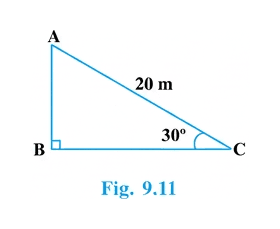
- The vertical pole and the ground form a right-angled triangle where .
- The rope acts as the hypotenuse, and the pole is the side opposite to the angle made with the ground ().
- To find the height of the pole (), we use the sine trigonometric ratio: .
Step 1 · Find the Height of the Pole
Let be the vertical pole and be the rope.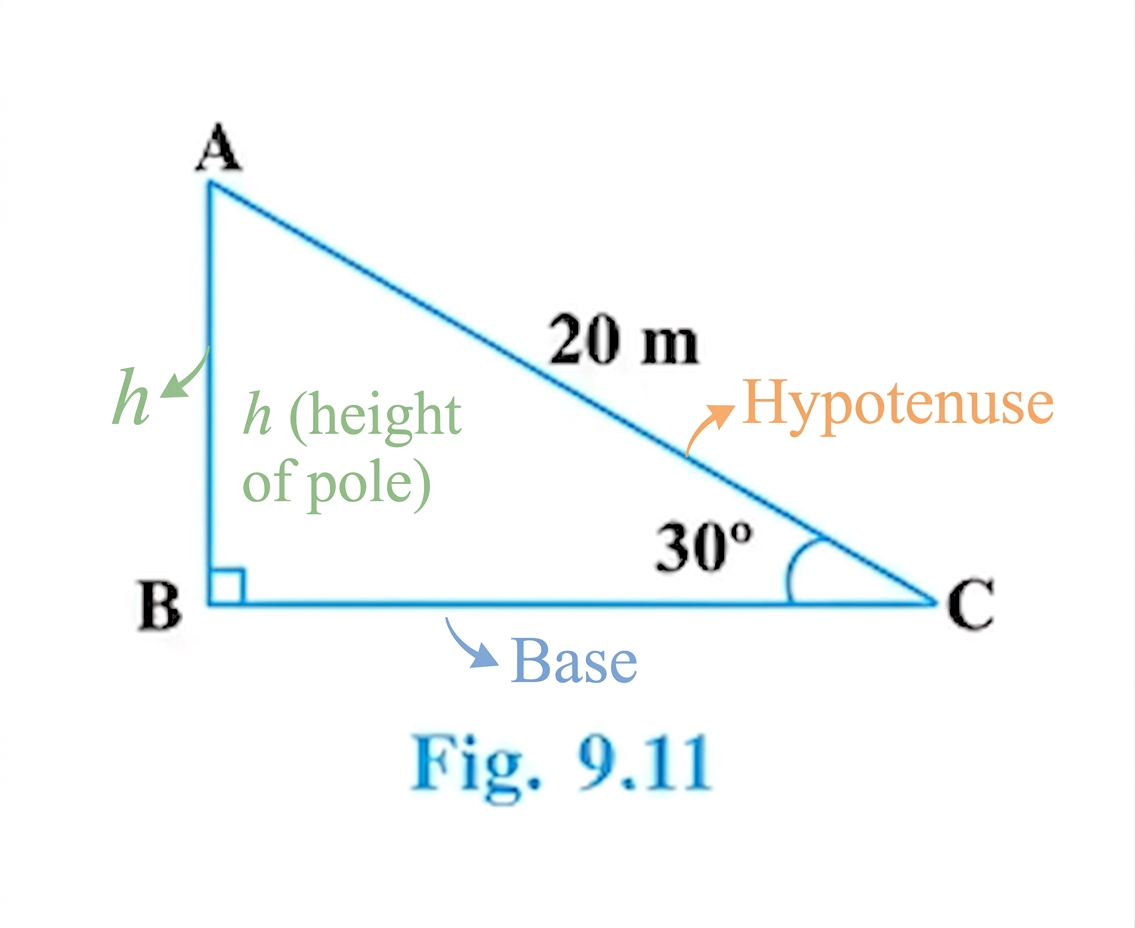
In right-angled triangle
Substitute and
Since
- Wrong Trigonometric Ratio: Using or instead of , which directly relates the unknown opposite side to the known hypotenuse.
- Incorrect Value of : Confusing with or .
More questions in Exercise 9.1
A circus artist is climbing a 20 m long rope, which is tightly stretched and tied from the top of a vertical pole to the ground. Find the height of the pole, if the angle made by the rope with the ground level is (see Fig. 9.11).
A tree breaks due to storm and the broken part bends so that the top of the tree touches the ground making an angle with it. The distance between the foot of the tree to the point where the top touches the ground is 8 m. Find the height of the tree.
A contractor plans to install two slides for the children to play in a park. For the children below the age of 5 years, she prefers to have a slide whose top is at a height of 1.5 m, and is inclined at an angle of to the ground, whereas for elder children, she wants to have a steep slide at a height of 3 m, and inclined at an angle of to the ground. What should be the length of the slide in each case?
The angle of elevation of the top of a tower from a point on the ground, which is 30 m away from the foot of the tower, is . Find the height of the tower.
A kite is flying at a height of above the ground. The string attached to the kite is temporarily tied to a point on the ground. The inclination of the string with the ground is . Find the length of the string, assuming that there is no slack in the string.
A tall boy is standing at some distance from a tall building. The angle of elevation from his eyes to the top of the building increases from to as he walks towards the building. Find the distance he walked towards the building.
From a point on the ground, the angles of elevation of the bottom and the top of a transmission tower fixed at the top of a 20 m high building are and respectively. Find the height of the tower.
A statue, tall, stands on the top of a pedestal. From a point on the ground, the angle of elevation of the top of the statue is and from the same point the angle of elevation of the top of the pedestal is . Find the height of the pedestal.
- The angle of elevation of the top of a building from the foot of the tower is and the angle of elevation of the top of the tower from the foot of the building is . If the tower is 50 m high, find the height of the building.
- Two poles of equal heights are standing opposite each other on either side of the road, which is 80 m wide. From a point between them on the road, the angles of elevation of the top of the poles are and , respectively. Find the height of the poles and the distances of the point from the poles.
- A TV tower stands vertically on a bank of a canal. From a point on the other bank directly opposite the tower, the angle of elevation of the top of the tower is . From another point 20 m away from this point on the line joing this point to the foot of the tower, the angle of elevation of the top of the tower is (see Fig. 9.12). Find the height of the tower and the width of the canal.
- From the top of a high building, the angle of elevation of the top of a cable tower is and the angle of depression of its foot is . Determine the height of the tower.
- As observed from the top of a high lighthouse from the sea-level, the angles of depression of two ships are and . If one ship is exactly behind the other on the same side of the lighthouse, find the distance between the two ships.
- A tall girl spots a balloon moving with the wind in a horizontal line at a height of from the ground. The angle of elevation of the balloon from the eyes of the girl at any instant is . After some time, the angle of elevation reduces to (see Fig. 9.13). Find the distance travelled by the balloon during the interval.
- A straight highway leads to the foot of a tower. A man standing at the top of the tower observes a car at an angle of depression of , which is approaching the foot of the tower with a uniform speed. Six seconds later, the angle of depression of the car is found to be . Find the time taken by the car to reach the foot of the tower from this point.