Question 25
In a circle, two chords and are drawn perpendicular to a diameter . Prove that the segment joining the midpoints of the chords and is perpendicular to .
- Two identical circles with radius pass through each other's centres, and . Thus, the distance between their centres is .
- The region enclosed between the two circles is symmetrical and consists of two identical circular segments on the common chord .
- Triangles and are equilateral triangles with all side lengths equal to , each having an interior angle of .
- The central angle subtended by chord at centre is .
- The area of the overlapping region is found by calculating the area of one circular segment and multiplying it by .
Step 1 · Find Central Angle
Let the centres of the two circles be and , each with radius .
Since each circle passes through the other's centre, .
Let and be the points of intersection of the two circles.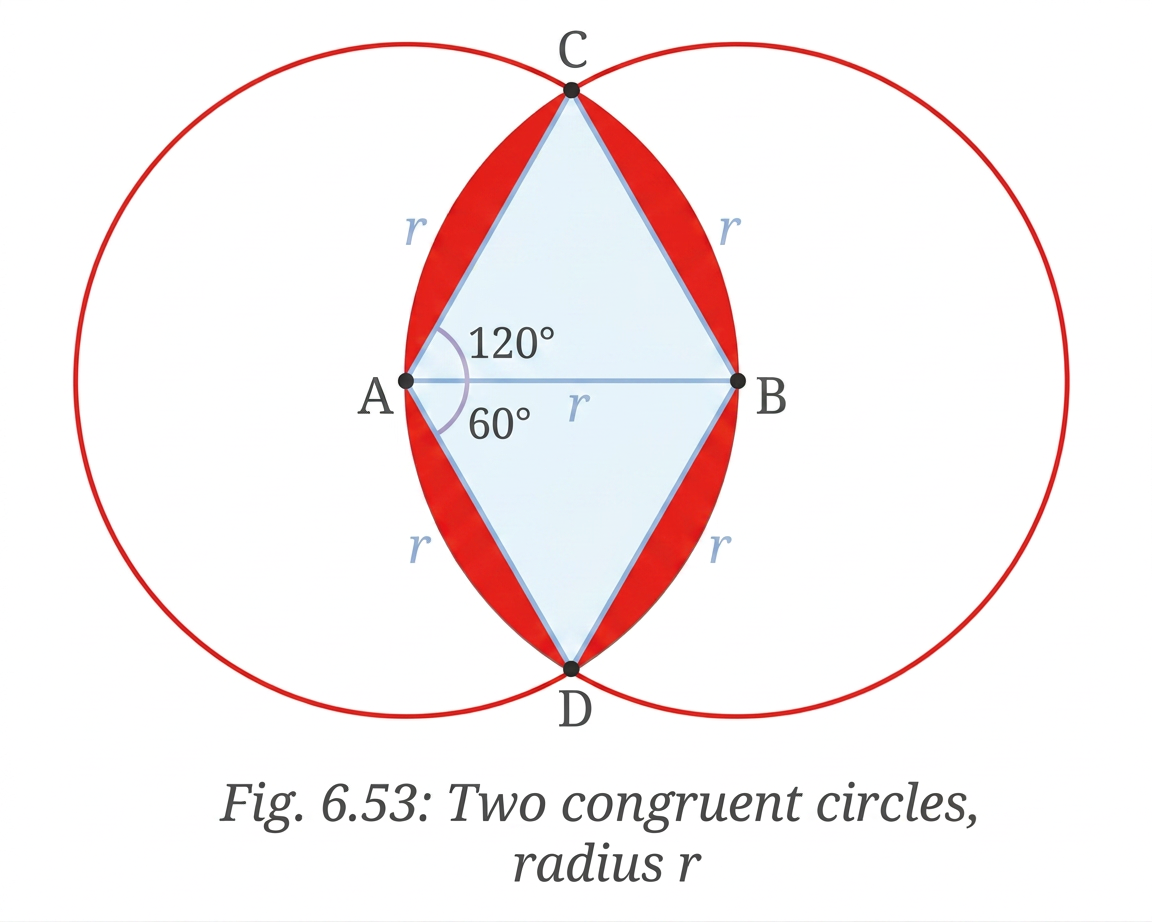
In :
Therefore, is equilateral, which gives .
Similarly, is equilateral, which gives .
The central angle is:
Step 2 · Calculate Area of One Circular Segment
The enclosed region consists of two identical circular segments bounded by chord .
First, find the area of sector :
Next, find the area of :
Since :
Now, find the area of one segment:
Step 3 · Calculate Total Enclosed Area
The total area enclosed by both circles is twice the area of one segment:
- Computing Only One Segment: Finding the area of a single circular segment and forgetting to multiply by to account for both overlapping segments.
- Incorrect Central Angle: Taking the central angle as from a single triangle instead of summing the two equilateral triangle angles ().
- Trigonometric Value Error: Miscalculating ; remember that .
More questions in EOT
In a circle, a chord is away from the centre. If the radius of the circle is , what is the length of the chord?
An arc of a circle subtends an angle of at the centre. What is the measure of the angle subtended by the arc at a point on the circle?
The diameter of a circle is . A chord of length is drawn in the circle. Find the distance from the centre of the circle to the chord.
A circle has a radius of . A chord is drawn. The distance from the centre of the circle to the chord is . What is the length of the chord?
Prove that the perpendicular bisector of a chord passes through the centre of the circle.
The diameter of a circle is . Point is on the circumference. What is the measure of the ? Explain your reasoning.
ABCD is a cyclic quadrilateral inscribed in a circle. If measures , what is the measure of ? If measures , what is the measure of ?
Quadrilateral is inscribed in a circle. If and , find the value of and the measures of and .
The distance of a chord of length from the centre of a circle is . Find the radius of the circle.
A cyclic quadrilateral has sides , , , units. Find its area.
Consider a cyclic quadrilateral. Without drawing its circumcircle, how can we find out whether the centre of the circumcircle lies inside the quadrilateral or outside? What is the best way of finding out?
When two chords intersect, each of them is divided into two line segments. Show that if the intersecting chords are of equal length, then the line segments of one chord are equal to the corresponding line segments of the other chord.
Draw a circle in which a chord of length stands at a distance of from the centre.
(Hint: Is it a circumcircle of a suitable triangle?)
Show that rectangle is the only parallelogram that can be inscribed in a circle.
Show that if a rectangle is inscribed in a circle, then the point of intersection of its diagonals must lie at the centre of the circle.
Consider all chords of a circle of a fixed length. What is the shape formed by the midpoints of all these chords?
In a circle with centre , chords and are congruent. Explain why this statement is true: "The centre of the circle lies on the angle bisector of ".
Two parallel chords of lengths and are on the same side of the centre of a circle. The distance between the chords is . Find the radius of the circle.
A regular hexagon is inscribed in a circle of radius . Find the length of the sides of the hexagon and the distance of each side from the centre of the circle.
A quadrilateral is inscribed in a circle. If is a diameter, what can you say about and ? Explain your reasoning.
Let be a cyclic quadrilateral. Explain why the exterior angle at any vertex is equal to the interior opposite angle (e.g., , where is a point on the extension of side ).
"There is no chord of a circle that is longer than its diameter." How do you justify this statement?
Let be any point within a given circle with centre . Show that the shortest chord of the circle that passes through point is the one that is perpendicular to .
How would you use the following figure to justify the statement that the angle in a semicircle is ?
In a circle, two chords and are drawn perpendicular to a diameter . Prove that the segment joining the midpoints of the chords and is perpendicular to .
How would you use the following figure to justify the statement that the sum of the opposite angles of a cyclic quadrilateral is ?