Question 26
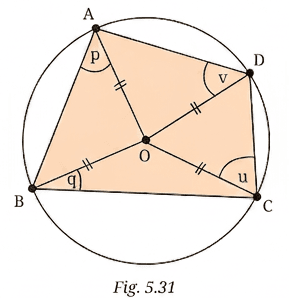
How would you use the following figure to justify the statement that the sum of the opposite angles of a cyclic quadrilateral is ?
- Let the rectangle have width , height , and total area .
- Place the rectangle on a coordinate plane to represent the vertices and calculate the areas of triangles , , and in terms of coordinates.
- Express the coordinates in terms of the areas and , and substitute them into the formula for area to derive a relationship involving , , , and .
- Check whether the proposed formula satisfies this geometric relationship.
Step 1 · Define Rectangle and Coordinates
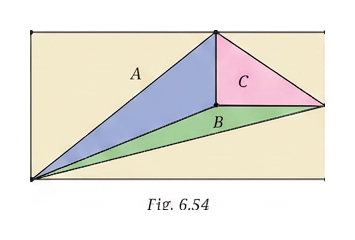
Let the rectangle have width and height , so its area is:
Set up coordinates with the bottom-left corner at the origin:
- Bottom-left:
- Bottom-right:
- Top-left:
- Top-right:
- Top-edge point:
- Internal point:
Step 2 · Express Triangle Areas
For Triangle with vertices , , and :
- Base on the left edge
- Height
For Triangle with vertices , , and :
- Base on the bottom edge
- Height
For Triangle with vertices , , and :
- Base on the top edge
- Height
Step 3 · Derive Relationship for Rectangle Area
From the area equations of and , express and :
Substitute these into the expression for :
Expanding the right-hand side:
Since :
Multiplying by :
Rearranging into standard quadratic form:
Step 4 · Evaluate the Given Formula
Let the given expression for the area be :
Expanding :
Let , so .
Substitute into the quadratic equation :
Substitute back:
Dividing through by (since ):
Multiplying by :
Since are positive geometric areas, the sum must be strictly positive, leading to a contradiction.
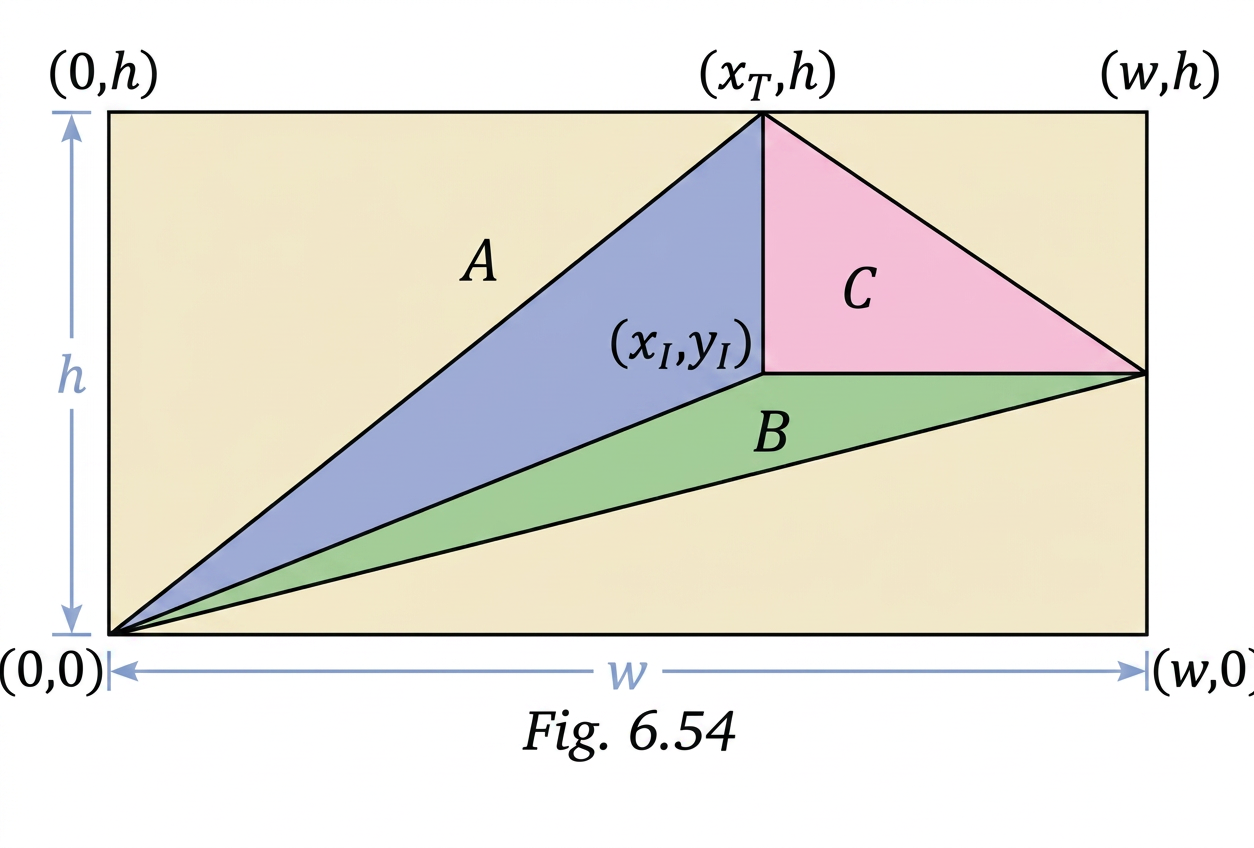
The geometric relationship leads to the quadratic equation . Substituting yields , which is impossible for positive areas .
- Assuming Validity Without Verification: Directly assuming the given formula is an identity without checking if it satisfies the underlying quadratic equation derived from the coordinates.
- Sign and Expansion Errors: Miscalculating cross-terms when expanding , leading to incorrect signs for the linear coefficients in the quadratic equation.
More questions in EOT
In a circle, a chord is away from the centre. If the radius of the circle is , what is the length of the chord?
An arc of a circle subtends an angle of at the centre. What is the measure of the angle subtended by the arc at a point on the circle?
The diameter of a circle is . A chord of length is drawn in the circle. Find the distance from the centre of the circle to the chord.
A circle has a radius of . A chord is drawn. The distance from the centre of the circle to the chord is . What is the length of the chord?
Prove that the perpendicular bisector of a chord passes through the centre of the circle.
The diameter of a circle is . Point is on the circumference. What is the measure of the ? Explain your reasoning.
ABCD is a cyclic quadrilateral inscribed in a circle. If measures , what is the measure of ? If measures , what is the measure of ?
Quadrilateral is inscribed in a circle. If and , find the value of and the measures of and .
The distance of a chord of length from the centre of a circle is . Find the radius of the circle.
A cyclic quadrilateral has sides , , , units. Find its area.
Consider a cyclic quadrilateral. Without drawing its circumcircle, how can we find out whether the centre of the circumcircle lies inside the quadrilateral or outside? What is the best way of finding out?
When two chords intersect, each of them is divided into two line segments. Show that if the intersecting chords are of equal length, then the line segments of one chord are equal to the corresponding line segments of the other chord.
Draw a circle in which a chord of length stands at a distance of from the centre.
(Hint: Is it a circumcircle of a suitable triangle?)
Show that rectangle is the only parallelogram that can be inscribed in a circle.
Show that if a rectangle is inscribed in a circle, then the point of intersection of its diagonals must lie at the centre of the circle.
Consider all chords of a circle of a fixed length. What is the shape formed by the midpoints of all these chords?
In a circle with centre , chords and are congruent. Explain why this statement is true: "The centre of the circle lies on the angle bisector of ".
Two parallel chords of lengths and are on the same side of the centre of a circle. The distance between the chords is . Find the radius of the circle.
A regular hexagon is inscribed in a circle of radius . Find the length of the sides of the hexagon and the distance of each side from the centre of the circle.
A quadrilateral is inscribed in a circle. If is a diameter, what can you say about and ? Explain your reasoning.
Let be a cyclic quadrilateral. Explain why the exterior angle at any vertex is equal to the interior opposite angle (e.g., , where is a point on the extension of side ).
"There is no chord of a circle that is longer than its diameter." How do you justify this statement?
Let be any point within a given circle with centre . Show that the shortest chord of the circle that passes through point is the one that is perpendicular to .
How would you use the following figure to justify the statement that the angle in a semicircle is ?
In a circle, two chords and are drawn perpendicular to a diameter . Prove that the segment joining the midpoints of the chords and is perpendicular to .
How would you use the following figure to justify the statement that the sum of the opposite angles of a cyclic quadrilateral is ?