Question 7
Two concentric circles are of radii and . Find the length of the chord of the larger circle which touches the smaller circle.
- Concentric Circles: Circles that share the same centre but have different radii ( and ).
- A chord of the larger circle touches the smaller circle at point , making a tangent to the smaller circle at .
- By the tangent-radius theorem, the radius is perpendicular to (), forming a right-angled triangle .
- We use the Pythagoras theorem in to find the length of .
- Since the perpendicular from the centre to a chord bisects the chord, the total chord length is .
Step 1 · Find the Length of
Let be the common centre of the two concentric circles.
Let be the chord of the larger circle touching the smaller circle at point .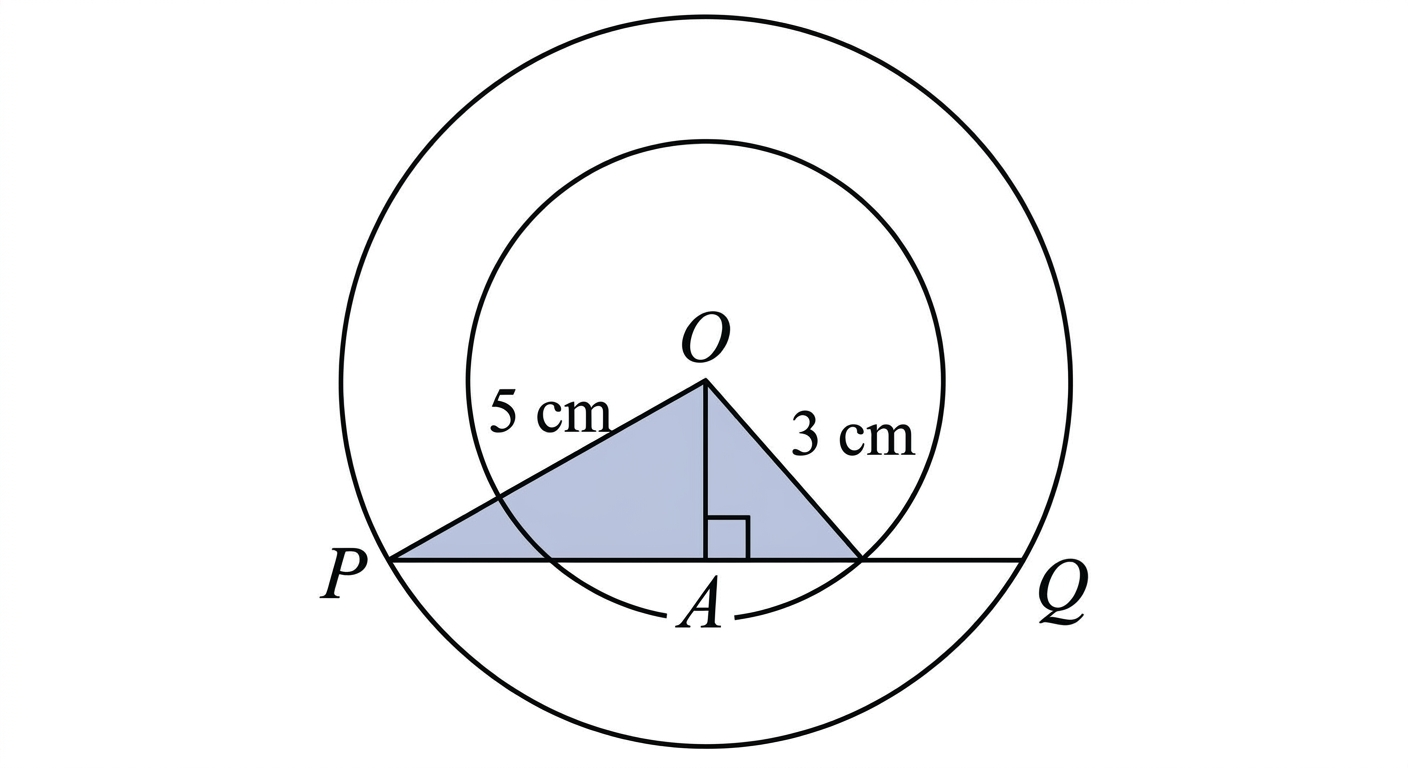
Radius of smaller circle, Radius of larger circle,
Since the tangent is perpendicular to the radius at the point of contact:
Applying Pythagoras theorem in right :
Step 2 · Find the Total Length of Chord
The perpendicular drawn from the centre of a circle to a chord bisects the chord.
Since , is the midpoint of :
- Stopping at Half-Length: Forgetting to double , mistakenly reporting instead of the full chord length .
- Hypotenuse Confusion: Confusing the radii — the radius of the larger circle () is the hypotenuse, while the radius of the smaller circle () is one of the legs.
More questions in Exercise 10.2
In Q.1 to 3, choose the correct option and give justification.
- From a point , the length of the tangent to a circle is and the distance of from the centre is . The radius of the circle is (A) (B) (C) (D)
In Q.1 to 3, choose the correct option and give justification.
- In Fig. 10.11, if TP and TQ are the two tangents to a circle with centre O so that , then is equal to (A) (B) (C) (D)
In Q.1 to 3, choose the correct option and give justification.
- If tangents PA and PB from a point P to a circle with centre O are inclined to each other at angle of , then is equal to (A) (B) (C) (D)
Prove that the tangents drawn at the ends of a diameter of a circle are parallel.
Prove that the perpendicular at the point of contact to the tangent to a circle passes through the centre.
The length of a tangent from a point at distance from the centre of the circle is . Find the radius of the circle.
Two concentric circles are of radii and . Find the length of the chord of the larger circle which touches the smaller circle.
A quadrilateral is drawn to circumscribe a circle (see Fig. 10.12). Prove that
In Fig. 10.13, and are two parallel tangents to a circle with centre and another tangent with point of contact intersecting at and at . Prove that .
Prove that the angle between the two tangents drawn from an external point to a circle is supplementary to the angle subtended by the line-segment joining the points of contact at the centre.
Prove that the parallelogram circumscribing a circle is a rhombus.
A triangle is drawn to circumscribe a circle of radius such that the segments and into which is divided by the point of contact are of lengths and respectively (see Fig. 10.14). Find the sides and .
Prove that opposite sides of a quadrilateral circumscribing a circle subtend supplementary angles at the centre of the circle.