Question 6
The length of a tangent from a point at distance from the centre of the circle is . Find the radius of the circle.
- The tangent to a circle is perpendicular to the radius through the point of contact, forming a right-angled triangle with the right angle at the point of contact.
- The line segment from the centre to the external point is the hypotenuse of this right triangle.
- We use the Pythagoras theorem () to calculate the unknown radius.
Step 1 · Apply Pythagoras Theorem to Find the Radius
Let be the centre of the circle and be the tangent touching the circle at .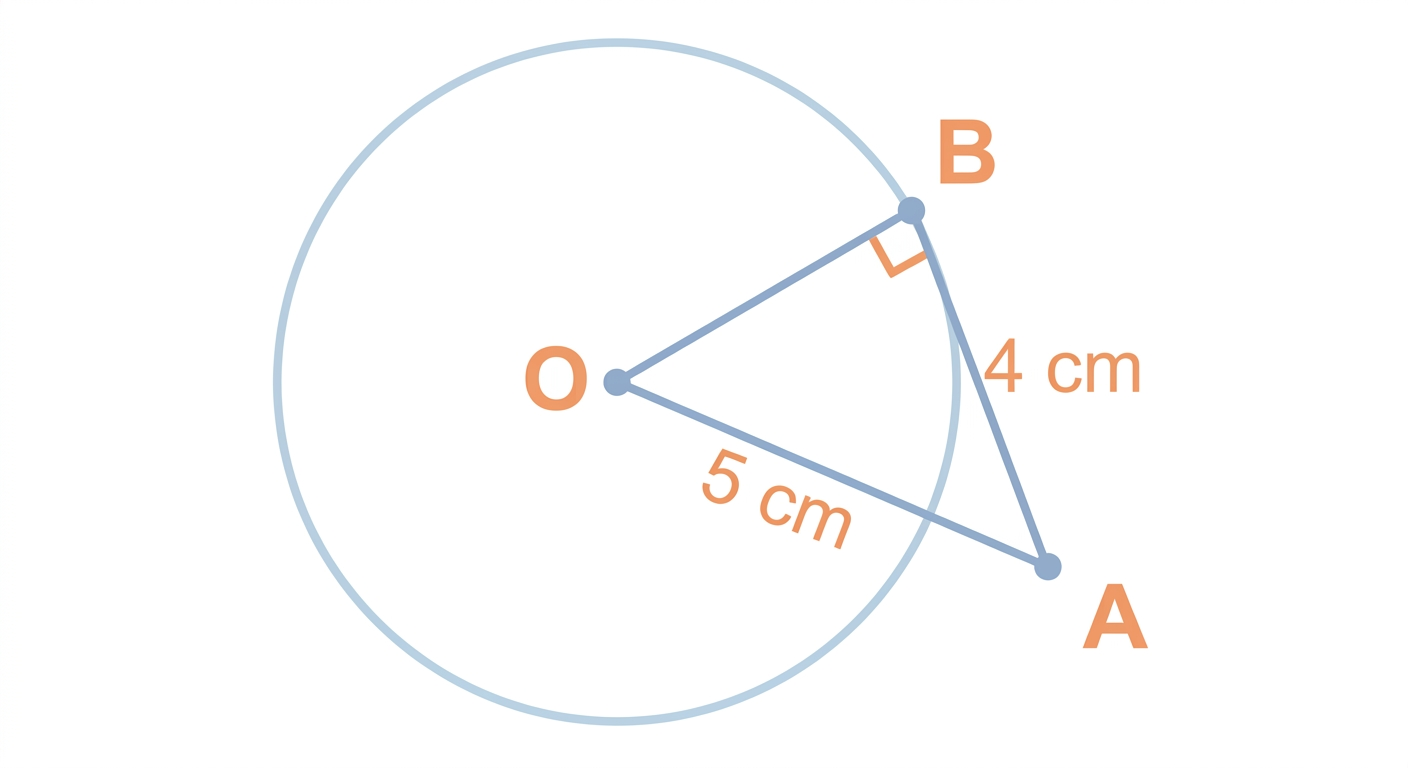
Since the radius is perpendicular to the tangent at the point of contact:
Given:
- (Hypotenuse)
- (Tangent)
By Pythagoras theorem in right-angled :
- Hypotenuse Identification: Confusing the tangent length with the hypotenuse. The distance from the centre to the external point () is always opposite the angle and hence is the hypotenuse.
- Point of Contact Angle: Assuming the right angle is at the centre or external point , whereas is always at the point of contact where the radius meets the tangent.
More questions in Exercise 10.2
In Q.1 to 3, choose the correct option and give justification.
- From a point , the length of the tangent to a circle is and the distance of from the centre is . The radius of the circle is (A) (B) (C) (D)
In Q.1 to 3, choose the correct option and give justification.
- In Fig. 10.11, if TP and TQ are the two tangents to a circle with centre O so that , then is equal to (A) (B) (C) (D)
In Q.1 to 3, choose the correct option and give justification.
- If tangents PA and PB from a point P to a circle with centre O are inclined to each other at angle of , then is equal to (A) (B) (C) (D)
Prove that the tangents drawn at the ends of a diameter of a circle are parallel.
Prove that the perpendicular at the point of contact to the tangent to a circle passes through the centre.
The length of a tangent from a point at distance from the centre of the circle is . Find the radius of the circle.
Two concentric circles are of radii and . Find the length of the chord of the larger circle which touches the smaller circle.
A quadrilateral is drawn to circumscribe a circle (see Fig. 10.12). Prove that
In Fig. 10.13, and are two parallel tangents to a circle with centre and another tangent with point of contact intersecting at and at . Prove that .
Prove that the angle between the two tangents drawn from an external point to a circle is supplementary to the angle subtended by the line-segment joining the points of contact at the centre.
Prove that the parallelogram circumscribing a circle is a rhombus.
A triangle is drawn to circumscribe a circle of radius such that the segments and into which is divided by the point of contact are of lengths and respectively (see Fig. 10.14). Find the sides and .
Prove that opposite sides of a quadrilateral circumscribing a circle subtend supplementary angles at the centre of the circle.