Question 13
Prove that opposite sides of a quadrilateral circumscribing a circle subtend supplementary angles at the centre of the circle.
- A quadrilateral circumscribes a circle with centre , touching the four sides and at points and respectively.
- Tangents drawn from an external point to a circle are equal in length, which allows us to prove pairs of adjacent triangles congruent by the SSS congruence criterion.
- By CPCT, the angles subtended at the centre by the tangents from each vertex are equal.
- Since the sum of all angles around the centre is , we substitute these equal angles to show that opposite sides subtend supplementary angles () at the centre.
Step 1 · Setup and Triangle Congruence
Let quadrilateral circumscribe a circle with centre , touching sides at respectively.
Join and radii .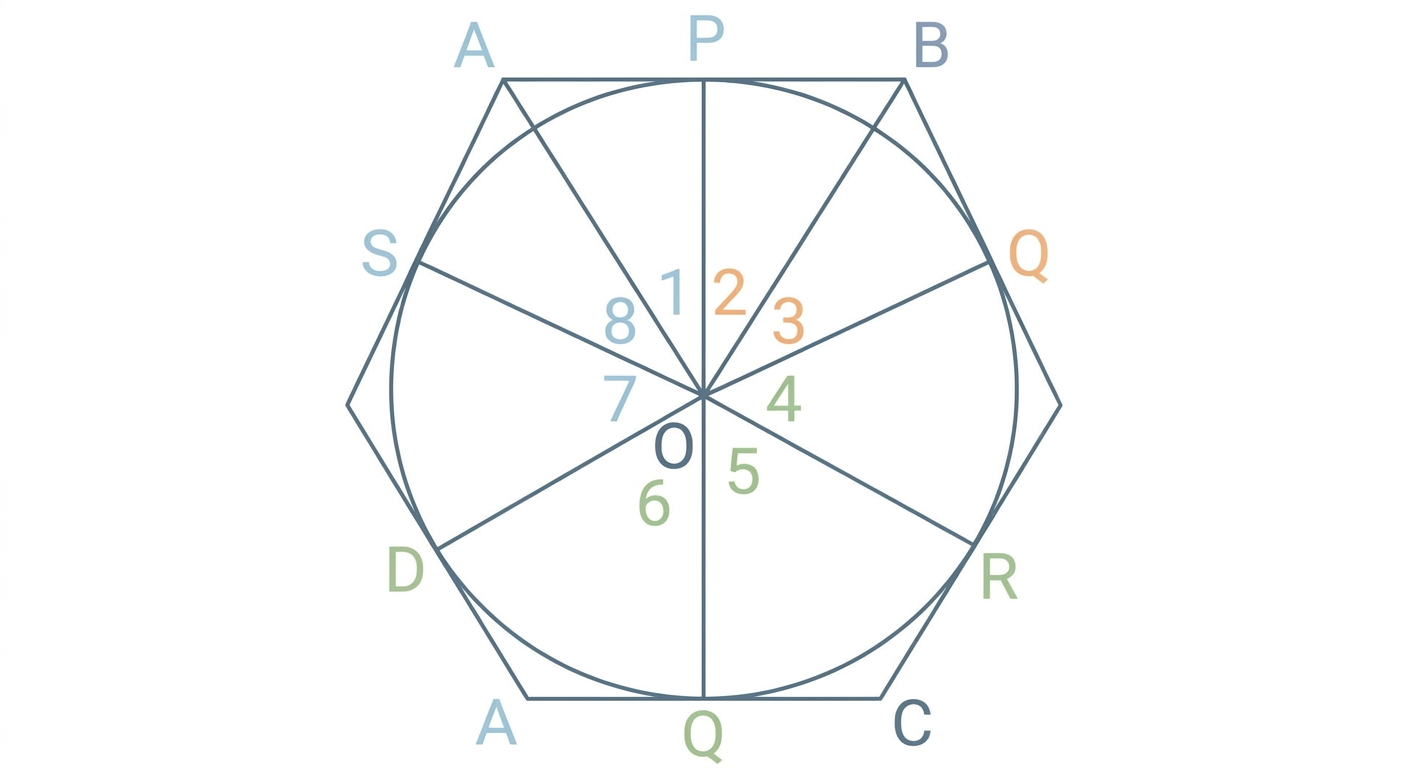
In and :
By SSS congruence criterion:
Step 2 · Establish Equal Angles at the Centre
Since corresponding parts of congruent triangles are equal (CPCT):
Similarly, by proving the respective pairs of triangles congruent:
Step 3 · Sum of Angles Around the Centre
The sum of all angles around the centre is :
Substitute , , , and :
Similarly, substituting for the other pairs:
Hence, opposite sides subtend supplementary angles at the centre.
- Misgrouping Angles: Substituting the incorrect angle relations, which fails to combine adjacent angles into and .
- Confusing Cyclic with Circumscribed Quadrilaterals: Assuming the opposite interior angles of quadrilateral sum to ; the theorem specifically applies to angles subtended at the centre of the circle by opposite sides.
More questions in Exercise 10.2
In Q.1 to 3, choose the correct option and give justification.
- From a point , the length of the tangent to a circle is and the distance of from the centre is . The radius of the circle is (A) (B) (C) (D)
In Q.1 to 3, choose the correct option and give justification.
- In Fig. 10.11, if TP and TQ are the two tangents to a circle with centre O so that , then is equal to (A) (B) (C) (D)
In Q.1 to 3, choose the correct option and give justification.
- If tangents PA and PB from a point P to a circle with centre O are inclined to each other at angle of , then is equal to (A) (B) (C) (D)
Prove that the tangents drawn at the ends of a diameter of a circle are parallel.
Prove that the perpendicular at the point of contact to the tangent to a circle passes through the centre.
The length of a tangent from a point at distance from the centre of the circle is . Find the radius of the circle.
Two concentric circles are of radii and . Find the length of the chord of the larger circle which touches the smaller circle.
A quadrilateral is drawn to circumscribe a circle (see Fig. 10.12). Prove that
In Fig. 10.13, and are two parallel tangents to a circle with centre and another tangent with point of contact intersecting at and at . Prove that .
Prove that the angle between the two tangents drawn from an external point to a circle is supplementary to the angle subtended by the line-segment joining the points of contact at the centre.
Prove that the parallelogram circumscribing a circle is a rhombus.
A triangle is drawn to circumscribe a circle of radius such that the segments and into which is divided by the point of contact are of lengths and respectively (see Fig. 10.14). Find the sides and .
Prove that opposite sides of a quadrilateral circumscribing a circle subtend supplementary angles at the centre of the circle.