Question 1
In Q.1 to 3, choose the correct option and give justification.
- From a point , the length of the tangent to a circle is and the distance of from the centre is . The radius of the circle is (A) (B) (C) (D)
- The tangent at any point of a circle is perpendicular to the radius through the point of contact, making .
- Triangle forms a right-angled triangle with hypotenuse and side .
- We can calculate the radius using the Pythagoras theorem: .
Step 1 · Calculate the Radius using Pythagoras Theorem
Let be the centre of the circle, be the given point, and be the point of contact of the tangent.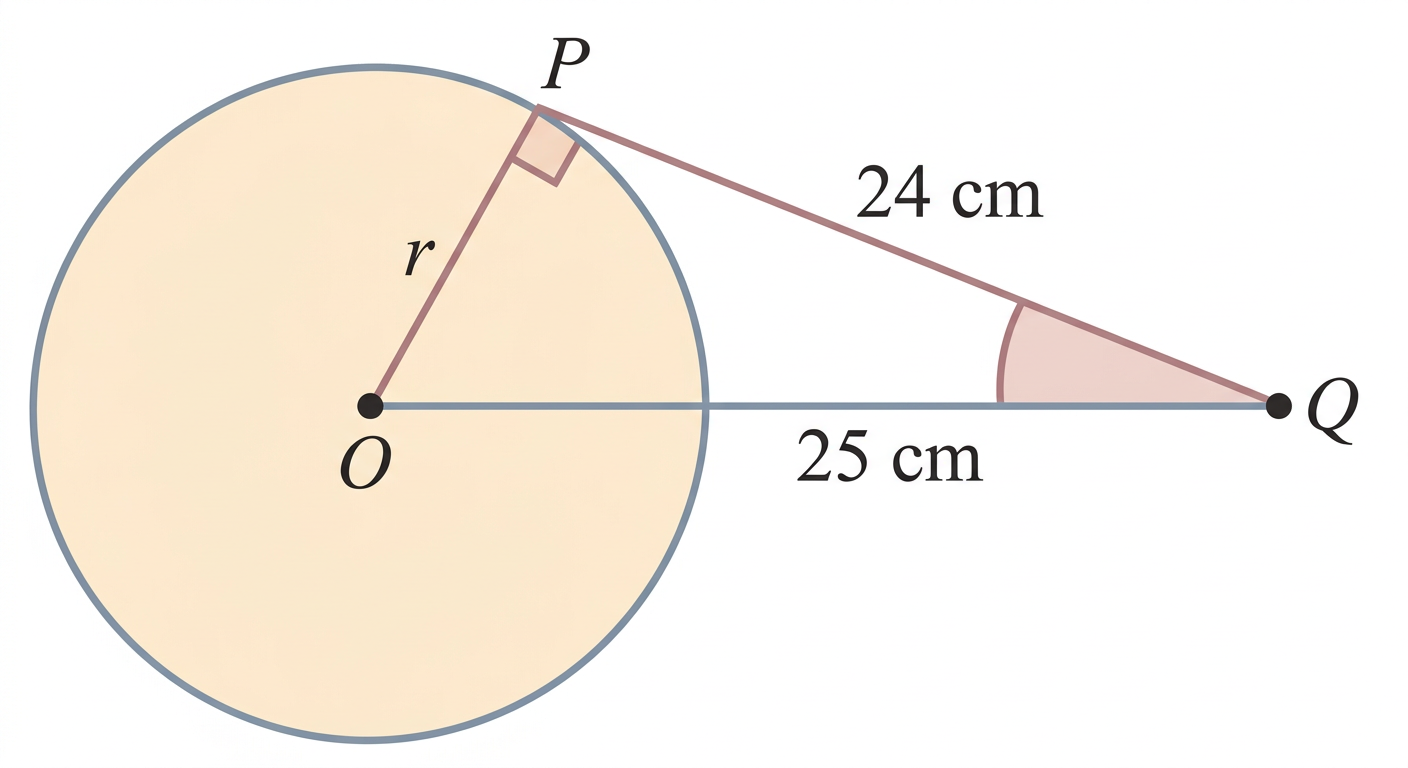
Since the radius is perpendicular to the tangent at the point of contact, .
In right , by Pythagoras theorem
(A)
- Identifying the Hypotenuse: The line connecting the centre to the external point () is opposite the angle and is therefore the hypotenuse, not the tangent ().
- Right Angle Placement: The right angle is formed at the point of contact (between the radius and tangent ), giving .
More questions in Exercise 10.2
In Q.1 to 3, choose the correct option and give justification.
- From a point , the length of the tangent to a circle is and the distance of from the centre is . The radius of the circle is (A) (B) (C) (D)
In Q.1 to 3, choose the correct option and give justification.
- In Fig. 10.11, if TP and TQ are the two tangents to a circle with centre O so that , then is equal to (A) (B) (C) (D)
In Q.1 to 3, choose the correct option and give justification.
- If tangents PA and PB from a point P to a circle with centre O are inclined to each other at angle of , then is equal to (A) (B) (C) (D)
Prove that the tangents drawn at the ends of a diameter of a circle are parallel.
Prove that the perpendicular at the point of contact to the tangent to a circle passes through the centre.
The length of a tangent from a point at distance from the centre of the circle is . Find the radius of the circle.
Two concentric circles are of radii and . Find the length of the chord of the larger circle which touches the smaller circle.
A quadrilateral is drawn to circumscribe a circle (see Fig. 10.12). Prove that
In Fig. 10.13, and are two parallel tangents to a circle with centre and another tangent with point of contact intersecting at and at . Prove that .
Prove that the angle between the two tangents drawn from an external point to a circle is supplementary to the angle subtended by the line-segment joining the points of contact at the centre.
Prove that the parallelogram circumscribing a circle is a rhombus.
A triangle is drawn to circumscribe a circle of radius such that the segments and into which is divided by the point of contact are of lengths and respectively (see Fig. 10.14). Find the sides and .
Prove that opposite sides of a quadrilateral circumscribing a circle subtend supplementary angles at the centre of the circle.