Question 8
A quadrilateral is drawn to circumscribe a circle (see Fig. 10.12). Prove that
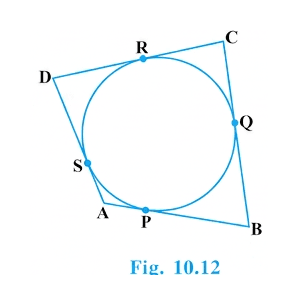
- A quadrilateral circumscribes a circle, meaning all four of its sides are tangent to the circle at points and .
- The lengths of two tangents drawn from an external point to a circle are equal.
- Treating each vertex () as an external point gives four pairs of equal tangent segments, which can be added and grouped to prove .
Step 1 · Write Equations for Tangents from Each Vertex
Since the lengths of tangents drawn from an external point to a circle are equal: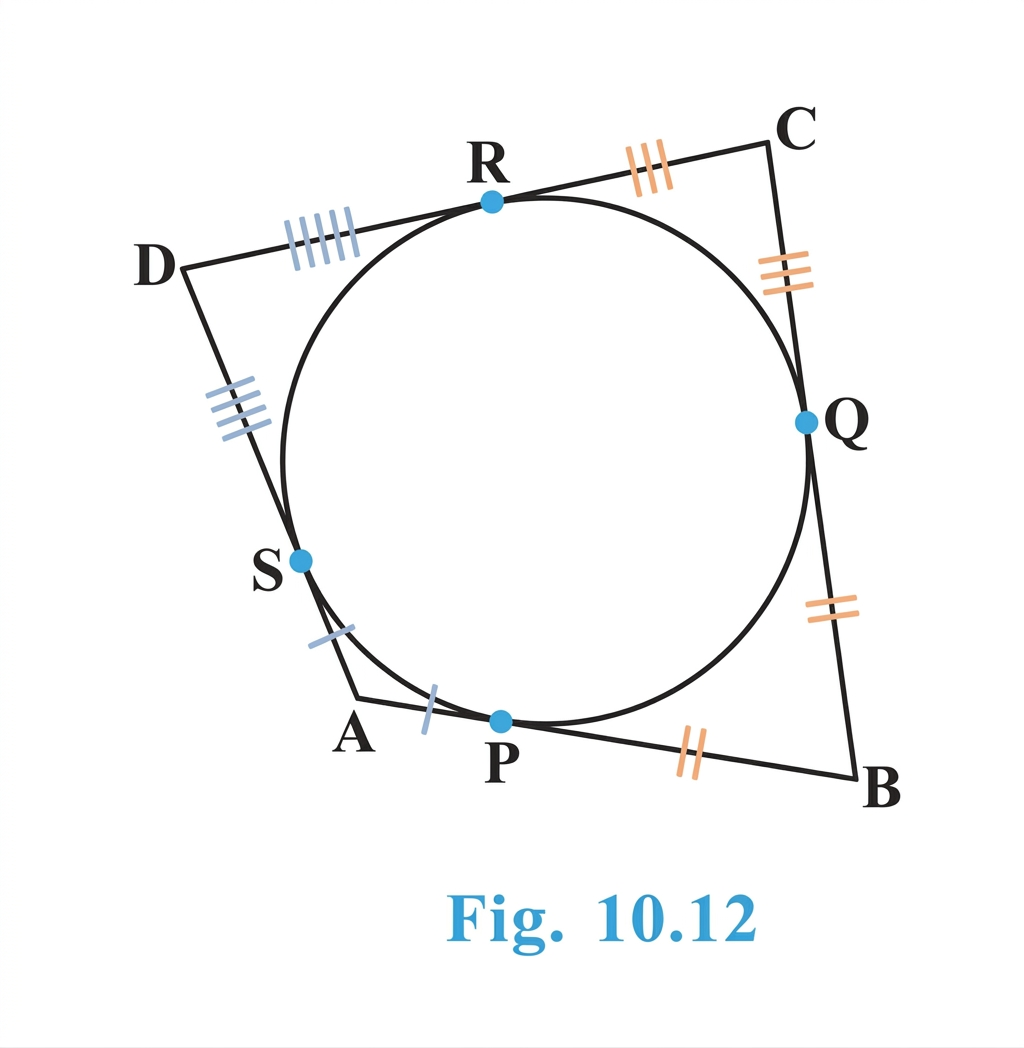
From external points and :
Step 2 · Add Equations and Group Terms
Adding equations and :
Grouping terms to form the complete sides of the quadrilateral:
Substituting the side lengths:
Hence proved, .
- Mismatched Sides: Writing equations with terms on the wrong side (e.g., writing instead of ). Keep on the same side so they add up directly to .
- Incorrect Grouping: Grouping non-adjacent segments (e.g., trying to add instead of adjacent collinear segments ). Each pair must lie on the same side of the quadrilateral.
More questions in Exercise 10.2
In Q.1 to 3, choose the correct option and give justification.
- From a point , the length of the tangent to a circle is and the distance of from the centre is . The radius of the circle is (A) (B) (C) (D)
In Q.1 to 3, choose the correct option and give justification.
- In Fig. 10.11, if TP and TQ are the two tangents to a circle with centre O so that , then is equal to (A) (B) (C) (D)
In Q.1 to 3, choose the correct option and give justification.
- If tangents PA and PB from a point P to a circle with centre O are inclined to each other at angle of , then is equal to (A) (B) (C) (D)
Prove that the tangents drawn at the ends of a diameter of a circle are parallel.
Prove that the perpendicular at the point of contact to the tangent to a circle passes through the centre.
The length of a tangent from a point at distance from the centre of the circle is . Find the radius of the circle.
Two concentric circles are of radii and . Find the length of the chord of the larger circle which touches the smaller circle.
A quadrilateral is drawn to circumscribe a circle (see Fig. 10.12). Prove that
In Fig. 10.13, and are two parallel tangents to a circle with centre and another tangent with point of contact intersecting at and at . Prove that .
Prove that the angle between the two tangents drawn from an external point to a circle is supplementary to the angle subtended by the line-segment joining the points of contact at the centre.
Prove that the parallelogram circumscribing a circle is a rhombus.
A triangle is drawn to circumscribe a circle of radius such that the segments and into which is divided by the point of contact are of lengths and respectively (see Fig. 10.14). Find the sides and .
Prove that opposite sides of a quadrilateral circumscribing a circle subtend supplementary angles at the centre of the circle.