Question 12
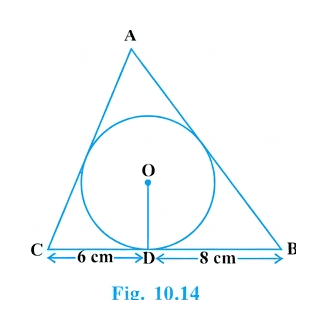
A triangle ABC is drawn to circumscribe a circle of radius 4 cm such that the segments BD and DC into which BC is divided by the point of contact D are of lengths 8 cm and 6 cm respectively (see Fig. 10.14). Find the sides AB and AC.
Tangent: A line that touches a circle at exactly one point without crossing through it.
Tangents from an External Point are Equal: Two tangents drawn from the same external point to a circle are always equal in length. Each vertex of the triangle is an external point — this lets us express all three sides in terms of the tangent lengths.
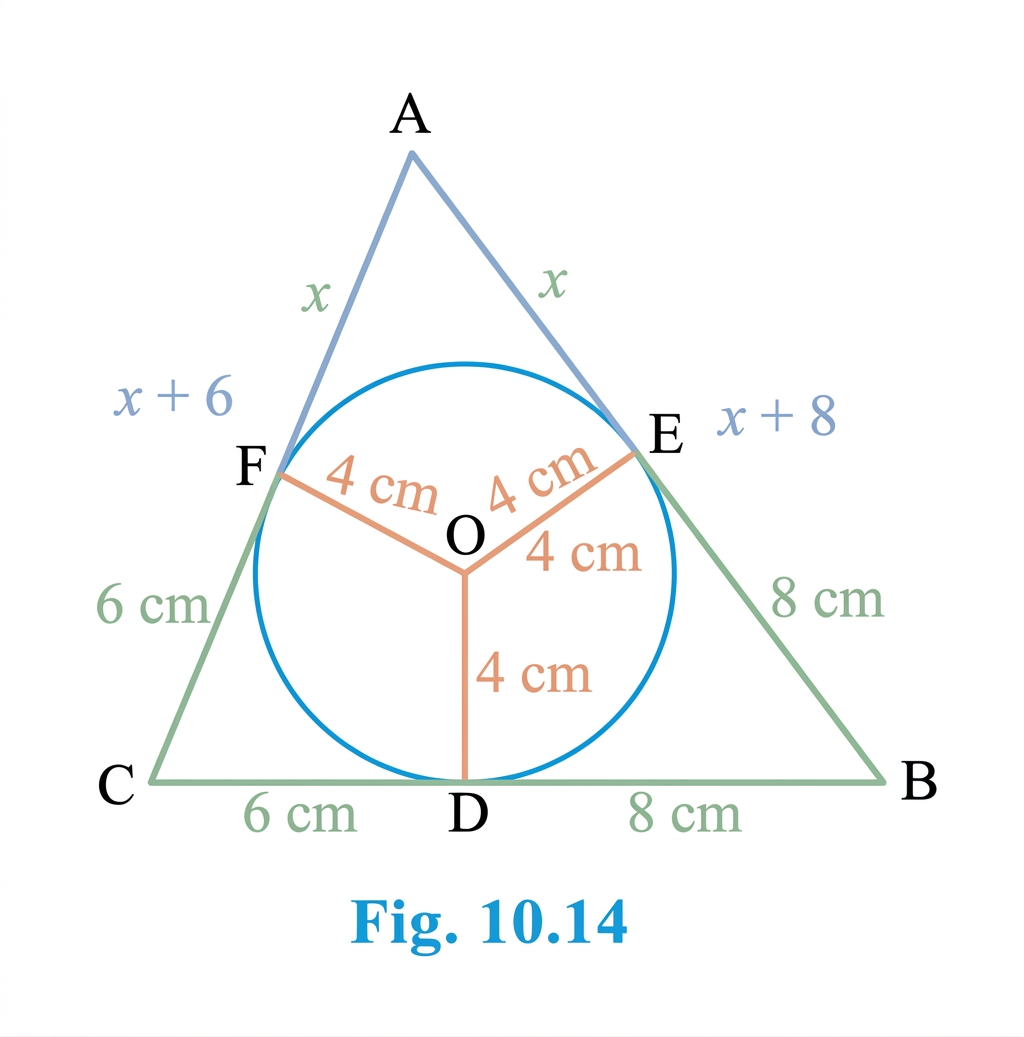
Circumscribed Triangle: A triangle that has a circle (incircle) inside it touching all three sides. The centre O is equidistant from all three sides, and OD = OE = OF = radius = 4 cm.
Semi-perimeter (): Half the perimeter of a triangle, used in Heron's formula: .
We will use the property that tangents from an external point to a circle are equal.
Step 1 — Find side lengths
Let the circle touch side at point . Let the circle touch side at point . We know that tangents from an external point are equal. From point , and are tangents. So, . From point , and are tangents. So, . From point , and are tangents. Let . Now, let's find the lengths of the sides of . Side .
Side .
Side .
Let's find the semi-perimeter of . The perimeter is .
Step 2 — Area using Heron's formula
Heron's Formula: Gives the area of a triangle using only its side lengths and semi-perimeter: where is the semi-perimeter and , , are the three sides.
We will use Heron's formula for the area of . Area . Here, , , . Let's find the terms , , and .
Now, let's substitute these into Heron's formula.
Step 3 — Area as sum of smaller triangles
Key insight: The centre O is connected to each vertex, splitting △ABC into three smaller triangles — △OAB, △OBC, △OCA. The perpendicular from O to each side equals the inradius (r = 4 cm), which is the height of each smaller triangle.
The radius of the circle is . The area of is the sum of the areas of , , and . The height of each small triangle is the radius . Area of .
Area of .
Area of .
Now, let's sum these areas to find the total area of .
Step 4 — Equate areas and solve for x
We have two expressions for the area of . Let's set them equal to each other.
We can factor out 4 from the right side.
Squaring both sides: Valid here since both sides are positive (areas/lengths). This removes the square root.
Let's square both sides of the equation.
Now, let's divide both sides by .
Let's move all terms to one side.
We can factor out .
This gives two possible solutions for .
Discarding negative solution: Since represents a length (AE = AF), it must be positive. So is rejected.
Since a length cannot be negative, we discard . Therefore, the value of is .
Step 5 — Find sides AB and AC
Now we can find the lengths of sides and . Side .
Side .
Answer
(i) The side is . (ii) The side is .
More questions in Exercise 10.2
In Q.1 to 3, choose the correct option and give justification.
- From a point Q, the length of the tangent to a circle is 24 cm and the distance of Q from the centre is 25 cm. The radius of the circle is (A) 7 cm (B) 12 cm (C) 15 cm (D) 24.5 cm
In Q.1 to 3, choose the correct option and give justification.
- In Fig. 10.11, if TP and TQ are the two tangents to a circle with centre O so that , then is equal to (A) (B) (C) (D)
In Q.1 to 3, choose the correct option and give justification.
- If tangents PA and PB from a point P to a circle with centre O are inclined to each other at angle of , then is equal to (A) (B) (C) (D)
Prove that the tangents drawn at the ends of a diameter of a circle are parallel.
Prove that the perpendicular at the point of contact to the tangent to a circle passes through the centre.
The length of a tangent from a point A at distance 5 cm from the centre of the circle is 4 cm. Find the radius of the circle.
Two concentric circles are of radii 5 cm and 3 cm. Find the length of the chord of the larger circle which touches the smaller circle.
A quadrilateral ABCD is drawn to circumscribe a circle (see Fig. 10.12). Prove that
In Fig. 10.13, XY and are two parallel tangents to a circle with centre O and another tangent AB with point of contact C intersecting XY at A and at B. Prove that .
Prove that the angle between the two tangents drawn from an external point to a circle is supplementary to the angle subtended by the line-segment joining the points of contact at the centre.
Prove that the parallelogram circumscribing a circle is a rhombus.
A triangle ABC is drawn to circumscribe a circle of radius 4 cm such that the segments BD and DC into which BC is divided by the point of contact D are of lengths 8 cm and 6 cm respectively (see Fig. 10.14). Find the sides AB and AC.
Prove that opposite sides of a quadrilateral circumscribing a circle subtend supplementary angles at the centre of the circle.