Exploring Algebraic Identities | EOT

Question 4

Simplify the following:

(i) 4x2+4x+14x21\dfrac{4x^2 + 4x + 1}{4x^2 - 1}

(ii) 9(3a324b3)9a236b2\dfrac{9(3a^3 - 24b^3)}{9a^2 - 36b^2}

(iii) s3+125t3s22st35t2\dfrac{s^3 + 125t^3}{s^2 - 2st - 35t^2}

Note: Assume that the denominators are not equal to 0.

Check your answer with HomiSolve it yourself, then let Homi check your steps and spot mistakes.
Solution
Understand the Question
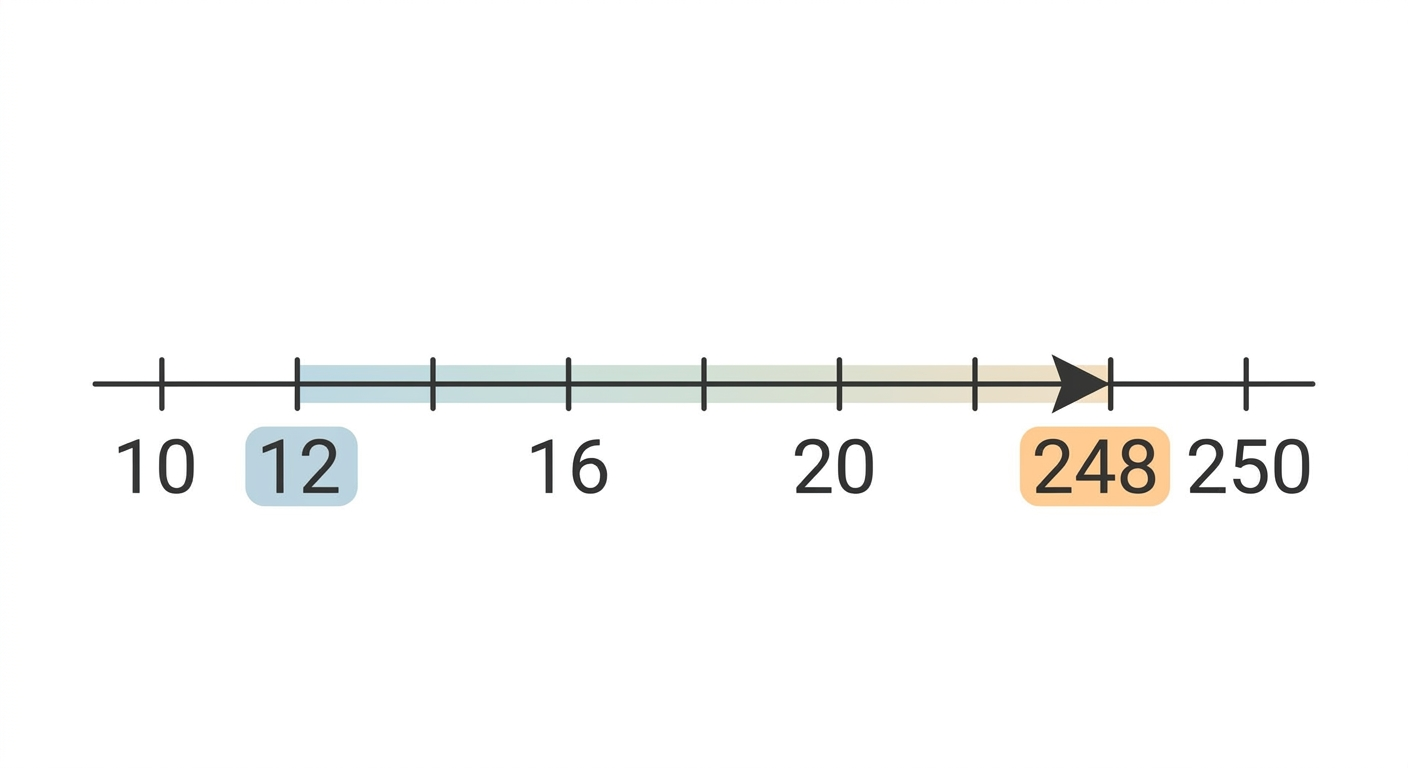
  • The multiples of 44 between 1010 and 250250 form an Arithmetic Progression (AP) with a common difference d=4d = 4.
  • The first multiple greater than 1010 is 1212 (first term a=12a = 12), and the last multiple less than 250250 is 248248 (last term tn=248t_n = 248).
  • To find the total number of multiples nn, use the nthn^{\text{th}} term formula: tn=a+(n1)dt_n = a + (n - 1)d.

Step 1 · Identify the Arithmetic Progression

To find the first term aa, find the smallest multiple of 44 greater than 1010: 10÷4=2 remainder 210 \div 4 = 2 \text{ remainder } 2 a=4×3=12a = 4 \times 3 = 12

To find the last term tnt_n, find the largest multiple of 44 less than 250250: 250÷4=62 remainder 2250 \div 4 = 62 \text{ remainder } 2 tn=4×62=248t_n = 4 \times 62 = 248Diagram 1

The multiples of 44 form an AP: 12,16,20,,24812, 16, 20, \dots, 248

Here

a=12d=4tn=248\begin{aligned} a &= 12 \\ d &= 4 \\ t_n &= 248 \end{aligned}

Step 2 · Calculate the Number of Terms

Using the nthn^{\text{th}} term formula of an AP tn=a+(n1)dt_n = a + (n - 1)d

Substitute the values 248=12+(n1)4248 = 12 + (n - 1)4

24812=(n1)4236=(n1)42364=n159=n1n=59+1n=60\begin{aligned} 248 - 12 &= (n - 1)4 \\[0.6em] 236 &= (n - 1)4 \\[0.6em] \dfrac{236}{4} &= n - 1 \\[0.6em] 59 &= n - 1 \\[0.6em] n &= 59 + 1 \\[0.6em] n &= 60 \end{aligned}
Answer

60

Common Mistakes
  • Boundary Inclusion Error: Using 1010 or 250250 directly as the first or last terms without verifying whether they are divisible by 44.
  • Off-by-One Error: Forgetting to add 11 at the final step, mistakenly giving n=59n = 59 instead of n=59+1=60n = 59 + 1 = 60.

More questions in EOT

Q1

Use suitable identities to find the following products:

(i) (3x+4)2(-3x + 4)^2

(ii) (2s+7)(2s7)(2s + 7)(2s - 7)

(iii) (p2+12)(p212)\left(p^2 + \dfrac{1}{2}\right)\left(p^2 - \dfrac{1}{2}\right)

(iv) (2n+7)(2n7)(2n + 7)(2n - 7)

(v) (s2t)(s2+2st+4t2)(s - 2t)(s^2 + 2st + 4t^2)

(vi) (12r4r)2\left(\dfrac{1}{2r} - 4r\right)^2

(vii) (3m+4kl)2(-3m + 4k - l)^2

(viii) (x13y)3\left(x - \dfrac{1}{3}y\right)^3

(ix) (72k23m)3\left(\dfrac{7}{2}k - \dfrac{2}{3}m\right)^3

Q2

Find the values using suitable identities:

(i) 17×2117 \times 21

(ii) 104×96104 \times 96

(iii) 24×1624 \times 16

(iv) 1473147^3

(v) 1993199^3

(vi) 1273127^3

(vii) (107)3(-107)^3

(viii) (299)3(-299)^3

Q3

Factor the following algebraic expressions:

(i) 4y2+1+116y24y^2 + 1 + \dfrac{1}{16y^2}

(ii) 9m2125n29m^2 - \dfrac{1}{25n^2}

(iii) 27b3164b327b^3 - \dfrac{1}{64b^3}

(iv) x2+5x6+16x^2 + \dfrac{5x}{6} + \dfrac{1}{6}

(v) 27u3112527u25+9u2527u^3 - \dfrac{1}{125} - \dfrac{27u^2}{5} + \dfrac{9u}{25}

(vi) 64y3+1125z364y^3 + \dfrac{1}{125}z^3

(vii) p3+27q3+r39pqrp^3 + 27q^3 + r^3 - 9pqr

(viii) 9m212m+49m^2 - 12m + 4

(ix) 9x383y3+z33+6xyz9x^3 - \dfrac{8}{3}y^3 + \dfrac{z^3}{3} + 6xyz

(x) 4x2+9y2+36z2+12xz+36yz+24xy4x^2 + 9y^2 + 36z^2 + 12xz + 36yz + 24xy

(xi) 27u312169u22+u427u^3 - \dfrac{1}{216} - \dfrac{9u^2}{2} + \dfrac{u}{4}

Q4

Simplify the following:

(i) 4x2+4x+14x21\dfrac{4x^2 + 4x + 1}{4x^2 - 1}

(ii) 9(3a324b3)9a236b2\dfrac{9(3a^3 - 24b^3)}{9a^2 - 36b^2}

(iii) s3+125t3s22st35t2\dfrac{s^3 + 125t^3}{s^2 - 2st - 35t^2}

Note: Assume that the denominators are not equal to 0.

Q5

Find possible expressions for the length and breadth of each of the following rectangles whose areas are given by the following expressions in square units.

(i) 25a230ab+9b225a^2 - 30ab + 9b^2

(ii) 36s249t236s^2 - 49t^2

Q6

Find possible expressions for the length, breadth, and heights of each of the following cuboids whose volumes are given by the following expressions in cubic units.

(i) 6a224b26a^2 - 24b^2

(ii) 3ps215ps+12p3ps^2 - 15ps + 12p

Q7

The village playground is shaped as a square of side 40 metres. A path of width ss metres is created around the playground for people to walk. Find an expression for the area of the path in terms of ss.

Q8

If a number plus its reciprocal equals 103\dfrac{10}{3}, find the number.

Q9

A rectangular pool has area 2x2+7x+32x^2 + 7x + 3 square hastas. If its width is 2x+12x + 1 hastas, find its length. Hasta was a unit used to measure length.

Q10

If both x2x - 2 and x12x - \dfrac{1}{2} are factors of px2+5x+rpx^2 + 5x + r, show that p=rp = r.

Q11

If a+b+c=5a + b + c = 5 and ab+bc+ca=10ab + bc + ca = 10, then prove that a3+b3+c33abc=25a^3 + b^3 + c^3 - 3abc = -25.

Q12

By factoring the expression, check that n3nn^3 - n is always divisible by 6 for all natural numbers nn. Give reasons.

Q13

Find the value of

(i) x3+y312xy+64x^3 + y^3 - 12xy + 64, when x+y=4x + y = -4

(ii) x38y336xy216x^3 - 8y^3 - 36xy - 216, when x=2y+6x = 2y + 6

← Back to Exploring Algebraic Identities