Question 19
There do not seem to be any parallel lines here. Or, are there?
What causes these illusions?
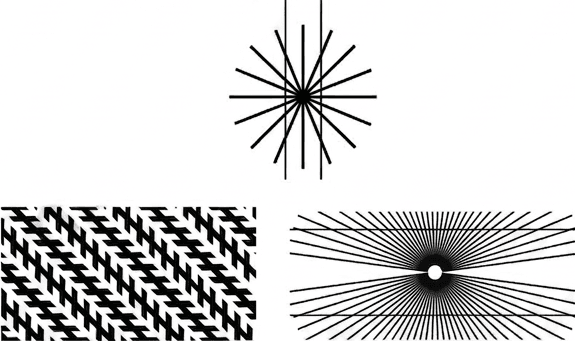
- Optical illusions occur when surrounding background patterns, intersecting angles, or contrasting shapes trick our brain into perceiving straight lines as curved, tilted, or non-parallel.
- In all the given figures, the primary lines are indeed straight and parallel, despite the visual distortion caused by the surrounding context.
Step 1 · Analyze the Central Star Pattern
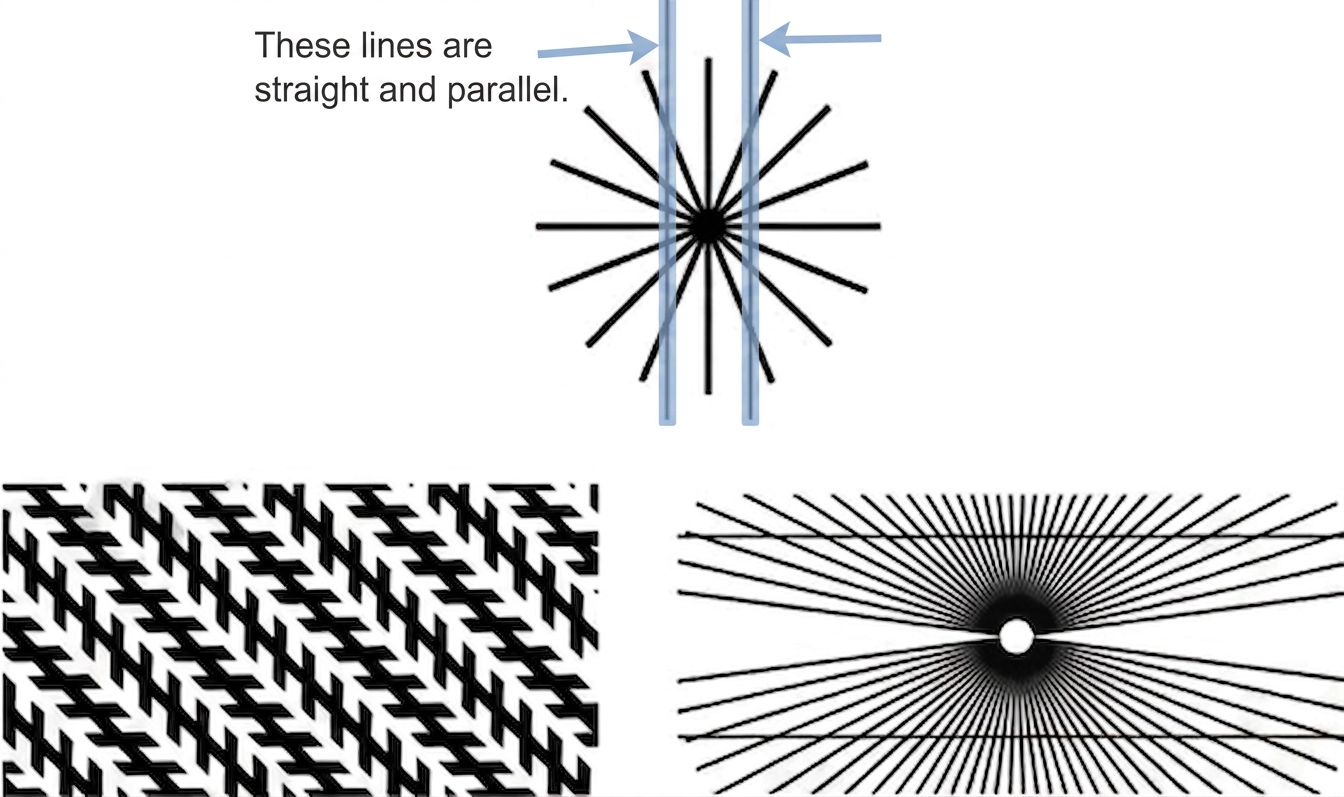
The vertical lines are straight and parallel to each other. The lines radiating outward from the central point cross the vertical lines at different angles, confusing our brain's perception of orientation and making the vertical lines appear bent.
Step 2 · Analyze the Zigzag Pattern
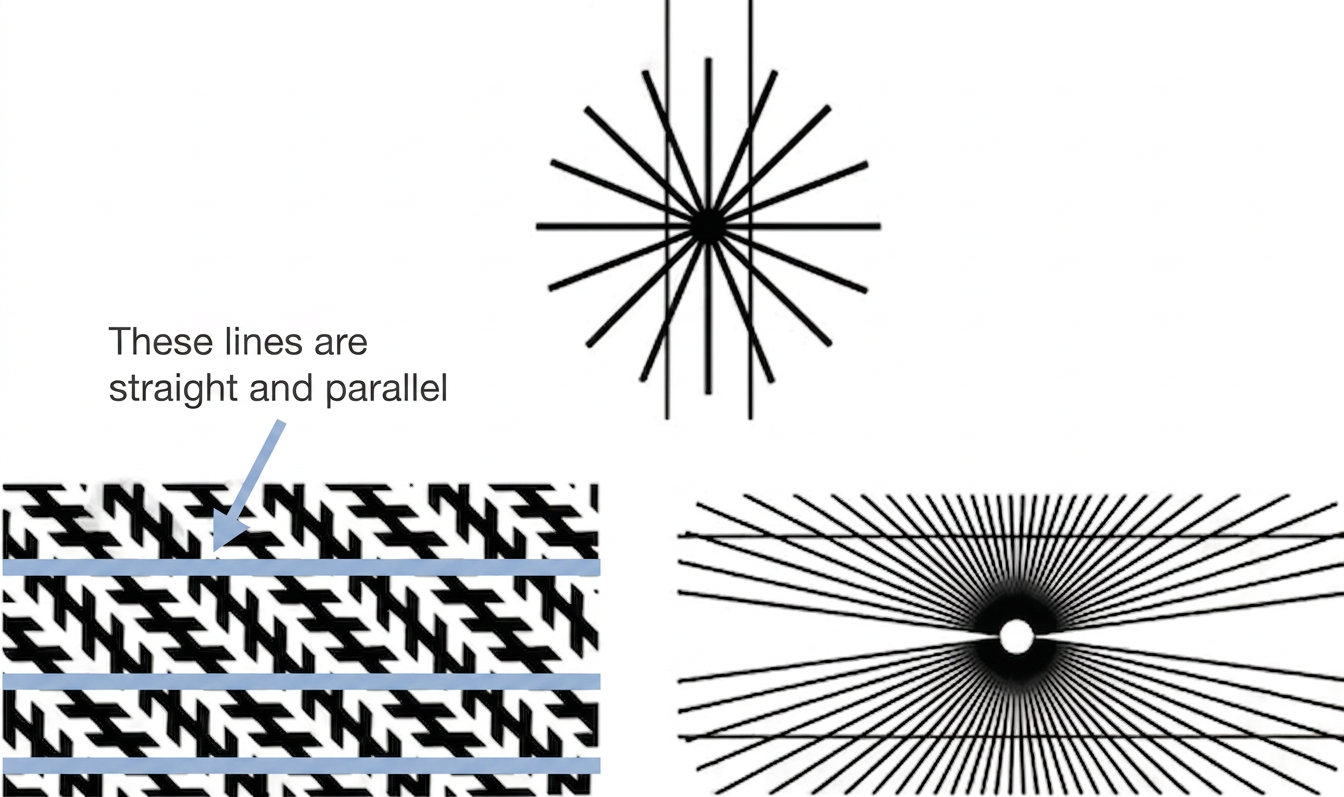
The horizontal white lines running across the pattern are straight and parallel. The alternating, slanted black shapes along their borders create high-contrast angles, tricking our brain into seeing the straight horizontal paths as tilted or zigzagged.
Step 3 · Analyze the Radiating Lines Pattern
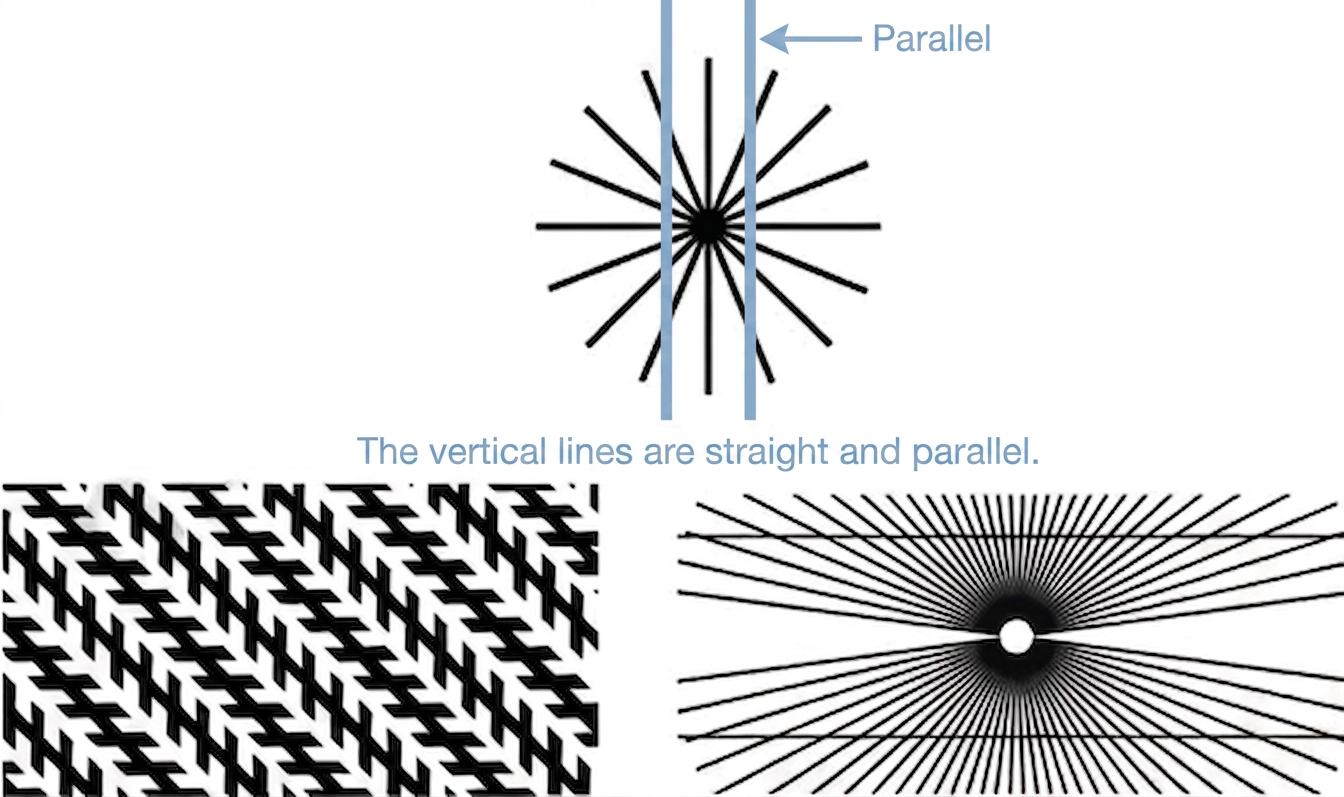
The top and bottom horizontal lines are straight and parallel. The diagonal lines radiating from the central focal point create an illusion of depth and perspective, which tricks the eye into seeing the parallel lines as curved inward.
Yes, there are parallel lines in each figure:
- Top image: The vertical lines are straight and parallel.
- Bottom-left image: The horizontal white lines are straight and parallel.
- Bottom-right image: The top and bottom horizontal lines are straight and parallel.
Cause of illusions: Intersecting diagonal spokes, radiating lines, and alternating contrasting shapes interfere with our visual processing, tricking the brain into perceiving straight, parallel lines as bent, tilted, or curved.
- Relying Solely on Visual Impression: Concluding lines are bent or tilted without verifying with a straightedge or ruler.
- Ignoring Background Interference: Overlooking how angled lines and contrasting geometric shapes distort the brain's perception of alignment and parallelism.
More questions in IT
Context: Let us observe what happens when two lines intersect.
Q. How many angles do they form?
Can two straight lines intersect at more than one point?
In Fig. 5.2, if is , can you figure out the measurements of , and , without drawing and measuring them?
Context: When two lines intersect each other and form four angles, labelled , , and , then and are equal, and and are equal.
Q. Is this always true for any pair of intersecting lines?
Can you draw a pair of intersecting lines such that all four angles are equal? Can you figure out what will be the measure of each angle?
Observe Fig. 5.5 and describe the way the line segments meet or cross each other in each case, with appropriate mathematical words (a point, an endpoint, the midpoint, meet, intersect) and the degree measure of each angle.
Are line segments and likely to meet if they are extended?
Are line segments and likely to meet if they are extended?
Name some parallel lines you can spot in your classroom.
Which pairs of lines appear to be parallel in Fig. 5.6 below?
Is it possible for all the eight angles to have different measurements? Why, why not?
What about five different angles — 6, 5, 4, 3 and 2?
Suppose, we have a transversal intersecting two parallel lines. What can be said about the corresponding angles?
Context: Activity 5 In Fig. 5.20, draw a transversal to the lines and such that one pair of corresponding angles is equal. You can measure the angles with a protractor.
Q. Are you finding it hard to draw a transversal such that the corresponding angles are equal?
Draw two more parallel lines using the long side of the set square as shown in Fig. 5.22. How do you know these two lines are parallel? Can you check if the corresponding angles are equal?
Why are lines and parallel to each other?
Is there a relation between and ? You could try to find the relationship by taking different values for and see what is. Once you find a relation, try to justify it or prove that this relation holds always.
There do not seem to be any parallel lines here. Or, are there?
What causes these illusions?