Question 10
Construct triangles for the following measurements:
(a) , ,
(b) , ,
(c) , ,
- To construct a triangle using the ASA (Angle-Side-Angle) criterion when one side length and the two adjacent angles are given:
- Draw the base line segment of the specified length.
- At each endpoint of the base, construct rays making the given angles on the same side of the segment.
- The intersection point of the two rays forms the third vertex of the triangle.
- A valid triangle is formed only when the sum of the two given angles is strictly less than .
(a) Construct a triangle for the measurements: , ,
Step 1 · Draw the Base
Draw a line segment .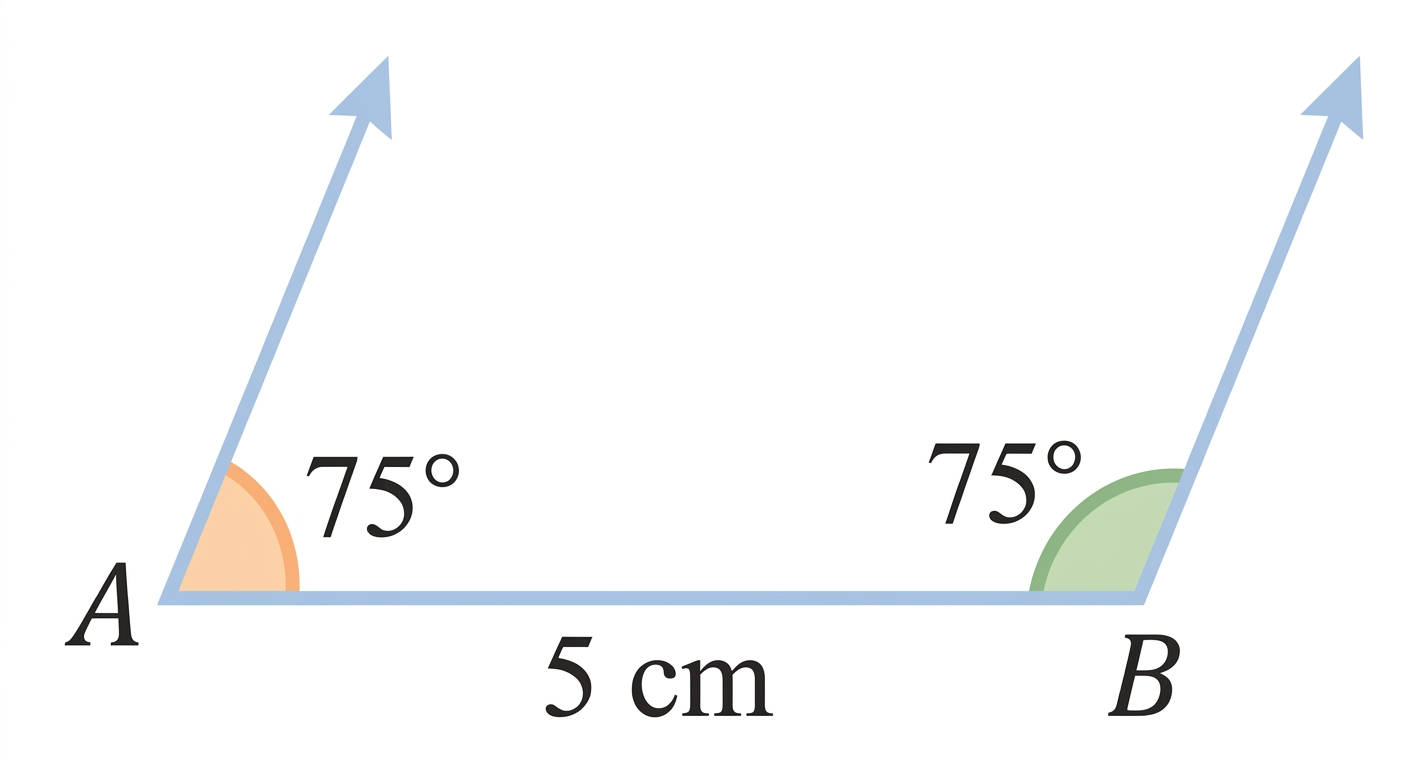
Step 2 · Construct the Base Angles
At point , construct an angle of .
At point , construct an angle of towards the same side of .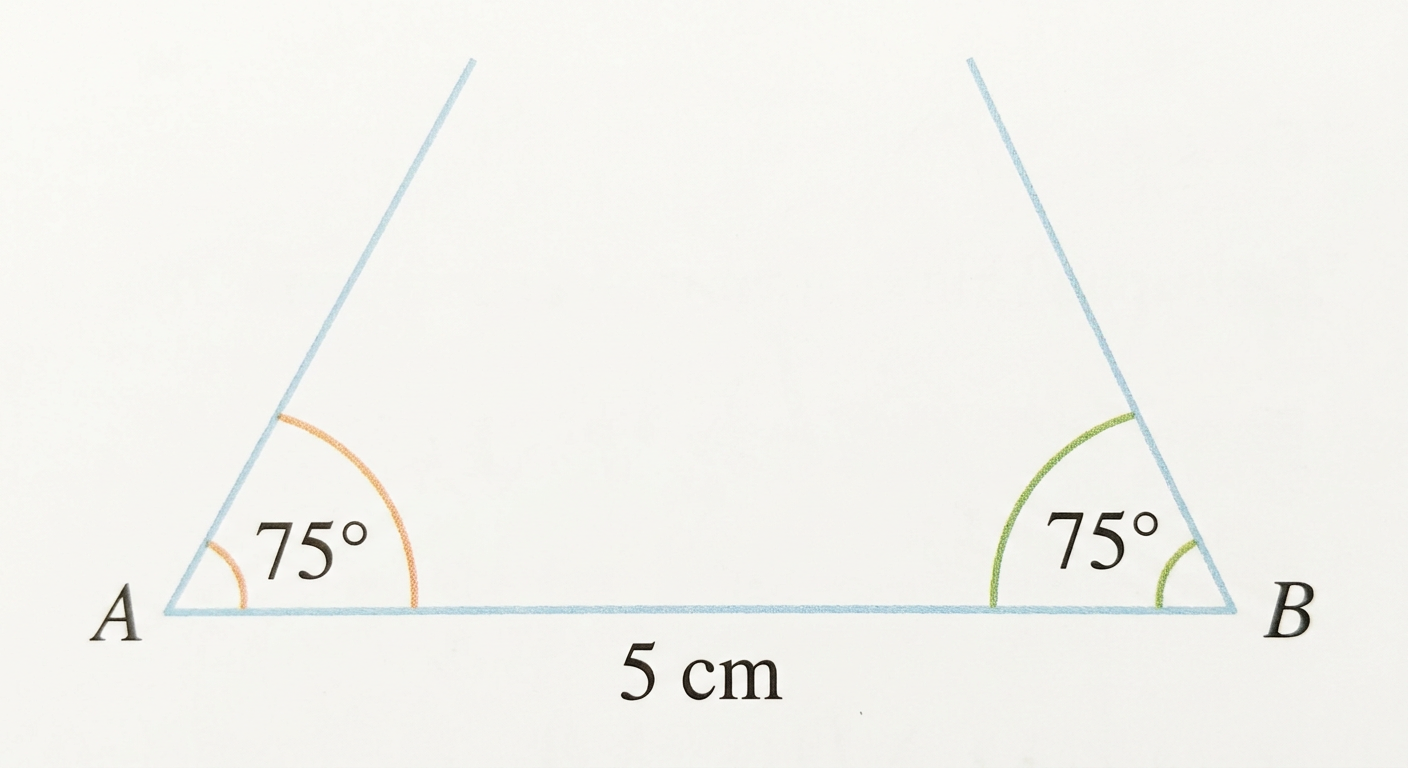
Step 3 · Locate the Third Vertex
Extend both rays until they intersect at point .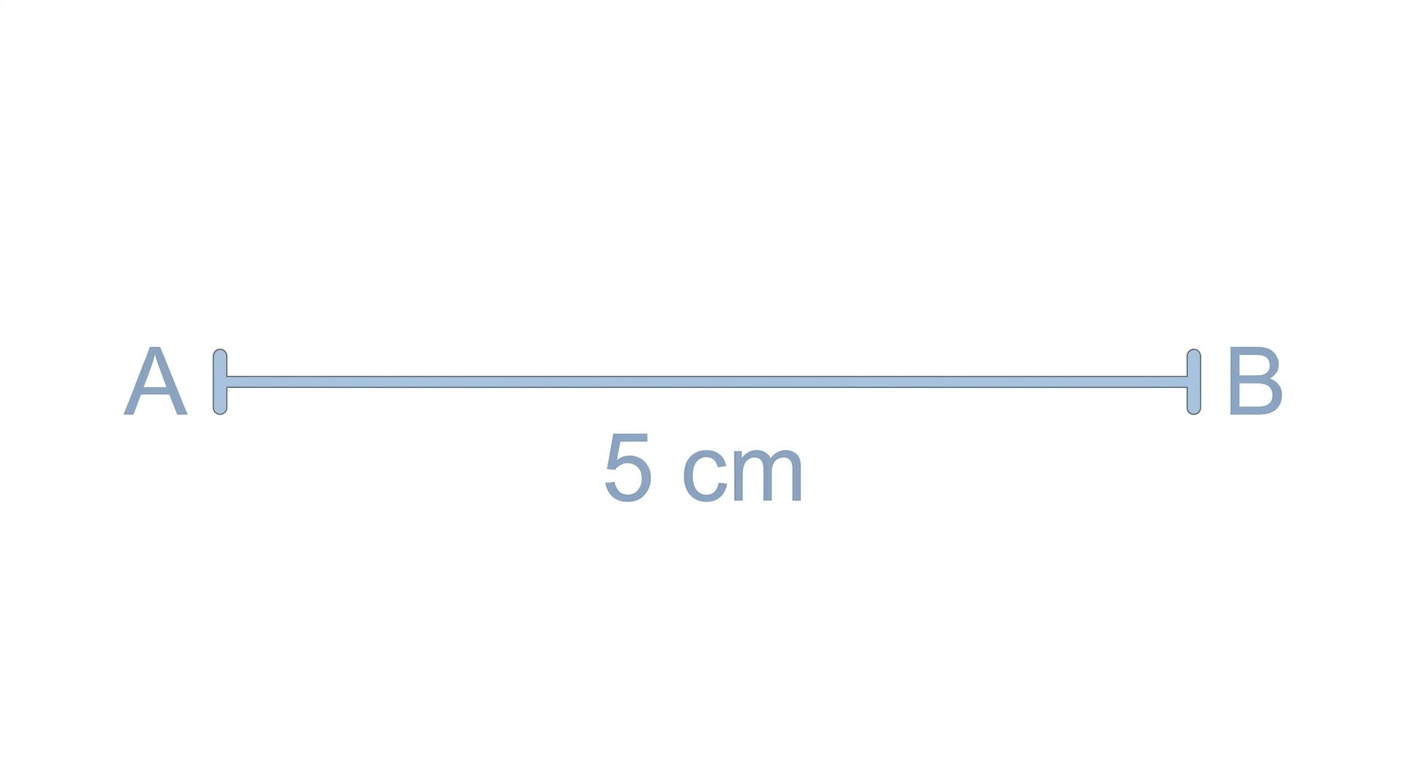
is the required triangle.
(a) is constructed with , , and .
(b) Construct a triangle for the measurements: , ,
Step 1 · Draw the Base
Draw a line segment .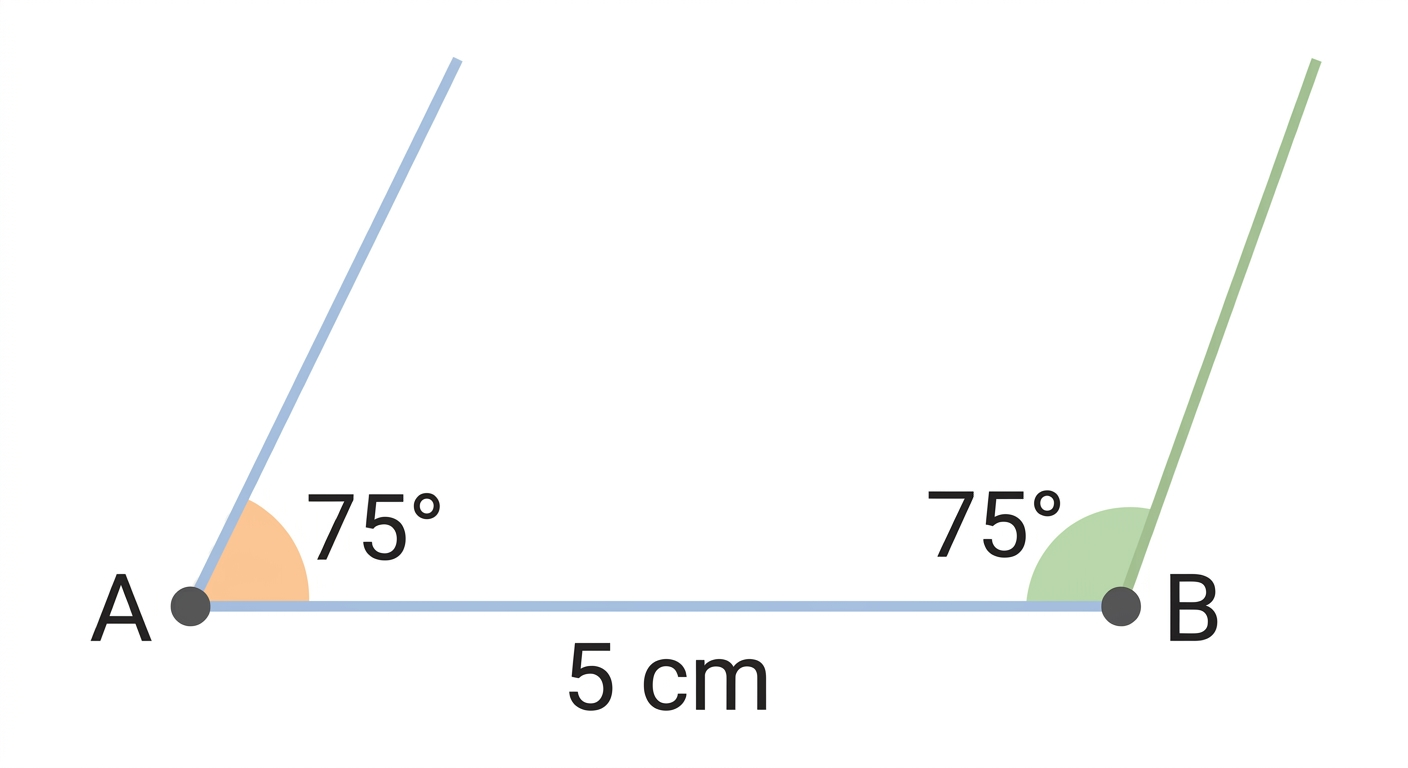
Step 2 · Construct the Base Angles
At point , construct an angle of .
At point , construct an angle of towards the same side of .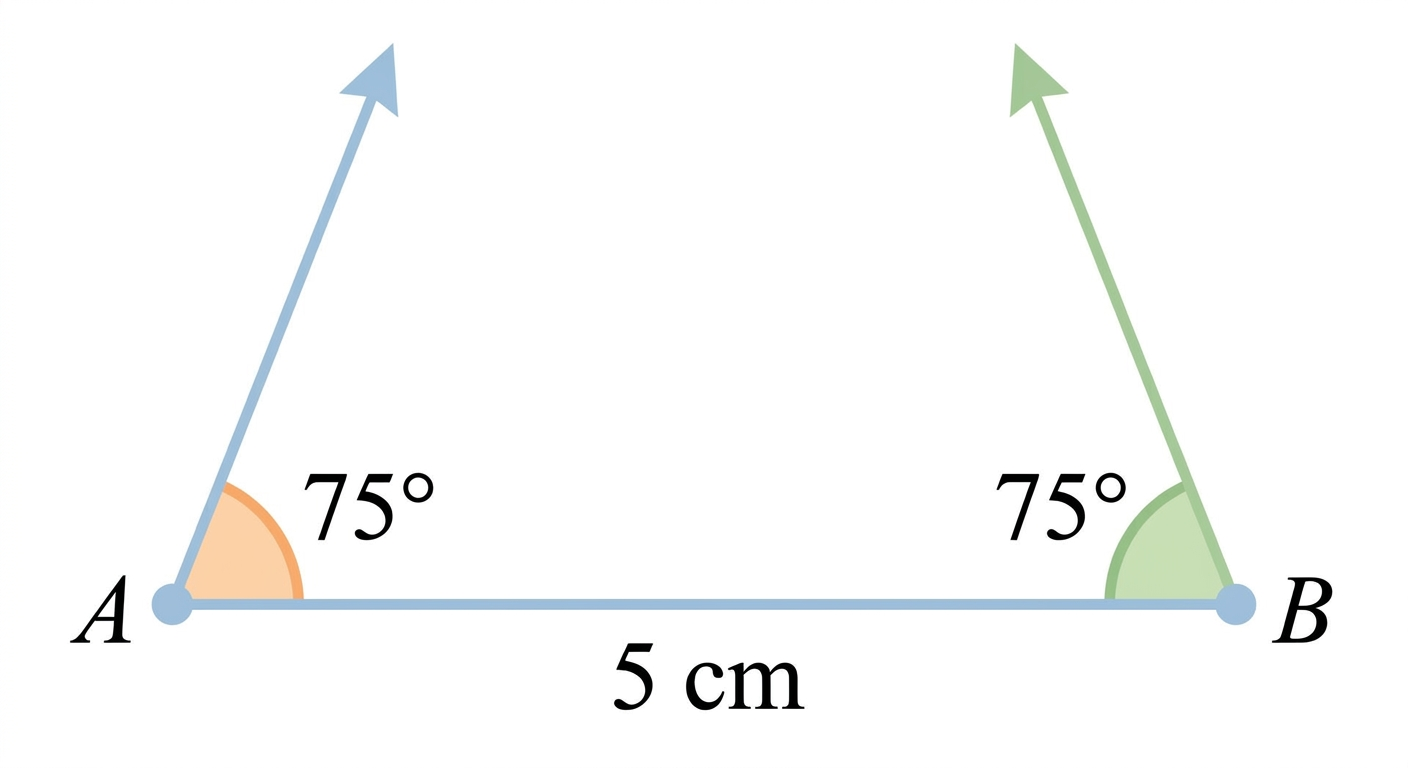
Step 3 · Locate the Third Vertex
Extend both rays until they intersect at point .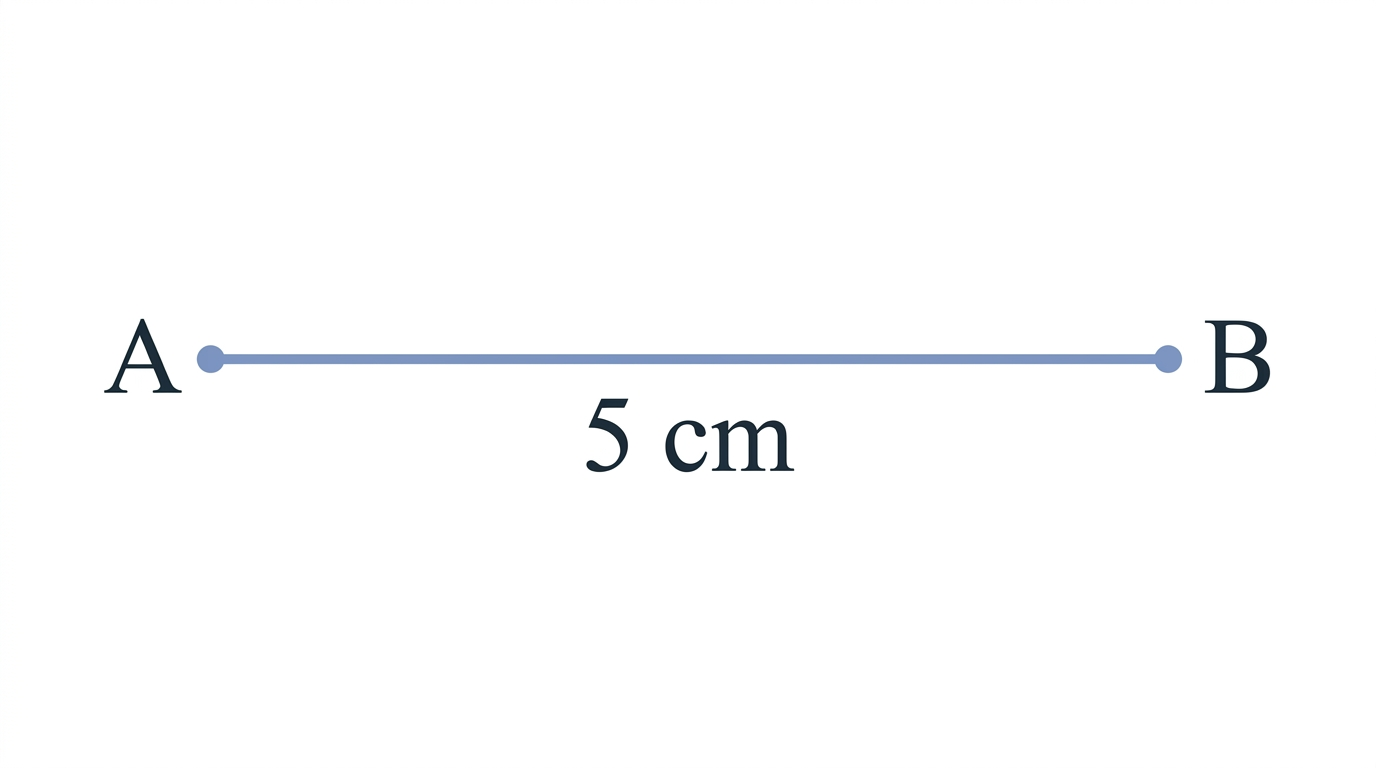
is the required triangle.
(b) is constructed with , , and .
(c) Construct a triangle for the measurements: , ,
Step 1 · Draw the Base
Draw a line segment .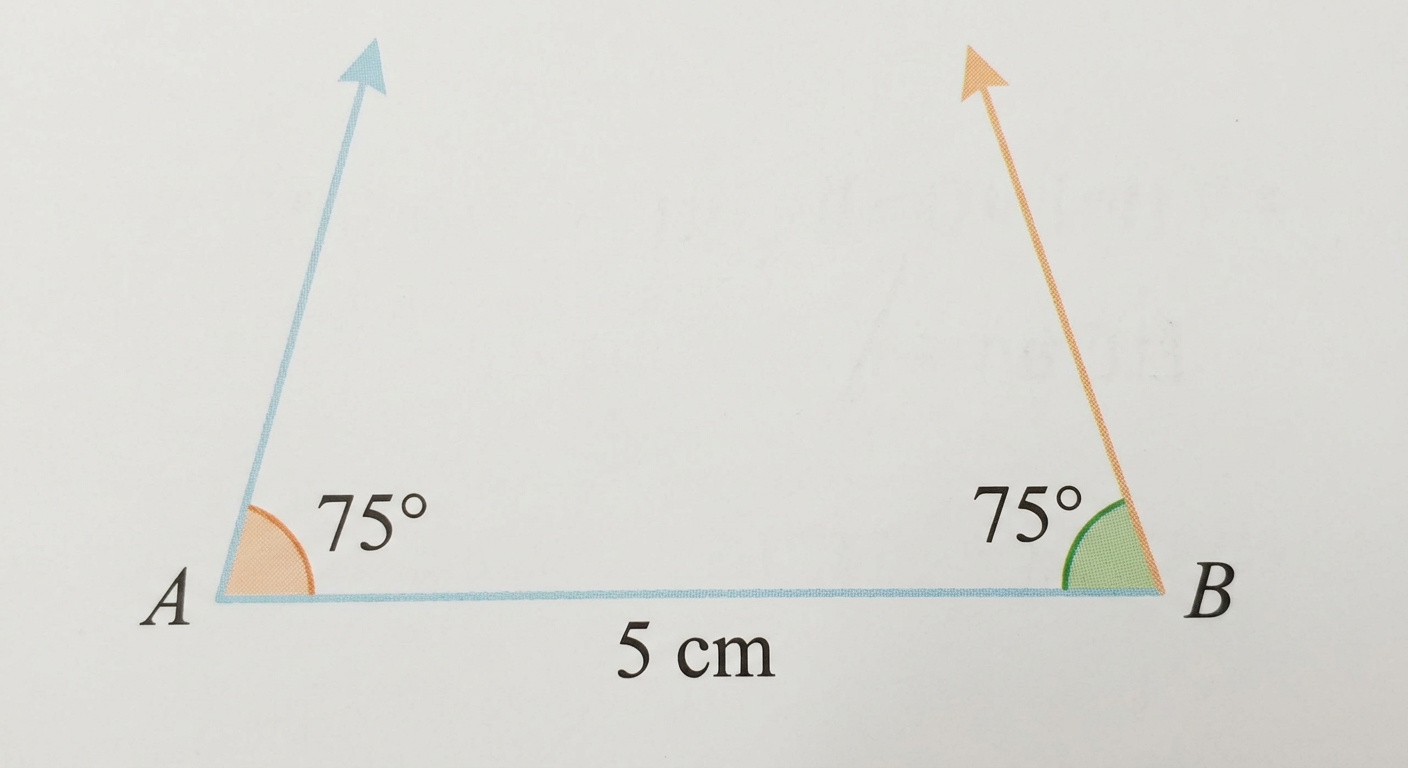
Step 2 · Construct the Base Angles
At point , construct an angle of .
At point , construct an angle of towards the same side of .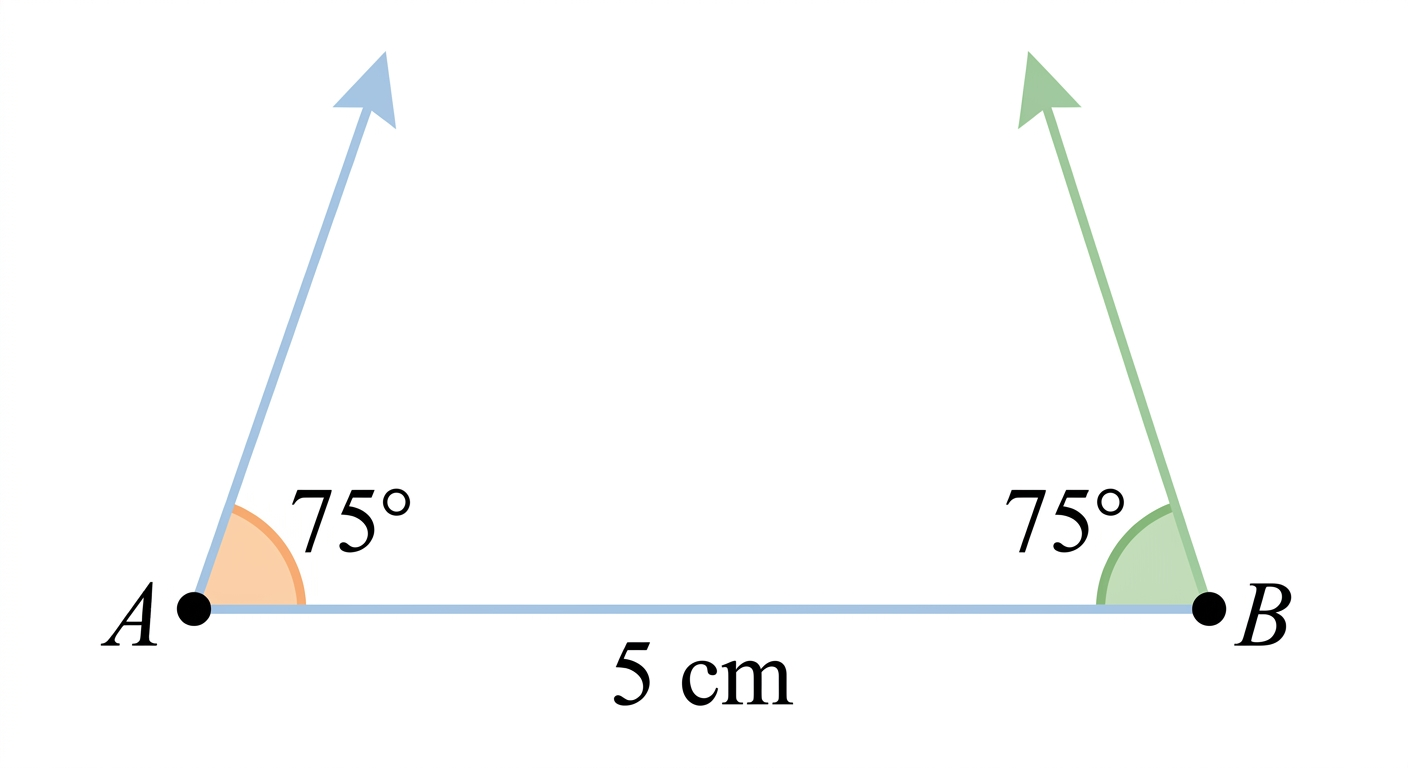
Step 3 · Locate the Third Vertex
Extend both rays until they meet at point . is the required triangle.
(c) is constructed with , , and .
- Angle Sum Condition: Failing to verify if the sum of the two given angles is strictly less than . If the sum is , the rays will never meet.
- Opposite Side Rays: Drawing rays on opposite sides of the base segment instead of the same side, preventing an intersection.
- Protractor Misreading: Misreading the inner/outer scale of a protractor when drawing obtuse angles such as (mistaking it for ).
More questions in FIO
Use the points on the circle and/or the centre to form isosceles triangles.
Use the points on the circles and/or their centres to form isosceles and equilateral triangles. The circles are of the same size.
We checked by construction that there are no triangles having sidelengths , and ; and , and . Check if you could have found this without trying to construct the triangle.
Can we say anything about the existence of a triangle for each of the following sets of lengths?
(a) , and
(b) , and
(c) , and
Which of the following lengths can be the sidelengths of a triangle? Explain your answers. Note that for each set, the three lengths have the same unit of measure.
(a) (b) (c) (d) (e) (f) (g)
Check if a triangle exists for each of the following set of lengths:
(a) 1, 100, 100
(b) 3, 6, 9
(c) 1, 1, 5
(d) 5, 10, 12
Does there exist an equilateral triangle with sides 50, 50, 50? In general, does there exist an equilateral triangle of any sidelength? Justify your answer.
For each of the following, give at least 5 possible values for the third length so there exists a triangle having these as sidelengths (decimal values could also be chosen):
(a) ,
(b) ,
(c) ,
See if you can describe all possible lengths of the third side in each case, so that a triangle exists with those sidelengths. For example, in case (a), all numbers strictly between and would be possible.
Construct triangles for the following measurements where the angle is included between the sides:
(a) , ,
(b) , ,
(c) , ,
Construct triangles for the following measurements:
(a) , ,
(b) , ,
(c) , ,
For each of the following angles, find another angle for which a triangle is (a) possible, (b) not possible. Find at least two different angles for each category:
(a)
(b)
(c)
(d)
Determine which of the following pairs can be the angles of a triangle and which cannot:
(a) ,
(b) ,
(c) ,
(d) ,
Find the third angle of a triangle (using a parallel line) when two of the angles are:
(a)
(b)
(c)
(d)
Can you construct a triangle all of whose angles are equal to ? If two of the angles are what would the third angle be? If all the angles in a triangle have to be equal, then what must its measure be? Explore and find out.
Here is a triangle in which we know and . Can you find and ?
Construct a triangle with , , . Construct an altitude from to .
Construct a triangle with , , . Construct an altitude from to .
Construct a right-angled triangle with , . How many different triangles exist with these measurements?
[Hint: Note that the other measurements can take any values. Take as the base. What values can and take so that the other angle is ?]
Through construction, explore if it is possible to construct an equilateral triangle that is: (i) right-angled (ii) obtuse-angled.
Also construct an isosceles triangle that is: (i) right-angled (ii) obtuse-angled.