Question 1
Given that all women are mortal, and suppose that A is a woman, what can we conclude about A?
- We are given two logical statements:
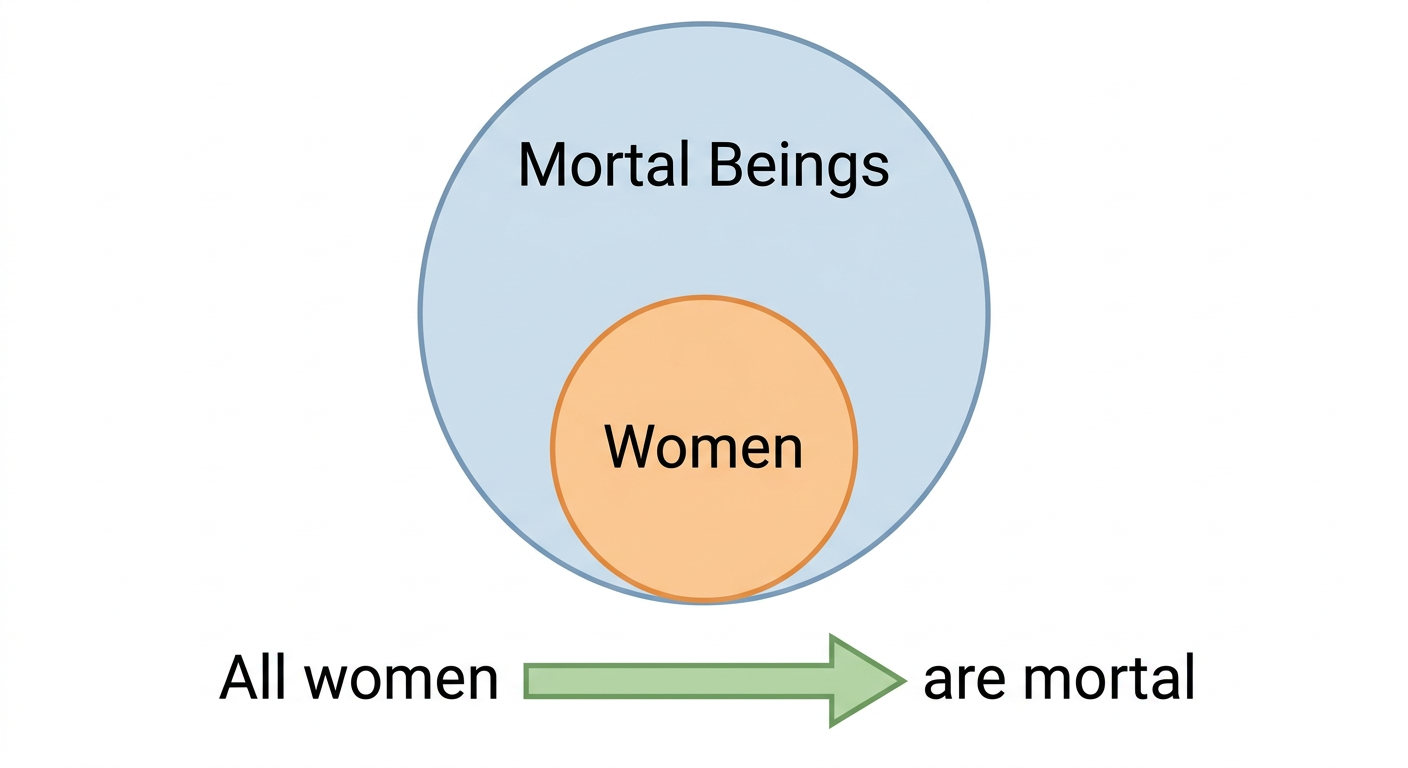
- Major premise (general rule): All women are mortal.
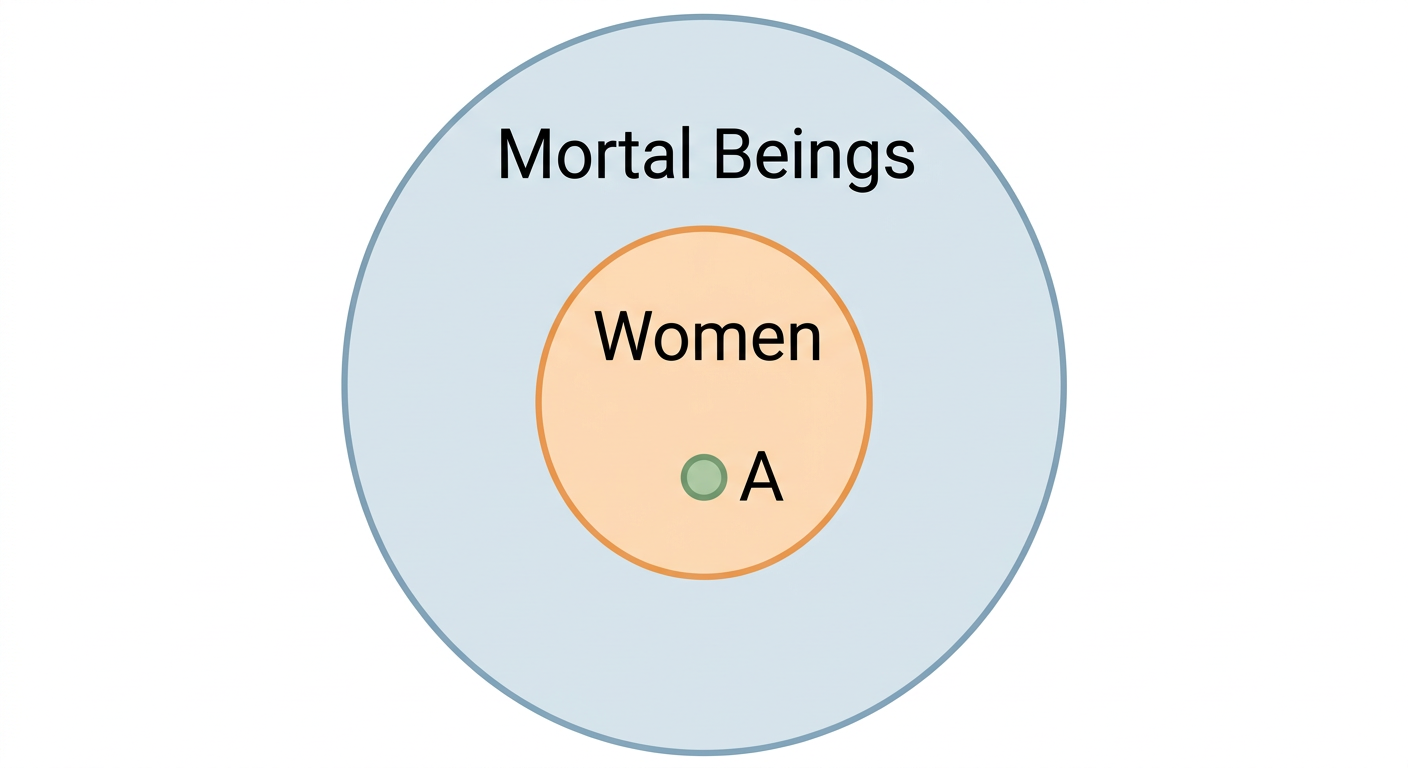
- Minor premise (specific fact): A is a woman.
- In deductive reasoning, if a general rule applies to an entire group and an individual belongs to that group, the rule must also apply to that individual.
- Therefore, we can deduce a definite conclusion about A.
Step 1 · Identify the Given Premises
We are given two premises:
-
General statement: All women are mortal.
-
Specific fact: A is a woman.
Step 2 · Deduce the Conclusion
Since A belongs to the group of women, and all women are mortal, it logically follows that:
A is mortal.
- Assuming the Converse: Incorrectly assuming that being mortal means someone is necessarily a woman. Deductive logic works from the whole group to the subset, not in reverse.
- Inductive vs. Deductive Confusion: Treating the deduction as an uncertain guess or generalization rather than a logically guaranteed fact based on the given premises.
More questions in A1.2
Given that all women are mortal, and suppose that A is a woman, what can we conclude about A?
Given that the product of two rational numbers is rational, and suppose and are rationals, what can you conclude about ?
Given that the decimal expansion of irrational numbers is non-terminating, non-recurring, and is irrational, what can we conclude about the decimal expansion of ?
Given that and , what can we conclude about the value of ?
Given that ABCD is a parallelogram and . What can you conclude about the other angles of the parallelogram?
Given that is a cyclic quadrilateral and also its diagonals bisect each other. What can you conclude about the quadrilateral?
Given that is irrational for all primes and also suppose that 3721 is a prime. Can you conclude that is an irrational number? Is your conclusion correct? Why or why not?