Question 5
Given that ABCD is a parallelogram and . What can you conclude about the other angles of the parallelogram?
- In a parallelogram:
- Opposite angles are equal: and .
- Adjacent (consecutive) angles are supplementary: They add up to (e.g., ).
- Given , we can find the remaining angles directly using these two geometric properties.
Step 1 · Find
In a parallelogram, opposite angles are equal.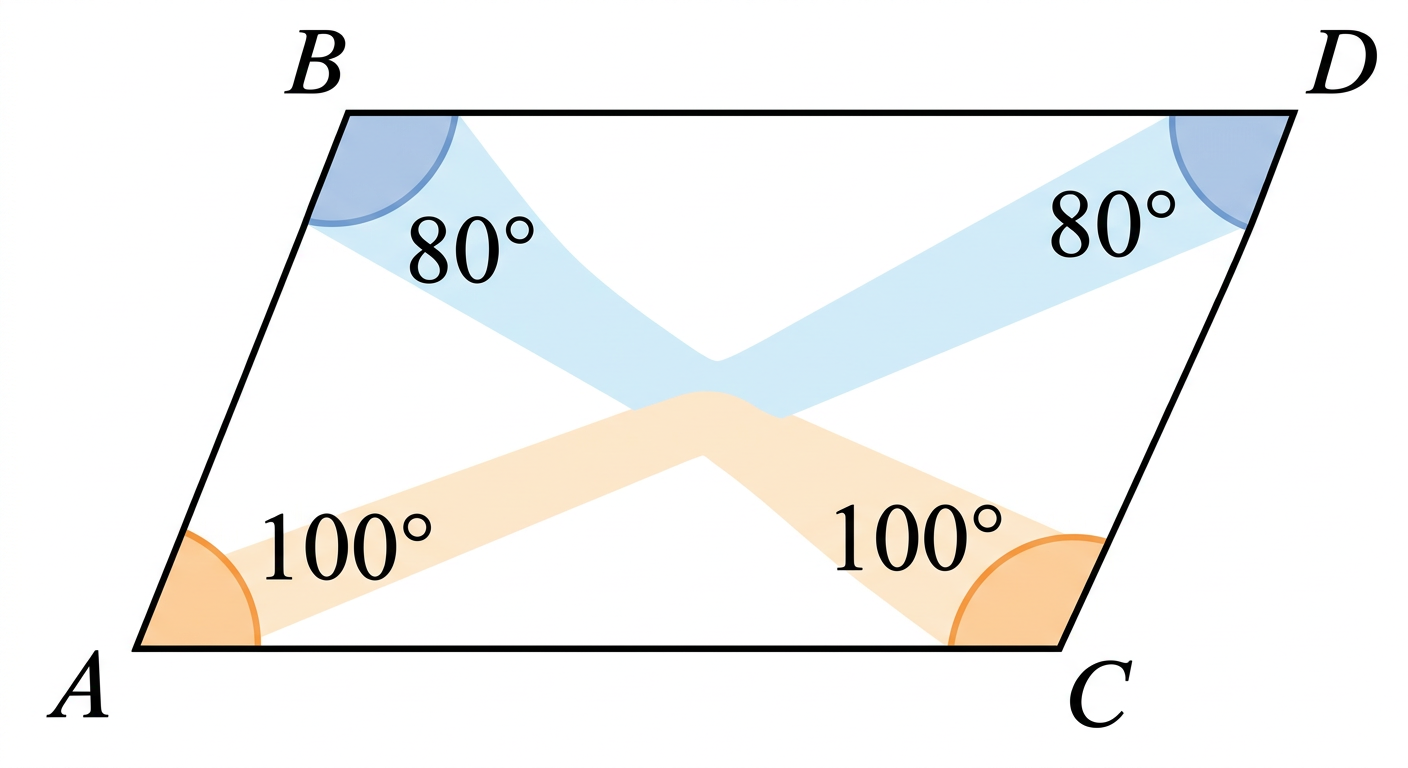
Given
Step 2 · Find
Consecutive angles in a parallelogram are supplementary:
Step 3 · Find
Since opposite angles are equal:
, , and
- Opposite vs. Adjacent Angle Rules: Confusing opposite angles (which are equal) with consecutive adjacent angles (which sum to ).
- Incorrect Angle Sum Assumption: Assuming all angles in a parallelogram must be equal to , which is only true for rectangles and squares.
More questions in A1.2
Given that all women are mortal, and suppose that A is a woman, what can we conclude about A?
Given that the product of two rational numbers is rational, and suppose and are rationals, what can you conclude about ?
Given that the decimal expansion of irrational numbers is non-terminating, non-recurring, and is irrational, what can we conclude about the decimal expansion of ?
Given that and , what can we conclude about the value of ?
Given that ABCD is a parallelogram and . What can you conclude about the other angles of the parallelogram?
Given that is a cyclic quadrilateral and also its diagonals bisect each other. What can you conclude about the quadrilateral?
Given that is irrational for all primes and also suppose that 3721 is a prime. Can you conclude that is an irrational number? Is your conclusion correct? Why or why not?