Question 4
What is the least possible radius of a circle through two points and ?
- Any circle passing through two points and must have its center equidistant from both points ().
- The locus of all points equidistant from and is the perpendicular bisector of the segment .
- The distance from the center to either point is minimized when the center is chosen as the midpoint of , making segment the diameter of the circle.
Step 1 · Position of the Circle's Center
Let be the center of a circle passing through points and .
Since is equidistant from and , must lie on the perpendicular bisector of the segment .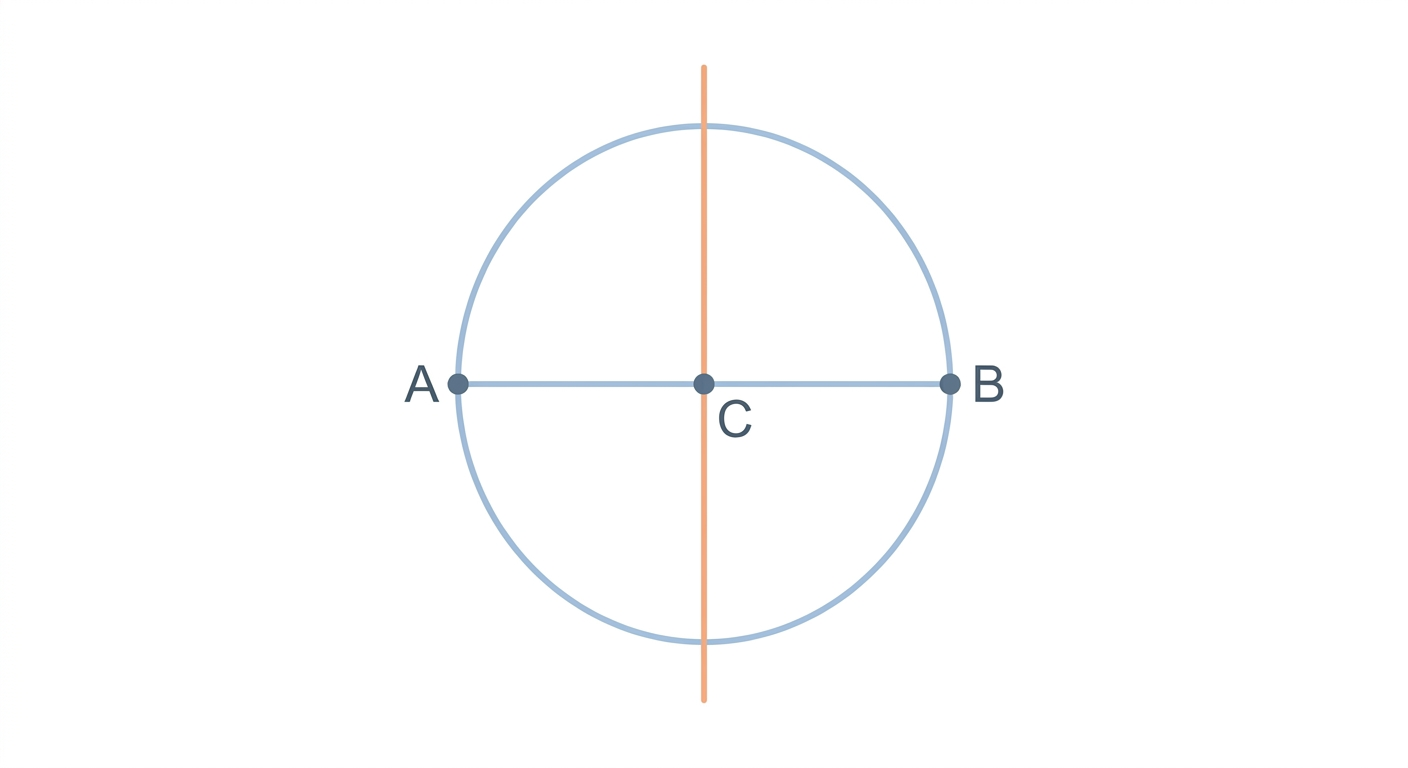
Step 2 · Find the Minimum Radius
The radius is minimized when the center is at the closest possible point to on the perpendicular bisector.
This occurs when is the midpoint of the segment , making the diameter of the circle.
- Confusing Radius with Diameter: Stating the least radius is rather than , mistakenly treating the segment length as the radius instead of the diameter.
- Unique Circle Misconception: Assuming only one circle can pass through two points; infinitely many circles can pass through and , but the circle with diameter has the smallest possible radius.
More questions in Exercise 5.1
Draw with , and . Draw the circumcircle of . Is the centre inside or outside the triangle?
Draw with , , . Draw the circumcircle of . Is the centre inside or outside the triangle?
Draw , with , and . Draw the circumcircle of . Let the circumcentre be . Measure , , .
What is the least possible radius of a circle through two points and ?