Question 6
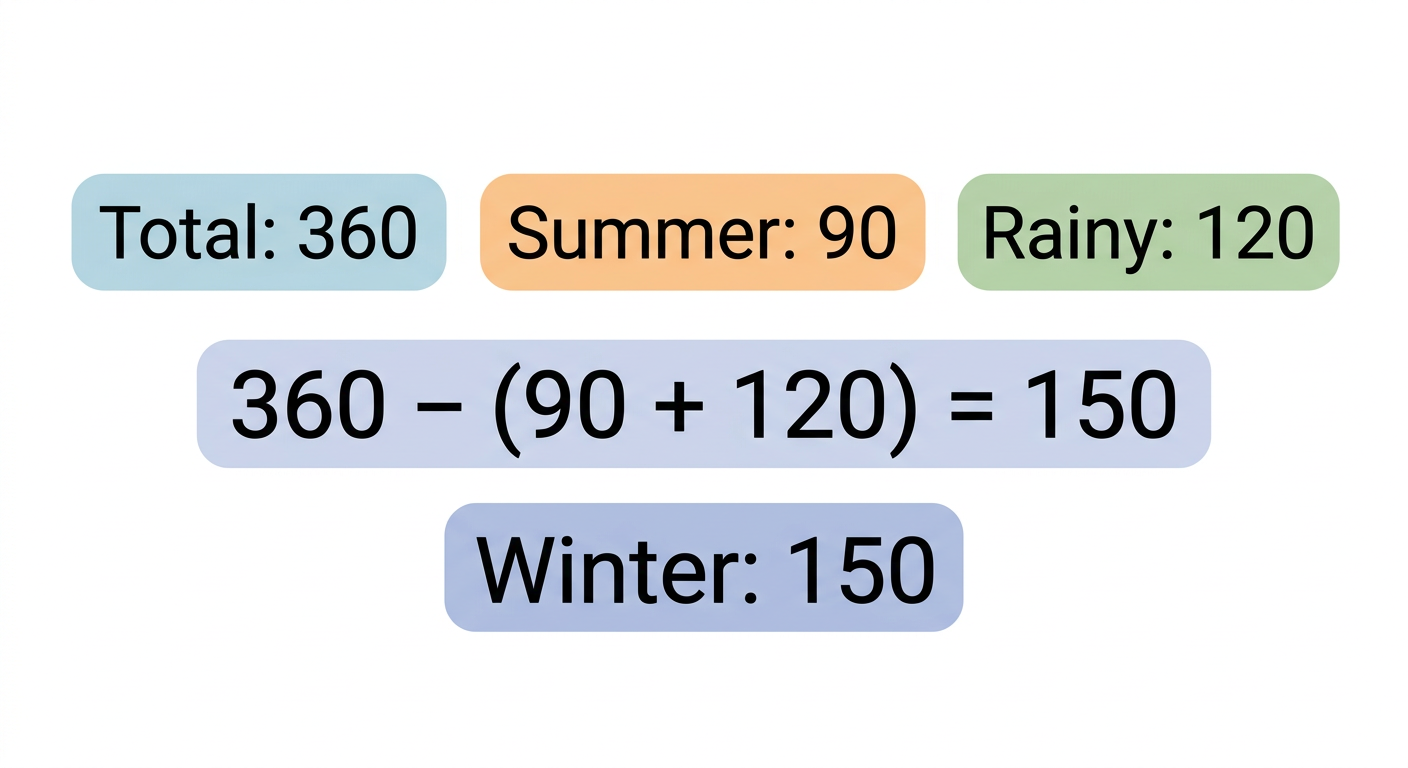
A group of 360 people were asked to vote for their favourite season from the three seasons — rainy, winter and summer. 90 liked the summer season, 120 liked the rainy season, and the rest liked the winter. Draw a pie chart to show this information.
- Total number of people surveyed .
- To represent the data in a pie chart, calculate the central angle for each sector corresponding to each season:
- First, find the number of people who preferred the winter season by subtracting the summer and rainy votes from the total.
Step 1 · Find the Number of People Who Liked Winter
Given:
Calculate the number of people who liked winter:
Step 2 · Calculate Central Angles and Draw Pie Chart
The central angle for a sector is calculated as:
For Summer:
For Rainy:
For Winter:
Check the sum of central angles:
The central angles for the pie chart are:
- Summer:
- Rainy:
- Winter:
- Sum of Angles Verification: Forgetting to verify that all central angles add up to ().
- Frequency vs. Angle Confusion: Assuming the central angle is always numerically equal to the frequency. Here, it matches only because the total number of people happens to be .
More questions in FIO
A cricket coach schedules practice sessions that include different activities in a specific ratio — time for warm-up/cool-down : time for batting : time for bowling : time for fielding :: . If each session is 150 minutes long, how much time is spent on each activity?
A school library has books in different languages in the following ratio — . If the library has 288 Odiya books, how many Hindi and English books does it have?
I have coins in the ratio — no. of coins : no. of coins : no. of coins : no. of coins . How much money do I have in coins?
Construct a triangle with sidelengths in the ratio . Will all the triangles drawn with this ratio of sidelengths be congruent to each other? Why or why not?
Can you construct a triangle with sidelengths in the ratio ? Why or why not?
A group of 360 people were asked to vote for their favourite season from the three seasons — rainy, winter and summer. 90 liked the summer season, 120 liked the rainy season, and the rest liked the winter. Draw a pie chart to show this information.
Draw a pie chart based on the following information about viewers’ favourite type of TV channel: Entertainment — , Sports — , News — , Information — .
Prepare a pie chart that shows the favourite subjects of the students in your class. You can collect the data of the number of students for each subject shown in the table (each student should choose only one subject). Then write these numbers in the table and construct a pie chart:
Which of these are in inverse proportion?
Fill in the empty cells if and are in inverse proportion.
Which of the following pairs of quantities are in inverse proportion?
(i) The number of taps filling a water tank and the time taken to fill it.
(ii) The number of painters hired and the days needed to paint a wall of fixed size.
(iii) The distance a car can travel and the amount of petrol in the tank.
(iv) The speed of a cyclist and the time taken to cover a fixed route.
(v) The length of cloth bought and the price paid at a fixed rate per metre.
(vi) The number of pages in a book and the time required to read it at a fixed reading speed.
If 24 pencils cost ₹120, how much will 20 such pencils cost?
A tank on a building has enough water to supply 20 families living there for 6 days. If 10 more families move in there, how long will the water last? What assumptions do you need to make to work out this problem?
Fill in the average number of hours each living being sleeps in a day by looking at the charts. Select the appropriate hours from this list: 15, 2.5, 20, 8, 3.5, 13, 10.5, 18.
The pie chart on the right shows the result of a survey carried out to find the modes of transport used by children to go to school. Study the pie chart and answer the following questions.
(i) What is the most common mode of transport?
(ii) What fraction of children travel by car?
(iii) If 18 children travel by car, how many children took part in the survey? How many children use taxis to travel to school?
(iv) By which two modes of transport are equal numbers of children travelling?
Three workers can paint a fence in 4 days. If one more worker joins the team, how many days will it take them to finish the work? What are the assumptions you need to make?
It takes 6 hours to fill 2 tanks of the same size with a pump. How long will it take to fill 5 such tanks with the same pump?
A given set of chairs are arranged in 25 rows, with 12 chairs in each row. If the chairs are rearranged with 20 chairs in each row, how many rows does this new arrangement have?
A school has 8 periods a day, each of 45 minutes duration. How long is each period, if the school has 9 periods a day, assuming that the number of school hours per day stays the same?
A small pump can fill a tank in 3 hours, while a large pump can fill the same tank in 2 hours. If both pumps are used together, how long will the tank take to fill?
A factory requires 42 machines to produce a given number of toys in 63 days. How many machines are required to produce the same number of toys in 54 days?
A car takes 2 hours to reach a destination, travelling at a speed of . How long will the car take if it travels at a speed of ?