Question 10
What about a pyramid with three rows?
Using letter numbers for the bottom row, we can write an expression for the top row.
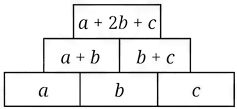
- In an addition pyramid, the value of each block is the sum of the two blocks directly supporting it underneath.
- For a 3-row pyramid:
- Bottom row: 3 blocks
- Middle row: 2 blocks
- Top row: 1 block
- By assigning variables to the bottom row, we build up each row algebraically until we obtain the simplified expression for the top block.
Step 1 · Label the Bottom Row
Let the three blocks in the bottom row be labeled from left to right as , , and .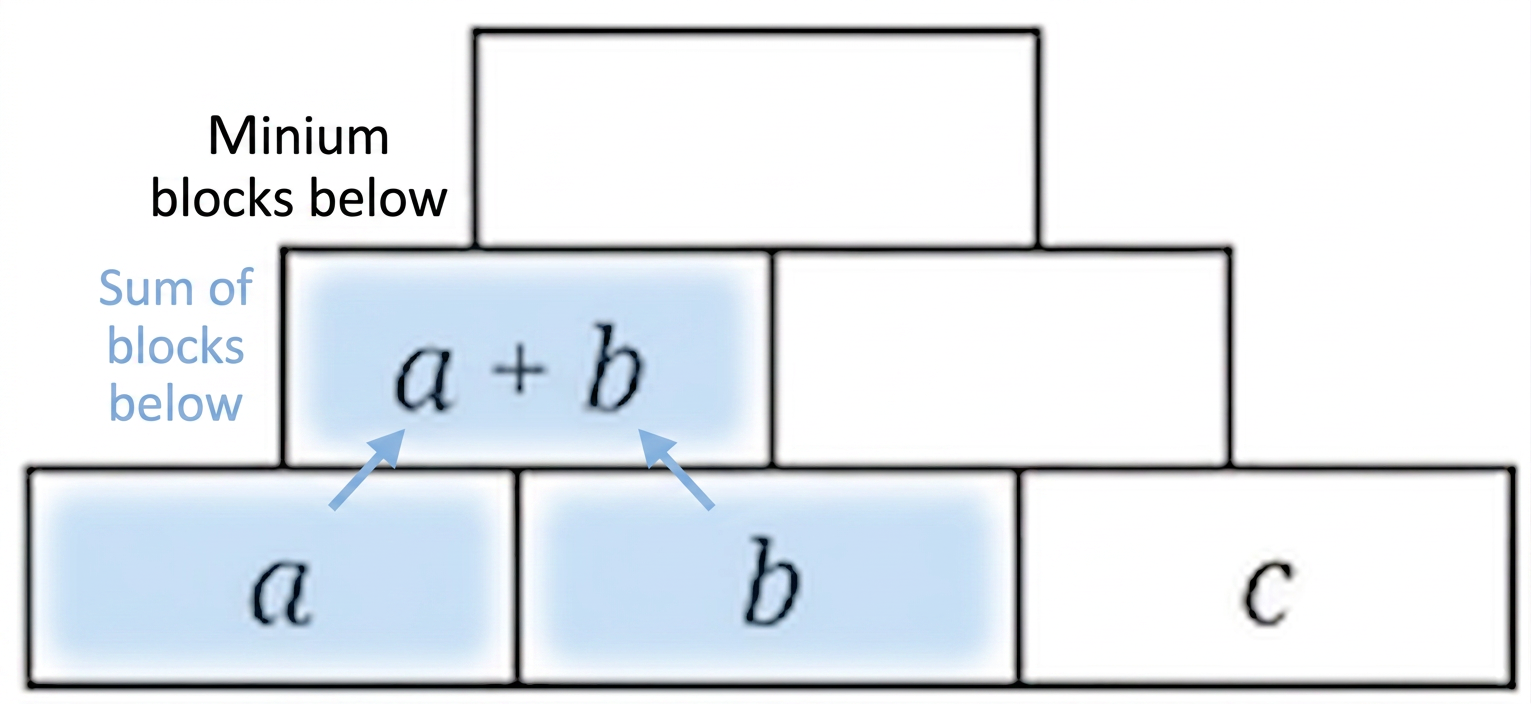
Step 2 · Calculate the Second Row
Each block in the second row is the sum of the two blocks directly below it.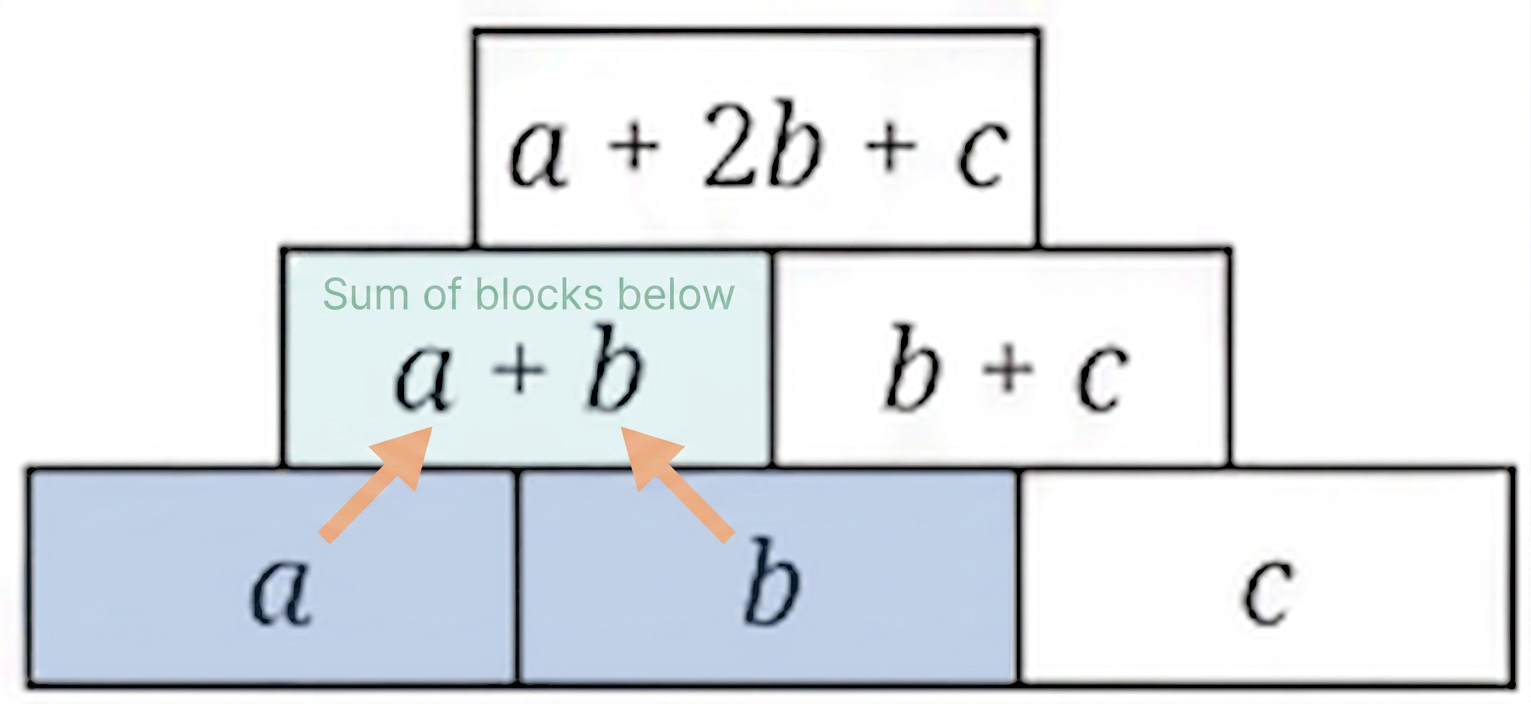
Step 3 · Find and Simplify the Top Block
The top block is the sum of the two blocks in the second row:
Combining like terms:
- Under-counting the middle variable: Forgetting that the middle block is shared by both blocks in the second row, which contributes (not just ) to the top.
- Confusing addition with multiplication: Writing as instead of .
More questions in IT
Context: Think of a number trick:
- Think of a number.
- Double it.
- Add four.
- Divide by two.
- Subtract the original number you thought of.
Q. I predict you get 2. Am I right? Try it out with different starting numbers. Do you always end up with the same value, 2? Why?
Context: Consider the following number trick:
- Think of a number.
- Double it.
- Add four.
- Divide by two.
- Subtract the original number you thought of. (This trick always results in 2).
Q. How would you change this game to make the final answer 3? What about 5?
Context: Consider the following number trick:
- Think of a number.
- Double it.
- Add four.
- Divide by two.
- Subtract the original number you thought of. (This trick always results in ).
Q. Can you come up with more complicated steps that always lead to the same final value?
Context: In the date trick, the final answer is given by , where is the month and is the day.
Q. Find the dates if the final answers are the following:
(i) 1269
(ii) 394
(iii) 296
Context: In the date trick, the final answer is given by , where is the month and is the day.
Q. Can you change the steps in this trick and still find the original date? Instead of subtracting 165 from the final answer, you might have to subtract some other number.
Try to devise your own 'Think of a Number' trick.
Use the same rule to fill these pyramids:
Fill the following pyramids:
What is the relationship between the numbers in the bottom row and the number at the top?
Let us start with the simplest pyramid.
What about a pyramid with three rows?
Using letter numbers for the bottom row, we can write an expression for the top row.
In the following grids, find the values of the shapes and fill in the empty squares:
Context: 6.5 The Largest Product
Q. Fill the digits 2, 3, and 5 in , using each digit once. What is the largest product possible?
Context: Mukta's trick: Choose a 2-digit number of different digits, reverse the digits to get another number, find their difference, and divide the result by 9.
Q. If we choose other 2-digit numbers, and follow the steps, will there always be no remainder?
Context: Suppose a two-digit number is . When it is reversed, the new number is . If , the difference is , which is divisible by 9.
Q. Can you work out what happens if ?