Question 18
Your bank balance was . You make at your business the next day.
Q. What is your balance now?
- An initial bank balance of represents a debt or negative amount of .
- Making/earning adds a positive amount of to the account.
- The new balance is found by adding the money earned to the initial balance: .
Step 1 · Represent the Initial Balance
Initial bank balance , which represents a debt of .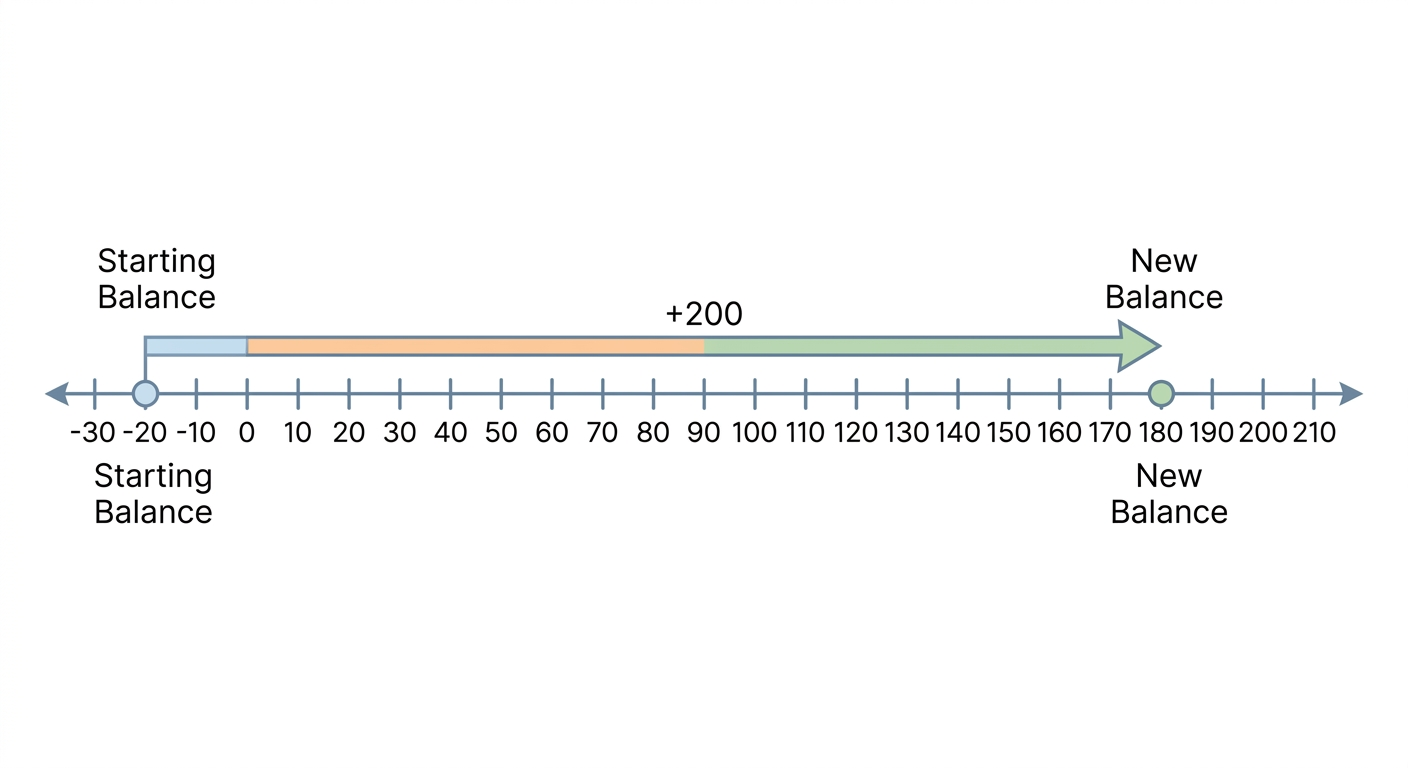
Step 2 · Add the Earnings to Calculate the New Balance
Money earned .
Adding this to the starting balance corresponds to moving units to the right from on the number line.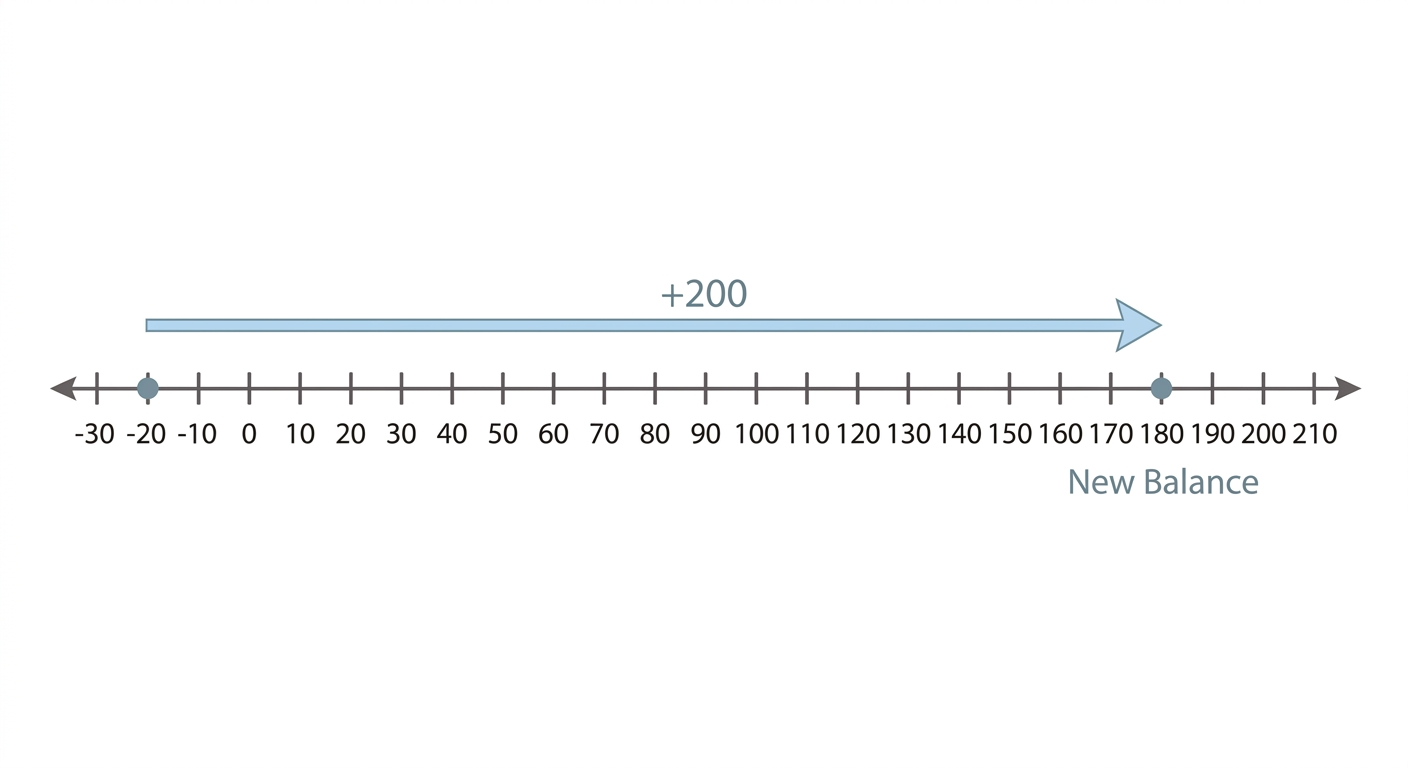
- Ignoring the Negative Sign: Adding the absolute values () instead of recognizing that is negative, which gives .
- Sign Error in the Result: Writing instead of , forgetting that the positive earnings () are greater than the negative debt ().
More questions in IT
Can there be a number less than ? Can you think of any ways to have less than of something?
Observe that some of the floors in the 'Building of Fun' are below the ground. What are the shops that you find on these floors? What is there on the ground floor?
In Bela's Building of Fun, a lift is used to go up and down between the floors. It has two buttons: '+' to go up and '-' to go down. Pressing '+' once goes up one floor (+1), and pressing '-' once goes down one floor (-1).
Q. What do you press to go four floors up? What do you press to go three floors down?
Number all the floors in the Building of Fun.
Start from the Food Court and press in the lift. Where will you reach?
If Basant now presses and then presses in the lift, where will he reach?
Write the inverses of these numbers: , , , , , .
Connect the inverses by drawing lines.
Comparing numbers using floors
Who is on the lowest floor?
Should we write or ?
Evaluate , and from this perspective.
In the other exercises that you did above, did you notice that subtracting a negative number was the same as adding the corresponding positive number?
Take a look at the 'infinite lift' above. Does it remind you of a number line? In what ways?
Use unmarked number lines to evaluate these expressions:
Suppose you open a bank account at your local bank with the ₹100 that you had been saving over the last month. Your bank balance therefore, starts at ₹100. Then you make ₹60 at your job the next day and you deposit it in your account. This is shown in your bank passbook as a 'credit'.
Q. Your new bank balance is _______.
Suppose you open a bank account with a starting balance of ₹100 and deposit ₹60 (making the balance ₹160). The next day you pay your electric bill of ₹30 using your bank account. This is shown in your bank passbook as a 'debit'.
Q. Your bank balance is now _______.
Suppose you open a bank account with a starting balance of ₹100, deposit ₹60 (making the balance ₹160), and pay an electric bill of ₹30 (making the balance ₹130). The next day you make a major purchase for your business of ₹150. Again this is shown as a debit.
Q. What is your bank balance now? _______
Is this possible?
Your bank balance was . You make at your business the next day.
Q. What is your balance now?