Question 4
Is the following situation possible? If so, determine their present ages.
The sum of the ages of two friends is years. Four years ago, the product of their ages in years was .
- Let the present age of the first friend be years. Since the sum of their ages is years, the present age of the other friend is years.
- Express their ages years ago and set their product equal to to form a quadratic equation .
- Evaluate the discriminant . If , the equation has no real roots, meaning the situation is not mathematically possible.
Step 1 · Formulate the Quadratic Equation
Let the present age of the first friend be years. Present age of the second friend .
Four years ago:
- Age of first friend
- Age of second friend
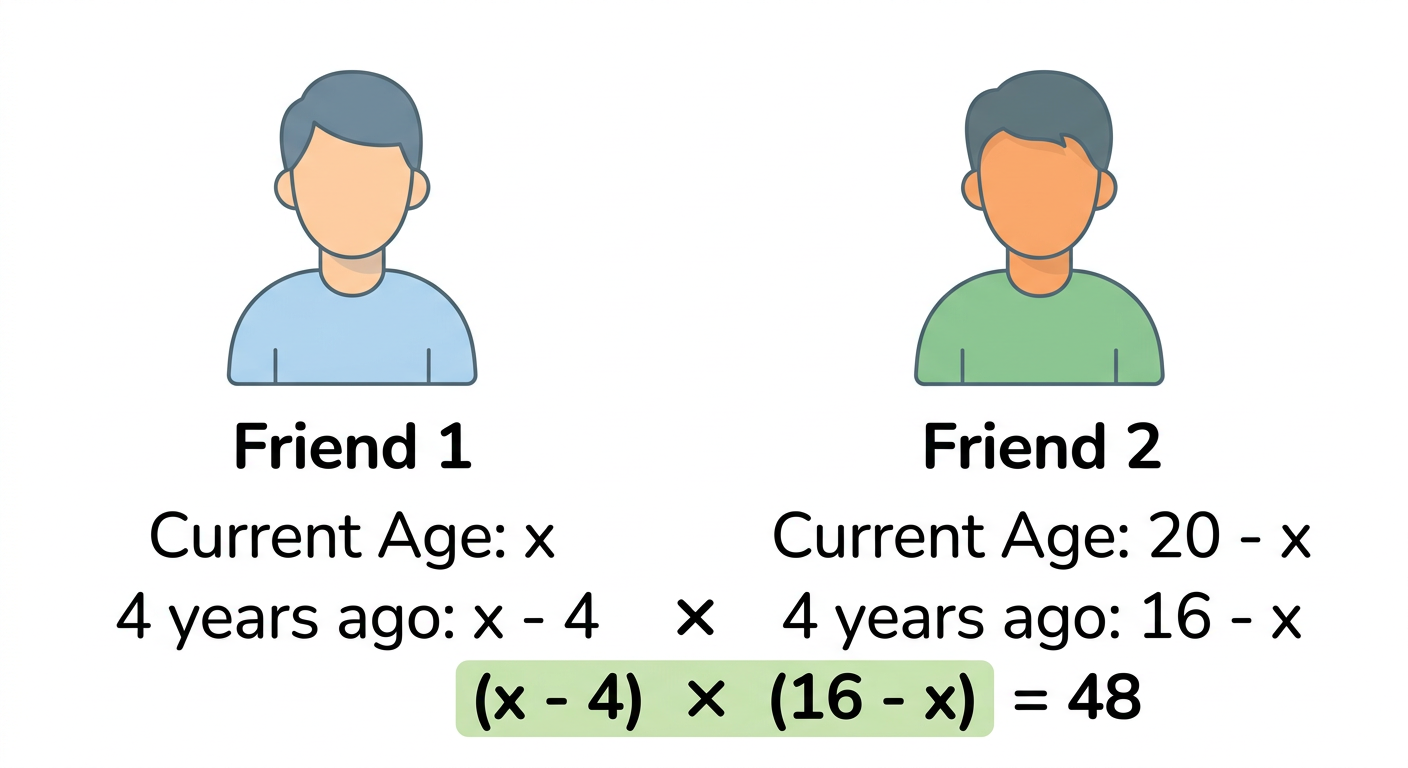
Given that the product of their ages four years ago was :
Step 2 · Check the Discriminant for Real Roots
Comparing with :
Calculate the discriminant :
Since , the quadratic equation has no real roots. Therefore, the given situation is not possible.
The given situation is not possible.
- Past Age Formulation: Forgetting to subtract from both friends' ages, or writing instead of .
- Sign Errors in Squaring: Incorrectly calculating as instead of .
- Interpreting the Discriminant: Overlooking that a negative discriminant () means no real roots exist, indicating that the described real-world scenario is impossible.
More questions in Exercise 4.3
Find the nature of the roots of the following quadratic equations. If the real roots exist, find them:
(i)
(ii)
(iii)
Find the values of for each of the following quadratic equations, so that they have two equal roots.
(i)
(ii)
Is it possible to design a rectangular mango grove whose length is twice its breadth, and the area is ? If so, find its length and breadth.
Is the following situation possible? If so, determine their present ages.
The sum of the ages of two friends is years. Four years ago, the product of their ages in years was .
Is it possible to design a rectangular park of perimeter and area ? If so, find its length and breadth.