Quadratic Equations | Exercise 4.3

Question 5

Is it possible to design a rectangular park of perimeter 80 m80\text{ m} and area 400 m2400\text{ m}^2? If so, find its length and breadth.

Check your answer with HomiSolve it yourself, then let Homi check your steps and spot mistakes.
Solution
Understand the Question
  • Let the length of the rectangular park be LL and the breadth be BB.
  • Given perimeter =2(L+B)=80 m    L+B=40 m= 2(L + B) = 80\text{ m} \implies L + B = 40\text{ m}.
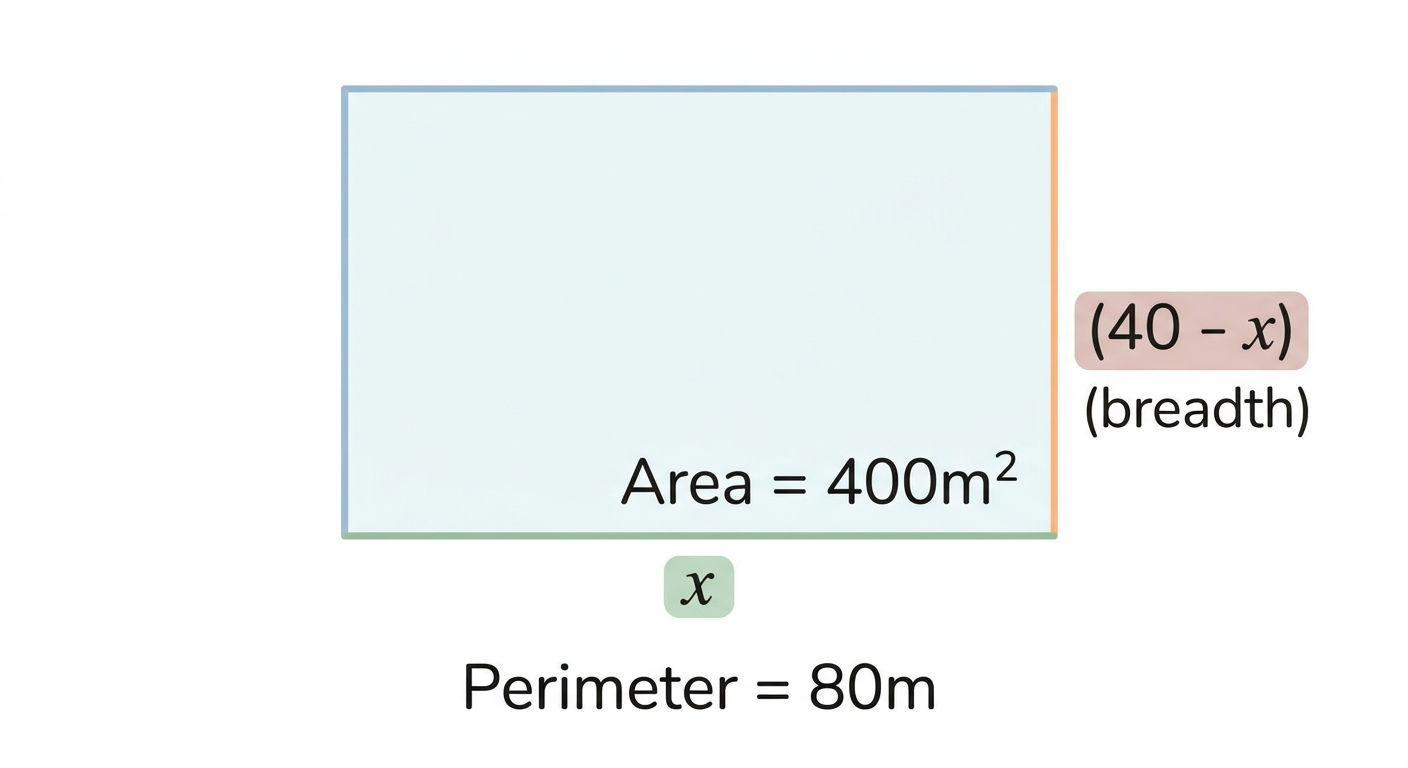
  • If length is x mx\text{ m}, breadth becomes (40x) m(40 - x)\text{ m}.
  • The area is given by Length×Breadth=x(40x)=400 m2\text{Length} \times \text{Breadth} = x(40 - x) = 400\text{ m}^2.
  • Setting up this quadratic equation lets us check whether real dimensions exist to determine if designing such a park is possible.

Step 1 · Express Dimensions in Terms of a Variable

Let the length be LL and breadth be BB.Diagram 1

Given Perimeter=2(L+B)=80 m\text{Perimeter} = 2(L + B) = 80\text{ m}

L+B=40L + B = 40

Let Length=x m\text{Length} = x\text{ m}, then Breadth=(40x) m\text{Breadth} = (40 - x)\text{ m}

Step 2 · Form the Quadratic Equation

Given Area=400 m2\text{Area} = 400\text{ m}^2

Length×Breadth=400\text{Length} \times \text{Breadth} = 400

x(40x)=400x(40 - x) = 400

40xx2=400x240x+400=0\begin{aligned} 40x - x^2 &= 400 \\[0.6em] x^2 - 40x + 400 &= 0 \end{aligned}

Step 3 · Solve the Quadratic Equation

Solving by factorisation

x220x20x+400=0x(x20)20(x20)=0(x20)(x20)=0(x20)2=0x20=0x=20\begin{aligned} x^2 - 20x - 20x + 400 &= 0 \\[0.6em] x(x - 20) - 20(x - 20) &= 0 \\[0.6em] (x - 20)(x - 20) &= 0 \\[0.6em] (x - 20)^2 &= 0 \\[0.6em] x - 20 &= 0 \\[0.6em] x &= 20 \end{aligned}

Step 4 · Determine Length and Breadth

Since real and equal roots exist (D=(40)24(1)(400)=0D = (-40)^2 - 4(1)(400) = 0), it is possible to design the park.

Length=x=20 m\text{Length} = x = 20\text{ m}

Breadth=40x=4020=20 m\text{Breadth} = 40 - x = 40 - 20 = 20\text{ m}

Answer

Yes, it is possible.

Length=20 m,Breadth=20 m\text{Length} = 20\text{ m}, \quad \text{Breadth} = 20\text{ m}

Common Mistakes
  • Square vs. Rectangle Confusion: Thinking length and breadth cannot both be 20 m20\text{ m}. A square is a special type of rectangle where all sides are equal.
  • Perimeter Formula Error: Writing L+B=80L + B = 80 instead of 2(L+B)=802(L + B) = 80, which incorrectly gives L+B=80L + B = 80 instead of 4040.
  • Sign Errors: Incorrectly rearranging 40xx2=40040x - x^2 = 400 into x2+40x+400=0x^2 + 40x + 400 = 0 instead of x240x+400=0x^2 - 40x + 400 = 0.

More questions in Exercise 4.3

Q1

Find the nature of the roots of the following quadratic equations. If the real roots exist, find them:

(i) 2x23x+5=02x^2 - 3x + 5 = 0

(ii) 3x243x+4=03x^2 - 4\sqrt{3}x + 4 = 0

(iii) 2x26x+3=02x^2 - 6x + 3 = 0

Q2

Find the values of kk for each of the following quadratic equations, so that they have two equal roots.

(i) 2x2+kx+3=02x^2 + kx + 3 = 0

(ii) kx(x2)+6=0kx (x - 2) + 6 = 0

Q3

Is it possible to design a rectangular mango grove whose length is twice its breadth, and the area is 800 m2800 \text{ m}^2? If so, find its length and breadth.

Q4

Is the following situation possible? If so, determine their present ages.

The sum of the ages of two friends is 2020 years. Four years ago, the product of their ages in years was 4848.

Q5

Is it possible to design a rectangular park of perimeter 80 m80\text{ m} and area 400 m2400\text{ m}^2? If so, find its length and breadth.

← Back to Quadratic Equations