The World of Numbers | Exercise 3.3
Question 6
Show that:
Solution
Understand the Question
- This problem demonstrates the distributive property of multiplication over addition: .
- To show that both sides are equal, we evaluate them independently:
- Left Hand Side (LHS): Add the fractions inside the bracket first, then multiply by .
- Right Hand Side (RHS): Perform each multiplication separately, then add the resulting fractions.
- If both calculations result in the same value, the equality is verified.
Step 1 · Calculate the Left Hand Side (LHS)
First, add the fractions inside the bracket using a common denominator of :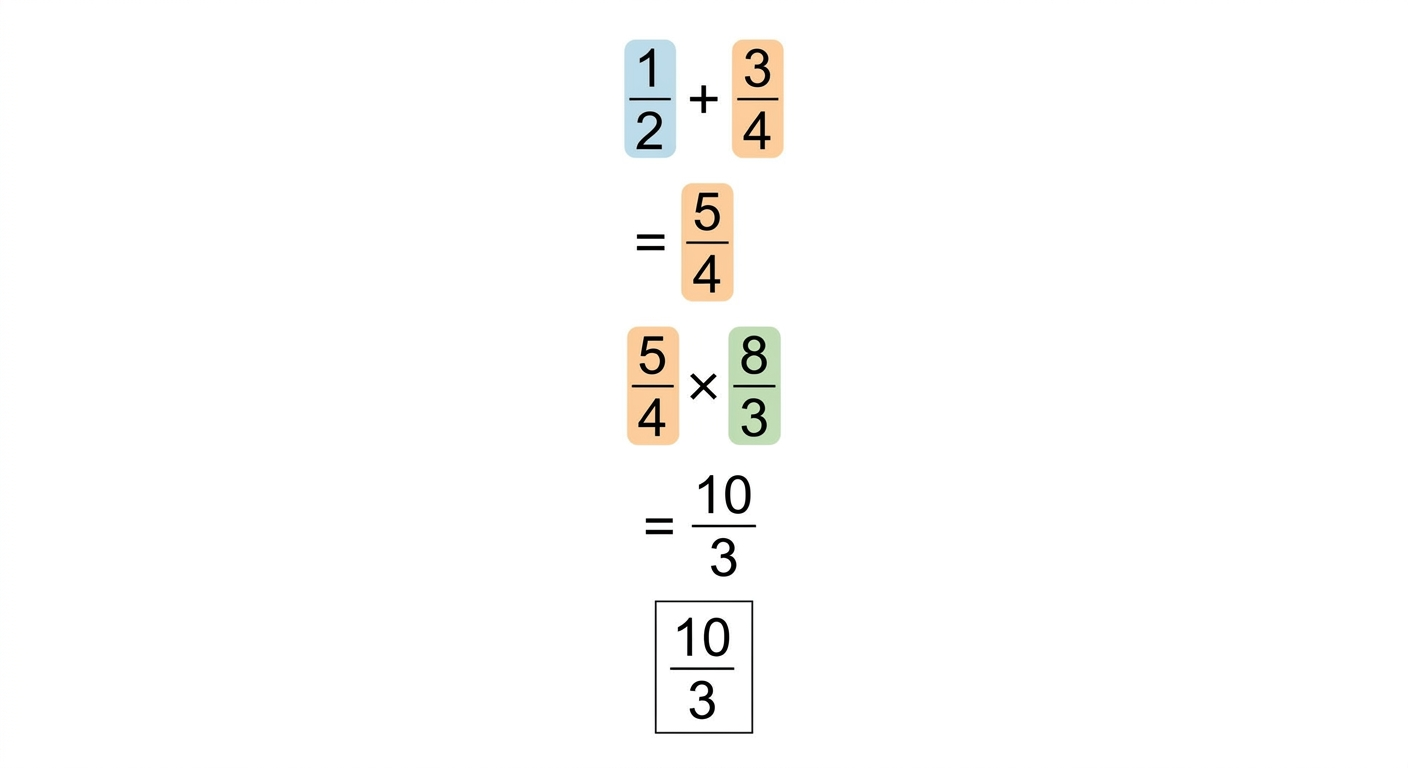
Now, multiply by :
Step 2 · Calculate the Right Hand Side (RHS)
Evaluate each multiplication term separately:
Now, add the two terms:
From and , .
Answer
Since , the statement is verified:
Common Mistakes
- Adding Denominators Directly: Adding fractions incorrectly by adding tops and bottoms directly (e.g. ). Always find the common denominator first.
- Order of Operations: In RHS, adding before multiplying violates the order of operations (BODMAS/PEMDAS). Each multiplication must be evaluated before performing the addition.
- Incomplete Simplification: Leaving fractions unsimplified (such as or ), which makes comparing LHS and RHS more difficult.
More questions in Exercise 3.3
Q1Q2Q3Q4Q5Q6
Q7
Q8
Prove that the following rational numbers are equal:
(i) and
(ii) and
(iii) and
(iv) and
Find the sum:
(i)
(ii)
(iii)
Find the difference:
(i)
(ii)
(iii)
Find the product:
(i)
(ii)
(iii)
Find the quotient:
(i)
(ii)
(iii)
Show that:
Simplify the following using the distributive property:
Find the rational number such that: