Question 2
Find the sum:
(i)
(ii)
(iii)
- To add fractions with different denominators, find the Least Common Multiple (LCM) of the denominators to determine a common denominator.
- Convert each fraction into an equivalent fraction having this common denominator.
- Add or subtract the numerators while keeping the common denominator, paying careful attention to negative signs.
(i) Find the sum:
Step 1 · Find Common Denominator and Add
LCM of denominators and is .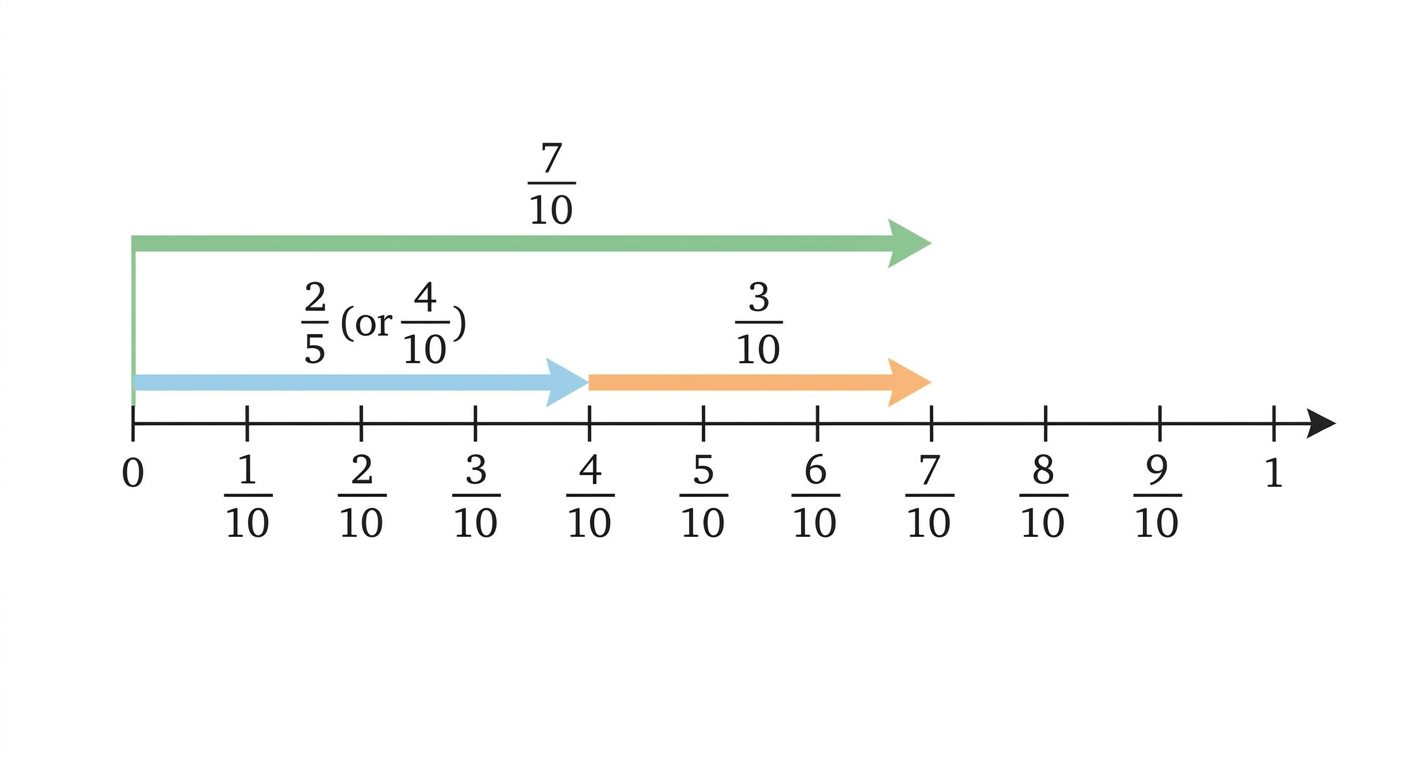
Convert to an equivalent fraction with denominator
Now, add the fractions
(i)
(ii) Find the sum:
Step 1 · Find Common Denominator and Add
LCM of denominators and is .
Convert each fraction to have a denominator of
Now, add the fractions
(ii)
(iii) Find the sum:
Step 1 · Find Common Denominator and Add
LCM of denominators and is .
Convert to an equivalent fraction with denominator
Now, add the fractions
(iii)
- Direct Addition of Denominators: Adding both numerators and denominators directly (e.g., ) instead of converting to a common denominator first.
- Sign Errors in Numerator Addition: Forgetting rules for negative integers when evaluating , which gives rather than or .
More questions in Exercise 3.3
Prove that the following rational numbers are equal:
(i) and
(ii) and
(iii) and
(iv) and
Find the sum:
(i)
(ii)
(iii)
Find the difference:
(i)
(ii)
(iii)
Find the product:
(i)
(ii)
(iii)
Find the quotient:
(i)
(ii)
(iii)
Show that:
Simplify the following using the distributive property:
Find the rational number such that: