Question 7
Fig. 8.12 shows Stages 0 to 3 of the Sierpiński square carpet. Stage 0 of this fractal is a square sheet of paper. To construct Stage 1, each side of the square is trisected and the points of trisection of opposite sides are joined to obtain nine smaller squares. The centre square is then removed and the 8 smaller squares are retained, leaving a square hole in the centre. The same process is repeated on the eight smaller shaded squares to obtain Stage 2 and so on.
Look at Fig. 8.12 and try to answer the following questions.
(i) How many red squares are there in Stages 0 to 3? (ii) Can you predict the number of red squares in Stages 4 and 5? (iii) Can you find a rule for the number of red squares at the stage? Write the explicit formula as well as the recursive formula for the number of red squares at any stage. (iv) Suppose the area of the square in Stage 0 is 1 square unit. What is the area of the red region in Stages 1, 2 and 3? What will be the area of the red region in Stages 4 and 5? Find the explicit as well as the recursive formula for the area of the red region at the stage. What happens to this area as , the number of stages, goes on increasing?
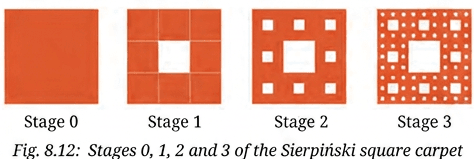
- The Sierpiński carpet is constructed recursively starting from a unit square (Stage 0).
- At each step, every retained square is divided into equal smaller squares and the central square is removed, leaving squares behind.
- Thus, at each subsequent stage:
- The number of red squares is multiplied by .
- The area of the red region is multiplied by .
(i) How many red squares are there in Stages 0 to 3?
Step 1 · Count Red Squares in Stages 0 to 3
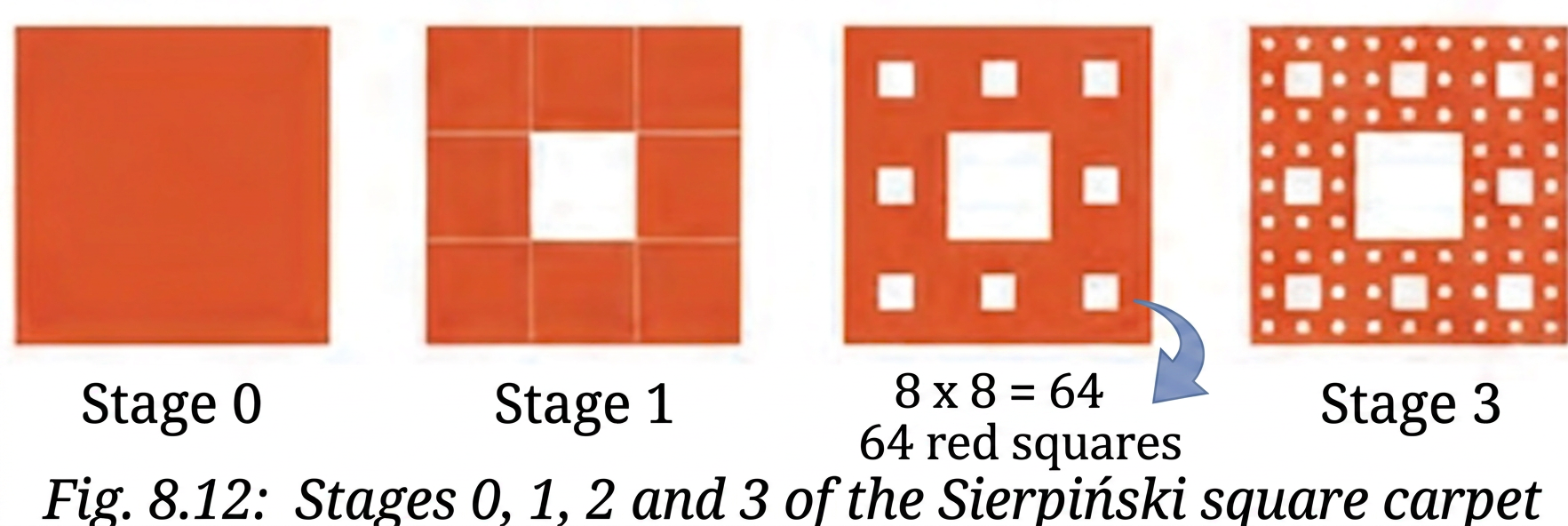
At Stage 0:
At Stage 1 (divided into squares, center square removed):
At Stage 2 (each of the squares yields smaller squares):
At Stage 3:
(i) Stage 0: , Stage 1: , Stage 2: , Stage 3:
(ii) Can you predict the number of red squares in Stages 4 and 5?
Step 1 · Calculate Number of Squares for Stages 4 and 5
At Stage 4:
At Stage 5:
(ii) Stage 4: , Stage 5:
(iii) Can you find a rule for the number of red squares at the stage? Write the explicit formula as well as the recursive formula for the number of red squares at any stage.
Step 1 · Formulate Explicit and Recursive Rules
Let be the number of red squares at stage for .
Explicit formula:
Recursive formula:
(iii) Explicit formula: ; Recursive formula:
(iv) Suppose the area of the square in Stage 0 is 1 square unit. What is the area of the red region in Stages 1, 2 and 3? What will be the area of the red region in Stages 4 and 5? Find the explicit as well as the recursive formula for the area of the red region at the stage. What happens to this area as , the number of stages, goes on increasing?
Step 1 · Find Area for Stages 1, 2, and 3
Given the area at Stage 0 is . Since of the area is removed at each step, of the previous area remains.
Stage 1:
Stage 2:
Stage 3:
Step 2 · Find Area for Stages 4 and 5
Stage 4:
Stage 5:
Step 3 · Determine Formulas and Long-Term Behavior
Explicit formula:
Recursive formula:
Behavior as : Since the common ratio , as increases, the area of the red region approaches .
(iv) Areas: Stage 1 = , Stage 2 = , Stage 3 = , Stage 4 = , Stage 5 = . Explicit formula: . Recursive formula: for . As , the area approaches .
- Base Case Indexing: Note that the sequence begins at Stage (), meaning and . Writing would be an off-by-one indexing error.
- Confusing Count and Area Ratios: The number of squares grows by a factor of at each step, but the total area is multiplied by because each new square has the area of the previous square.
More questions in Exercise 8.3
Find the term of a GP with common ratio 2, whose term is 192.
Find the and terms of the GP: .
A sequence is given by the recursive rule , for . Which term of the sequence is 730?
Which term of the GP: is ? Write the explicit formula as well as the recursive formula for the term.
A ball is dropped from a height of 80 metres. After hitting the ground, it bounces back to 60% of the height from which it fell. It continues bouncing in this way—each time rising to 60% of the previous height.
(i) What height does the ball reach after the bounce? (ii) What is the total vertical distance the ball has travelled by the time it hits the ground for the time?
Which term of the sequence is 128?
Fig. 8.12 shows Stages 0 to 3 of the Sierpiński square carpet. Stage 0 of this fractal is a square sheet of paper. To construct Stage 1, each side of the square is trisected and the points of trisection of opposite sides are joined to obtain nine smaller squares. The centre square is then removed and the 8 smaller squares are retained, leaving a square hole in the centre. The same process is repeated on the eight smaller shaded squares to obtain Stage 2 and so on.
Look at Fig. 8.12 and try to answer the following questions.
(i) How many red squares are there in Stages 0 to 3? (ii) Can you predict the number of red squares in Stages 4 and 5? (iii) Can you find a rule for the number of red squares at the stage? Write the explicit formula as well as the recursive formula for the number of red squares at any stage. (iv) Suppose the area of the square in Stage 0 is 1 square unit. What is the area of the red region in Stages 1, 2 and 3? What will be the area of the red region in Stages 4 and 5? Find the explicit as well as the recursive formula for the area of the red region at the stage. What happens to this area as , the number of stages, goes on increasing?