Understand the Question
Perimeter of any composite geometric figure is the total length around its outer boundary, obtained by adding the lengths of all its curved arcs and straight boundary edges.Useful arc length formulas (using π = 22 7 \pi = \dfrac{22}{7} π = 7 22
Semicircular arc: Length = π r = 1 2 π d \text{Length} = \pi r = \dfrac{1}{2}\pi d Length = π r = 2 1 π d Quarter-circular arc: Length = 1 4 ( 2 π r ) = 1 2 π r \text{Length} = \dfrac{1}{4}(2\pi r) = \dfrac{1}{2}\pi r Length = 4 1 ( 2 π r ) = 2 1 π r
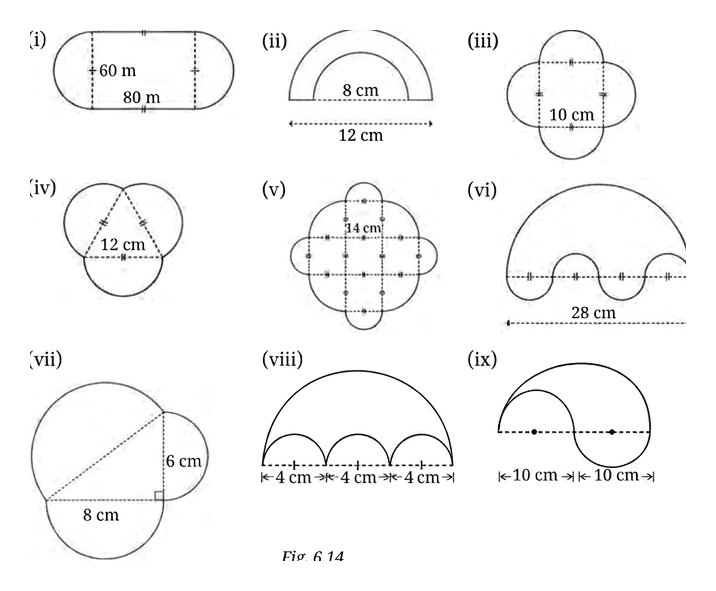
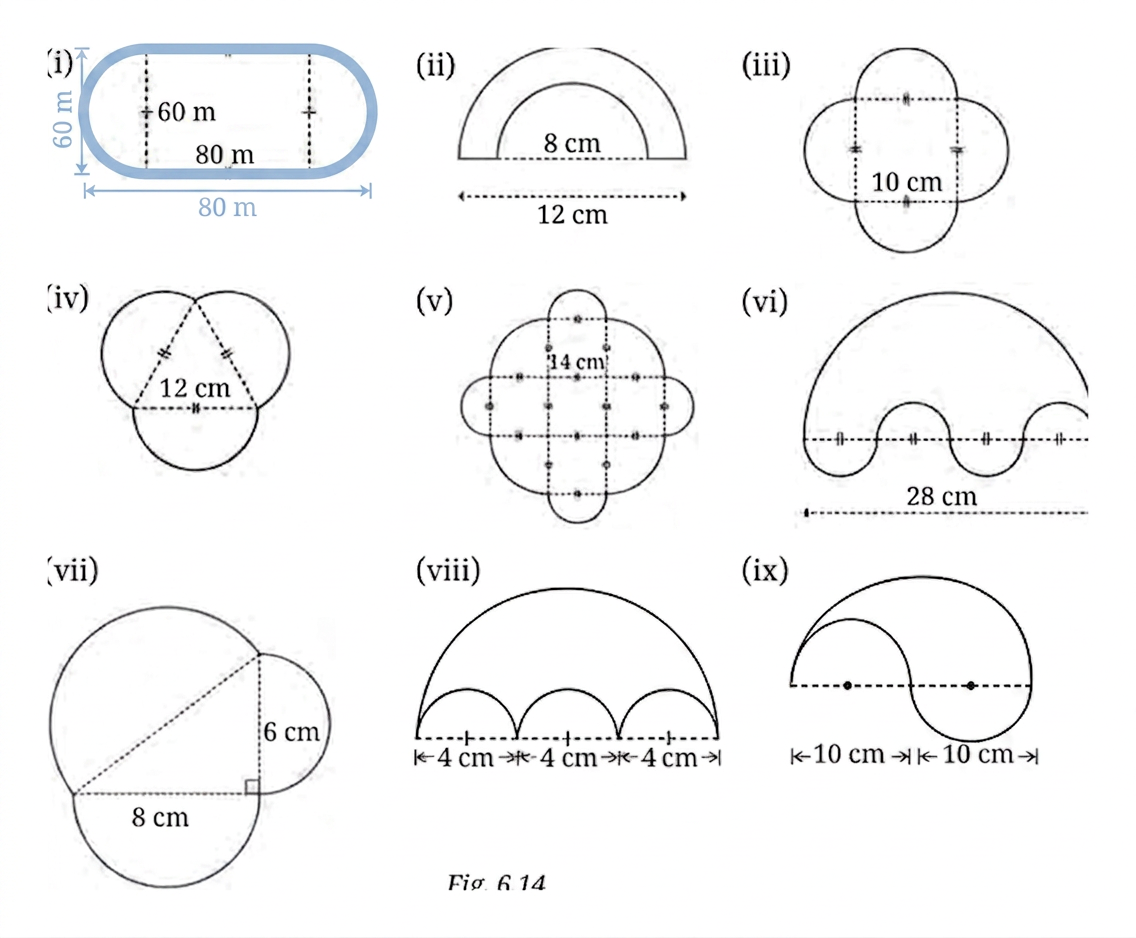
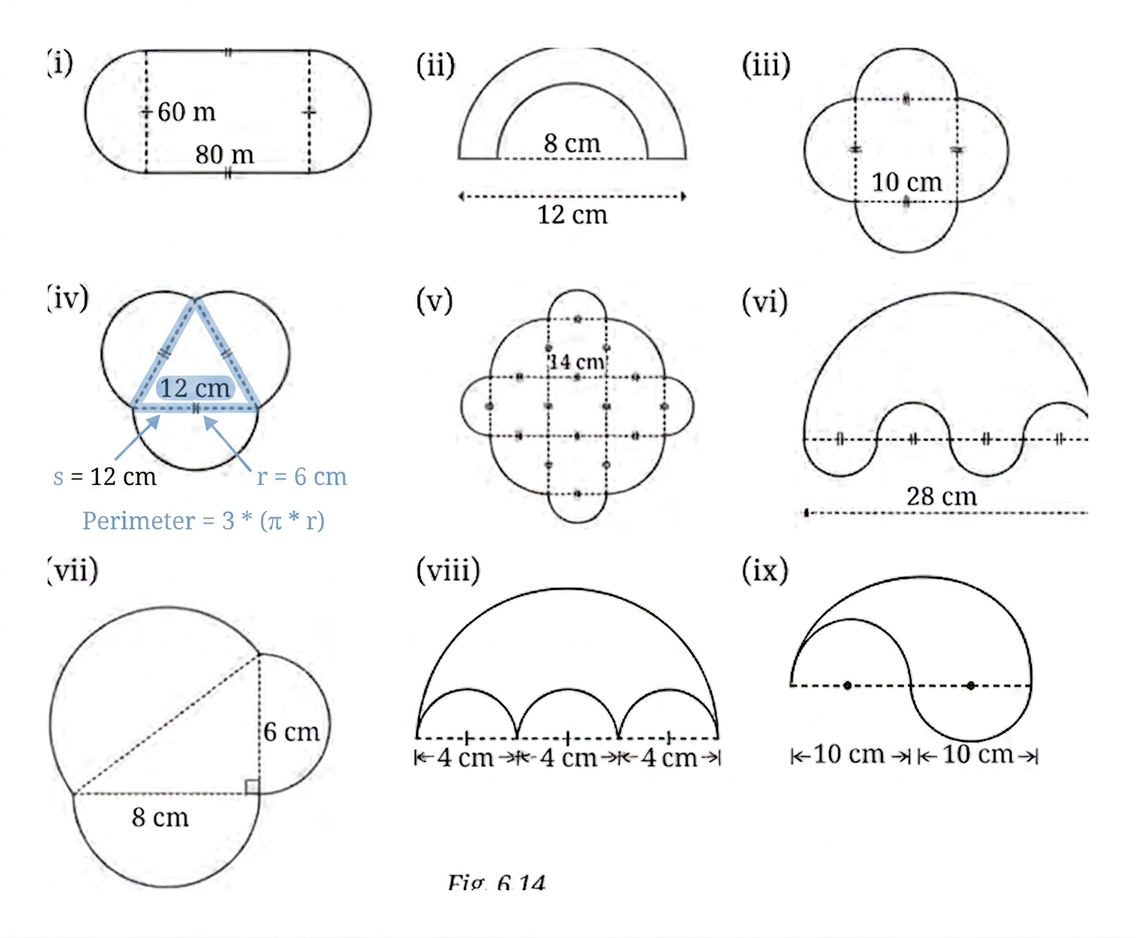
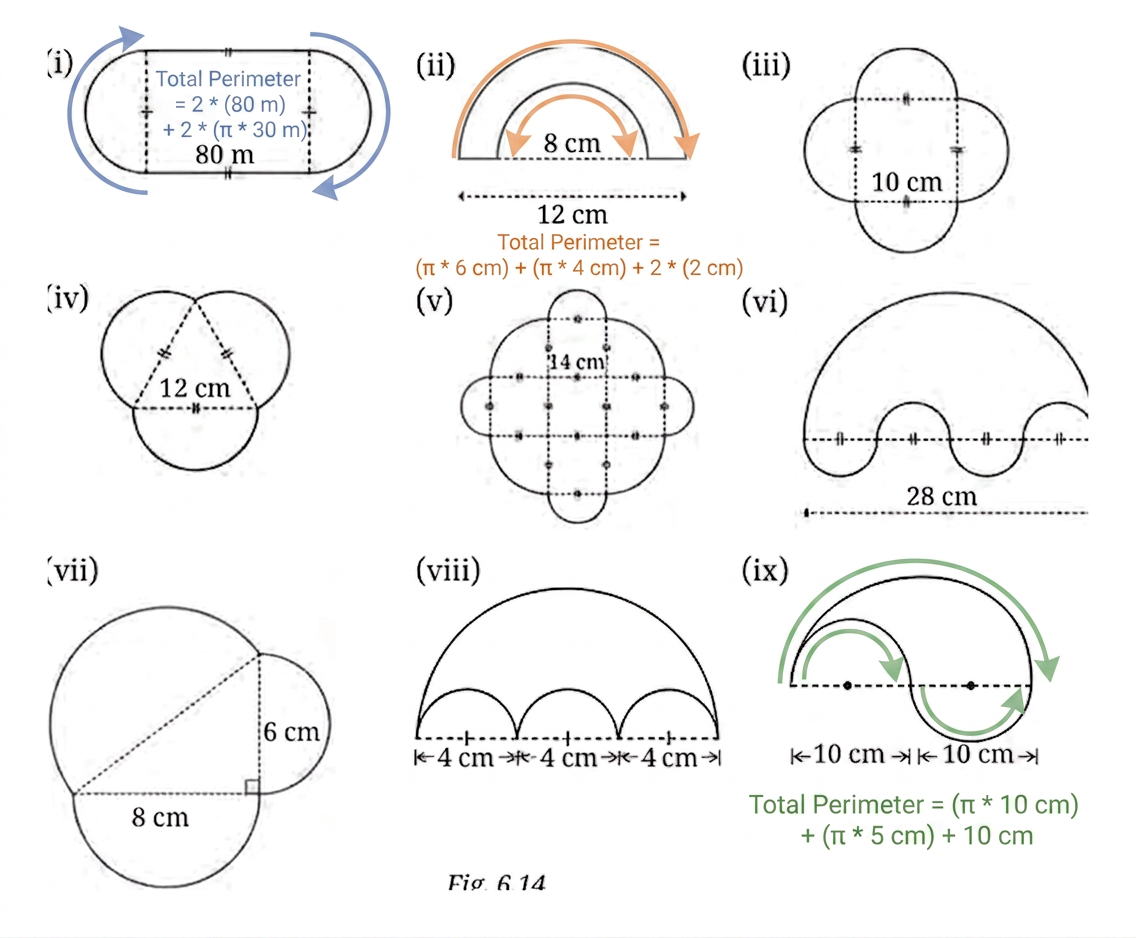
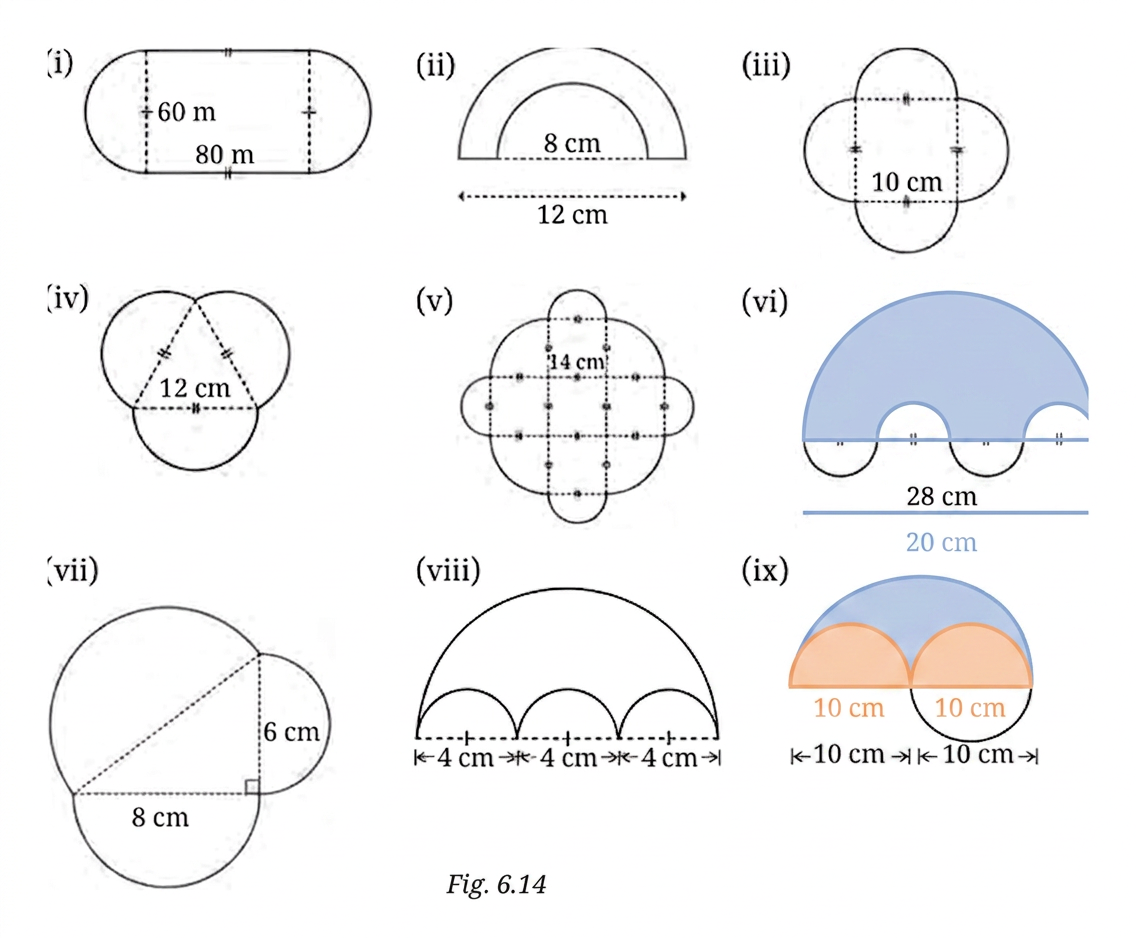
(i) Find the perimeter of the shape in Fig. 6.14i.
Step 1 · Calculate Perimeter of Shape (i)
The shape consists of two straight sides of length 80 m 80\text{ m} 80 m d = 60 m d = 60\text{ m} d = 60 m
Perimeter = 2 × straight length + π × diameter = 2 × 80 + 22 7 × 60 = 160 + 1320 7 = 1120 + 1320 7 = 2440 7 ≈ 348.57 m \begin{aligned}
\text{Perimeter} &= 2 \times \text{straight length} + \pi \times \text{diameter} \\[0.6em]
&= 2 \times 80 + \dfrac{22}{7} \times 60 \\[0.6em]
&= 160 + \dfrac{1320}{7} \\[0.6em]
&= \dfrac{1120 + 1320}{7} \\[0.6em]
&= \dfrac{2440}{7} \approx 348.57\text{ m}
\end{aligned} Perimeter = 2 × straight length + π × diameter = 2 × 80 + 7 22 × 60 = 160 + 7 1320 = 7 1120 + 1320 = 7 2440 ≈ 348.57 m Answer
(i) 348.57 m 348.57\text{ m} 348.57 m
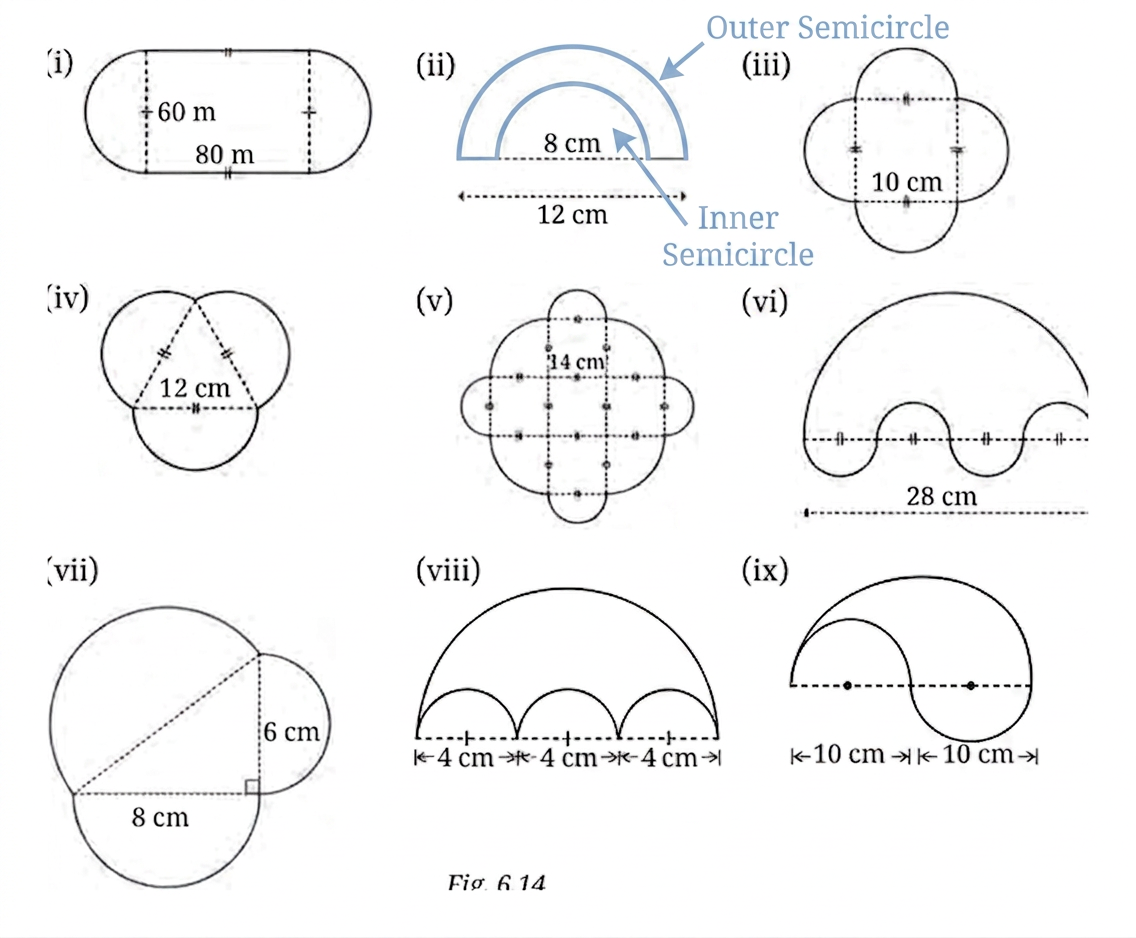
(ii) Find the perimeter of the shape in Fig. 6.14ii.
Step 1 · Calculate Perimeter of Shape (ii)
Outer radius R = 12 2 = 6 cm R = \dfrac{12}{2} = 6\text{ cm} R = 2 12 = 6 cm r = 8 2 = 4 cm r = \dfrac{8}{2} = 4\text{ cm} r = 2 8 = 4 cm 6 − 4 = 2 cm 6 - 4 = 2\text{ cm} 6 − 4 = 2 cm
Perimeter = π × outer radius + π × inner radius + 2 × straight part = π × 6 + π × 4 + 2 × 2 = 10 π + 4 = 10 × 22 7 + 4 = 220 7 + 28 7 = 248 7 ≈ 35.43 cm \begin{aligned}
\text{Perimeter} &= \pi \times \text{outer radius} + \pi \times \text{inner radius} + 2 \times \text{straight part} \\[0.6em]
&= \pi \times 6 + \pi \times 4 + 2 \times 2 \\[0.6em]
&= 10 \pi + 4 \\[0.6em]
&= 10 \times \dfrac{22}{7} + 4 \\[0.6em]
&= \dfrac{220}{7} + \dfrac{28}{7} \\[0.6em]
&= \dfrac{248}{7} \approx 35.43\text{ cm}
\end{aligned} Perimeter = π × outer radius + π × inner radius + 2 × straight part = π × 6 + π × 4 + 2 × 2 = 10 π + 4 = 10 × 7 22 + 4 = 7 220 + 7 28 = 7 248 ≈ 35.43 cm Answer
(ii) 35.43 cm 35.43\text{ cm} 35.43 cm
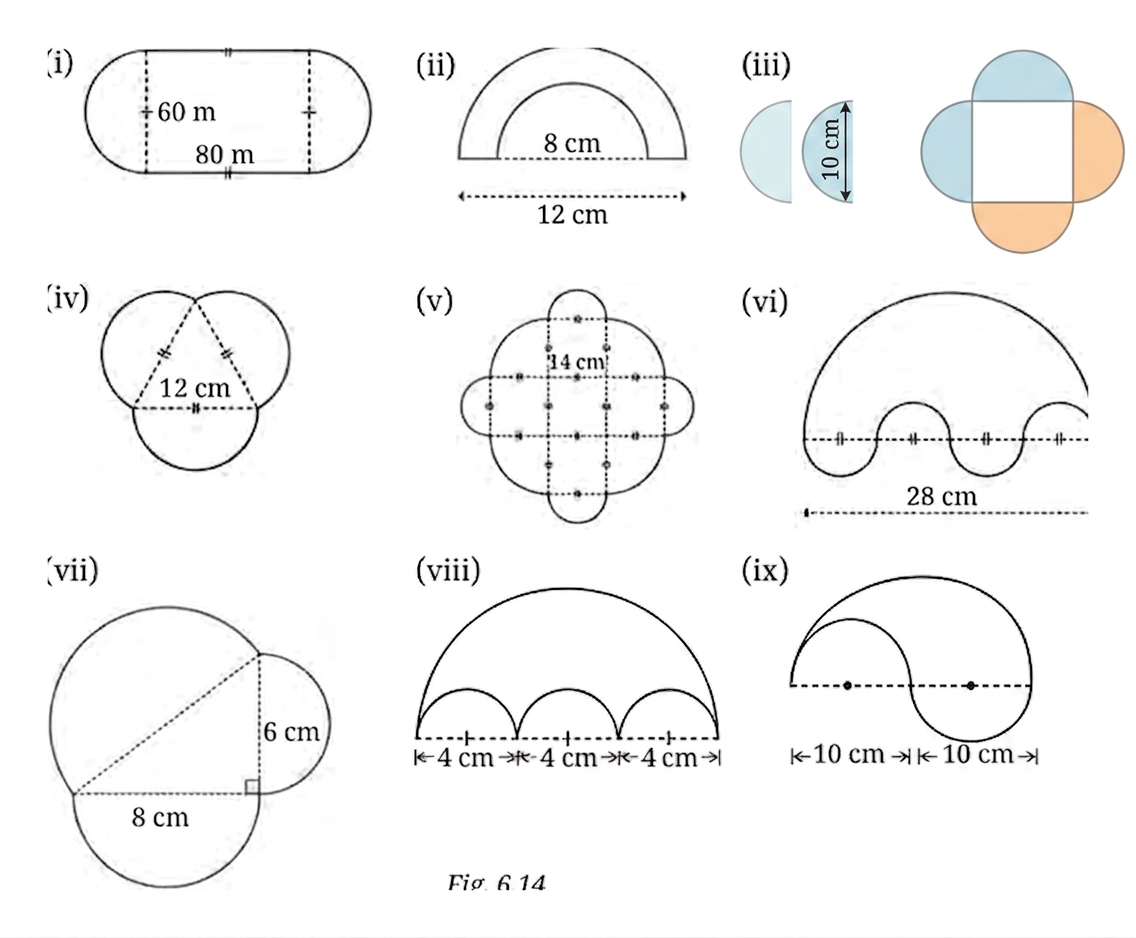
(iii) Find the perimeter of the shape in Fig. 6.14iii.
Step 1 · Calculate Perimeter of Shape (iii)
The boundary has 4 4 4 d = 10 cm d = 10\text{ cm} d = 10 cm r = 5 cm r = 5\text{ cm} r = 5 cm
Perimeter = 4 × ( π × radius ) = 4 × π × 5 = 20 π = 20 × 22 7 = 440 7 ≈ 62.86 cm \begin{aligned}
\text{Perimeter} &= 4 \times (\pi \times \text{radius}) \\[0.6em]
&= 4 \times \pi \times 5 \\[0.6em]
&= 20 \pi \\[0.6em]
&= 20 \times \dfrac{22}{7} \\[0.6em]
&= \dfrac{440}{7} \approx 62.86\text{ cm}
\end{aligned} Perimeter = 4 × ( π × radius ) = 4 × π × 5 = 20 π = 20 × 7 22 = 7 440 ≈ 62.86 cm Answer
(iii) 62.86 cm 62.86\text{ cm} 62.86 cm
(iv) Find the perimeter of the shape in Fig. 6.14iv.
Step 1 · Calculate Perimeter of Shape (iv)
The boundary consists of 3 3 3 d = 12 cm d = 12\text{ cm} d = 12 cm r = 6 cm r = 6\text{ cm} r = 6 cm
Perimeter = 3 × ( π × radius ) = 3 × π × 6 = 18 π = 18 × 22 7 = 396 7 ≈ 56.57 cm \begin{aligned}
\text{Perimeter} &= 3 \times (\pi \times \text{radius}) \\[0.6em]
&= 3 \times \pi \times 6 \\[0.6em]
&= 18 \pi \\[0.6em]
&= 18 \times \dfrac{22}{7} \\[0.6em]
&= \dfrac{396}{7} \approx 56.57\text{ cm}
\end{aligned} Perimeter = 3 × ( π × radius ) = 3 × π × 6 = 18 π = 18 × 7 22 = 7 396 ≈ 56.57 cm Answer
(iv) 56.57 cm 56.57\text{ cm} 56.57 cm
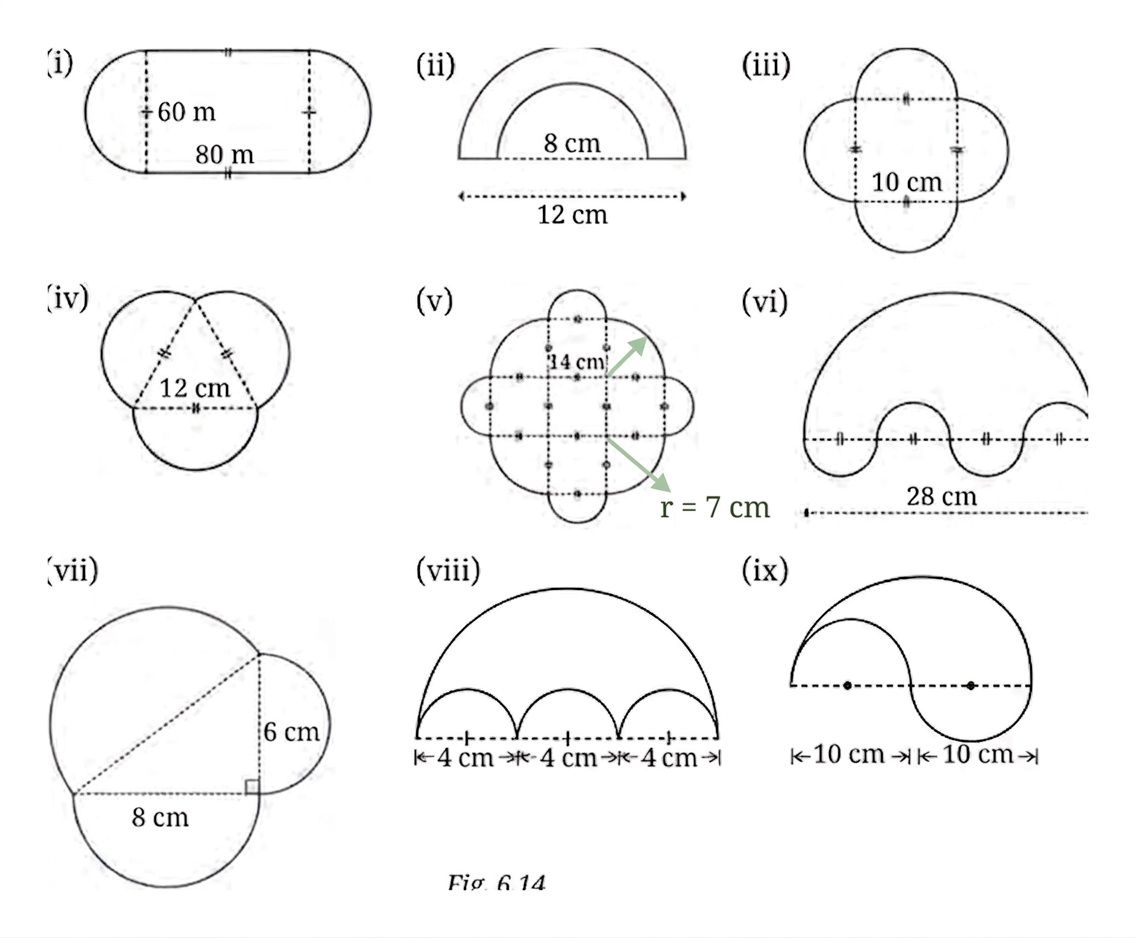
(v) Find the perimeter of the shape in Fig. 6.14v.
Step 1 · Calculate Perimeter of Shape (v)
The shape has 4 4 4 r = 7 cm r = 7\text{ cm} r = 7 cm 4 4 4 R = 14 cm R = 14\text{ cm} R = 14 cm
Perimeter = 4 × ( π × small radius ) + 4 × ( 1 2 π × large radius ) = 4 × π × 7 + 4 × 1 2 × π × 14 = 28 π + 28 π = 56 π = 56 × 22 7 = 8 × 22 = 176 cm \begin{aligned}
\text{Perimeter} &= 4 \times (\pi \times \text{small radius}) + 4 \times \left(\dfrac{1}{2} \pi \times \text{large radius}\right) \\[0.6em]
&= 4 \times \pi \times 7 + 4 \times \dfrac{1}{2} \times \pi \times 14 \\[0.6em]
&= 28 \pi + 28 \pi \\[0.6em]
&= 56 \pi \\[0.6em]
&= 56 \times \dfrac{22}{7} \\[0.6em]
&= 8 \times 22 = 176\text{ cm}
\end{aligned} Perimeter = 4 × ( π × small radius ) + 4 × ( 2 1 π × large radius ) = 4 × π × 7 + 4 × 2 1 × π × 14 = 28 π + 28 π = 56 π = 56 × 7 22 = 8 × 22 = 176 cm Answer
(v) 176 cm 176\text{ cm} 176 cm
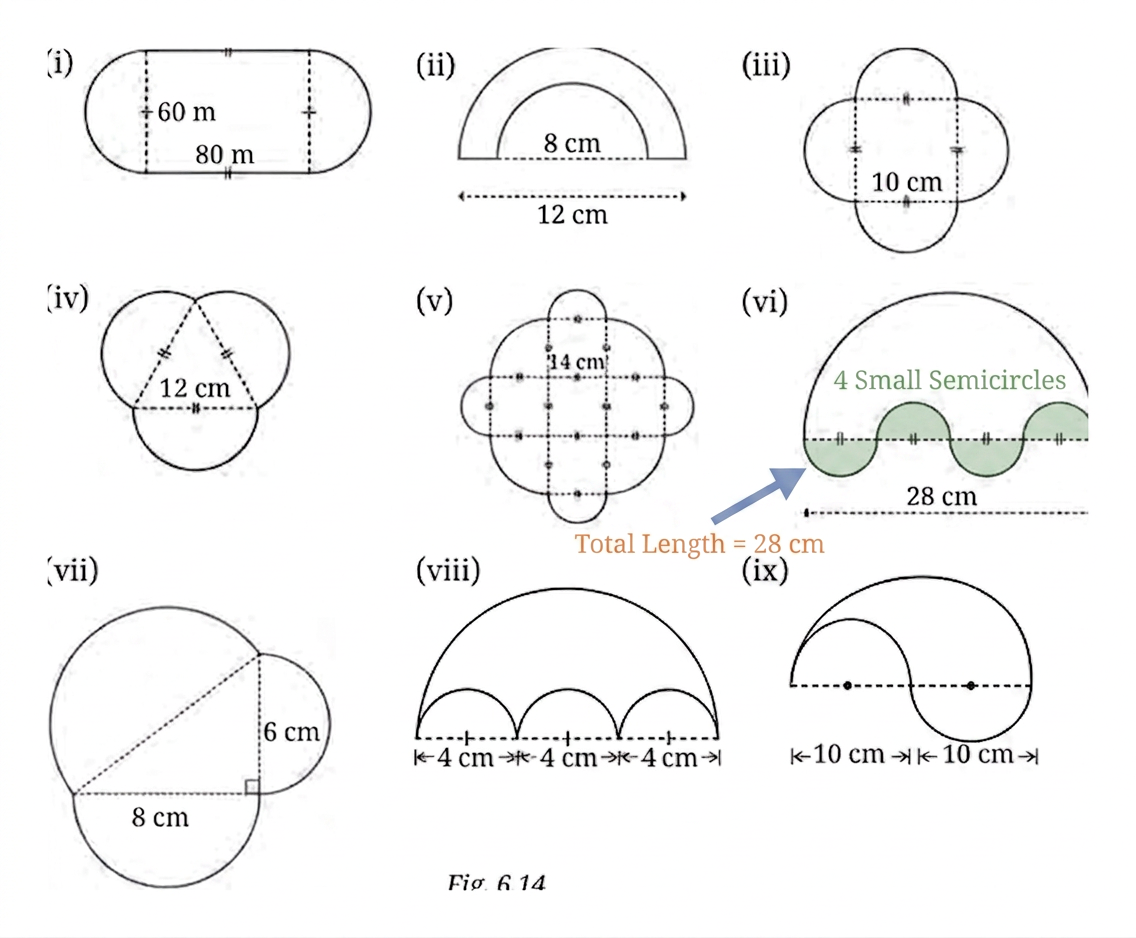
(vi) Find the perimeter of the shape in Fig. 6.14vi.
Step 1 · Calculate Perimeter of Shape (vi)
Large semicircle radius R = 14 cm R = 14\text{ cm} R = 14 cm 28 cm 28\text{ cm} 28 cm 4 4 4 d = 28 4 = 7 cm d = \dfrac{28}{4} = 7\text{ cm} d = 4 28 = 7 cm r = 3.5 cm r = 3.5\text{ cm} r = 3.5 cm
Perimeter = π × large radius + 4 × ( π × small radius ) = π × 14 + 4 × π × 3.5 = 14 π + 14 π = 28 π = 28 × 22 7 = 4 × 22 = 88 cm \begin{aligned}
\text{Perimeter} &= \pi \times \text{large radius} + 4 \times (\pi \times \text{small radius}) \\[0.6em]
&= \pi \times 14 + 4 \times \pi \times 3.5 \\[0.6em]
&= 14 \pi + 14 \pi \\[0.6em]
&= 28 \pi \\[0.6em]
&= 28 \times \dfrac{22}{7} \\[0.6em]
&= 4 \times 22 = 88\text{ cm}
\end{aligned} Perimeter = π × large radius + 4 × ( π × small radius ) = π × 14 + 4 × π × 3.5 = 14 π + 14 π = 28 π = 28 × 7 22 = 4 × 22 = 88 cm Answer
(vi) 88 cm 88\text{ cm} 88 cm
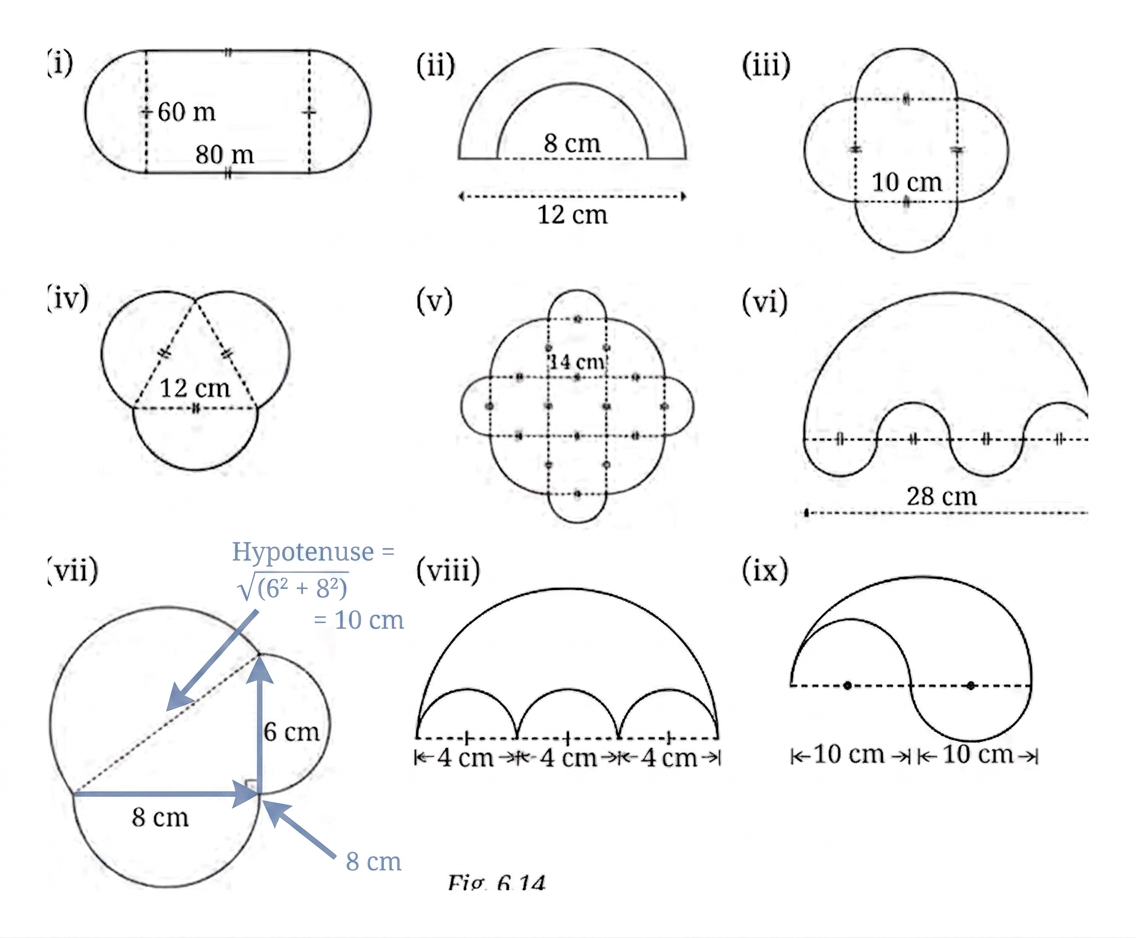
(vii) Find the perimeter of the shape in Fig. 6.14vii.
Step 1 · Calculate Perimeter of Shape (vii)
First, find the hypotenuse using the Pythagoras theorem
Hypotenuse 2 = 6 2 + 8 2 = 36 + 64 = 100 Hypotenuse = 100 = 10 cm \begin{aligned}
\text{Hypotenuse}^2 &= 6^2 + 8^2 \\[0.6em]
&= 36 + 64 \\[0.6em]
&= 100 \\[0.6em]
\text{Hypotenuse} &= \sqrt{100} = 10\text{ cm}
\end{aligned} Hypotenuse 2 Hypotenuse = 6 2 + 8 2 = 36 + 64 = 100 = 100 = 10 cm The diameters are 6 cm 6\text{ cm} 6 cm 8 cm 8\text{ cm} 8 cm 10 cm 10\text{ cm} 10 cm 3 cm 3\text{ cm} 3 cm 4 cm 4\text{ cm} 4 cm 5 cm 5\text{ cm} 5 cm
Perimeter = π × 3 + π × 4 + π × 5 = π × ( 3 + 4 + 5 ) = 12 π = 12 × 22 7 = 264 7 ≈ 37.71 cm \begin{aligned}
\text{Perimeter} &= \pi \times 3 + \pi \times 4 + \pi \times 5 \\[0.6em]
&= \pi \times (3 + 4 + 5) \\[0.6em]
&= 12 \pi \\[0.6em]
&= 12 \times \dfrac{22}{7} \\[0.6em]
&= \dfrac{264}{7} \approx 37.71\text{ cm}
\end{aligned} Perimeter = π × 3 + π × 4 + π × 5 = π × ( 3 + 4 + 5 ) = 12 π = 12 × 7 22 = 7 264 ≈ 37.71 cm Answer
(vii) 37.71 cm 37.71\text{ cm} 37.71 cm
(viii) Find the perimeter of the shape in Fig. 6.14viii.
Step 1 · Calculate Perimeter of Shape (viii)
Large semicircle radius R = 4 + 4 + 4 2 = 6 cm R = \dfrac{4 + 4 + 4}{2} = 6\text{ cm} R = 2 4 + 4 + 4 = 6 cm 3 3 3 4 cm 4\text{ cm} 4 cm r = 2 cm r = 2\text{ cm} r = 2 cm
Perimeter = π × large radius + 3 × ( π × small radius ) = π × 6 + 3 × π × 2 = 6 π + 6 π = 12 π = 12 × 22 7 = 264 7 ≈ 37.71 cm \begin{aligned}
\text{Perimeter} &= \pi \times \text{large radius} + 3 \times (\pi \times \text{small radius}) \\[0.6em]
&= \pi \times 6 + 3 \times \pi \times 2 \\[0.6em]
&= 6 \pi + 6 \pi \\[0.6em]
&= 12 \pi \\[0.6em]
&= 12 \times \dfrac{22}{7} \\[0.6em]
&= \dfrac{264}{7} \approx 37.71\text{ cm}
\end{aligned} Perimeter = π × large radius + 3 × ( π × small radius ) = π × 6 + 3 × π × 2 = 6 π + 6 π = 12 π = 12 × 7 22 = 7 264 ≈ 37.71 cm Answer
(viii) 37.71 cm 37.71\text{ cm} 37.71 cm
(ix) Find the perimeter of the shape in Fig. 6.14ix.
Step 1 · Calculate Perimeter of Shape (ix)
Large semicircle radius R = 10 + 10 2 = 10 cm R = \dfrac{10 + 10}{2} = 10\text{ cm} R = 2 10 + 10 = 10 cm 2 2 2 10 cm 10\text{ cm} 10 cm r = 5 cm r = 5\text{ cm} r = 5 cm
Perimeter = π × large radius + 2 × ( π × small radius ) = π × 10 + 2 × π × 5 = 10 π + 10 π = 20 π = 20 × 22 7 = 440 7 ≈ 62.86 cm \begin{aligned}
\text{Perimeter} &= \pi \times \text{large radius} + 2 \times (\pi \times \text{small radius}) \\[0.6em]
&= \pi \times 10 + 2 \times \pi \times 5 \\[0.6em]
&= 10 \pi + 10 \pi \\[0.6em]
&= 20 \pi \\[0.6em]
&= 20 \times \dfrac{22}{7} \\[0.6em]
&= \dfrac{440}{7} \approx 62.86\text{ cm}
\end{aligned} Perimeter = π × large radius + 2 × ( π × small radius ) = π × 10 + 2 × π × 5 = 10 π + 10 π = 20 π = 20 × 7 22 = 7 440 ≈ 62.86 cm Answer
(ix) 62.86 cm 62.86\text{ cm} 62.86 cm
Common Mistakes
Diameter vs. Radius Confusion: Using diameter d d d π r \pi r π r π d \pi d π d π r = 1 2 π d \pi r = \dfrac{1}{2}\pi d π r = 2 1 π d Omitting Straight Edges: In shapes like (i) and (ii), forgetting to add the straight boundary segments to the curved arc lengths.Internal Boundaries: Adding inner division lines that do not form part of the outer perimeter.