Question 6
If the diameter of a car tyre is , then:
(i) How far does the car need to travel for the tyre to complete one revolution?
(ii) How many revolutions does the tyre make if the car travels ?
- The distance covered by a wheel or tyre in one complete revolution is equal to its circumference, .
- To find the number of revolutions over a given distance, divide the total distance by the distance covered in one revolution:
- Ensure all measurements are converted to the same unit (centimetres) before calculating.
(i) How far does the car need to travel for the tyre to complete one revolution?
Step 1 · Calculate Distance Covered in One Revolution
Given diameter .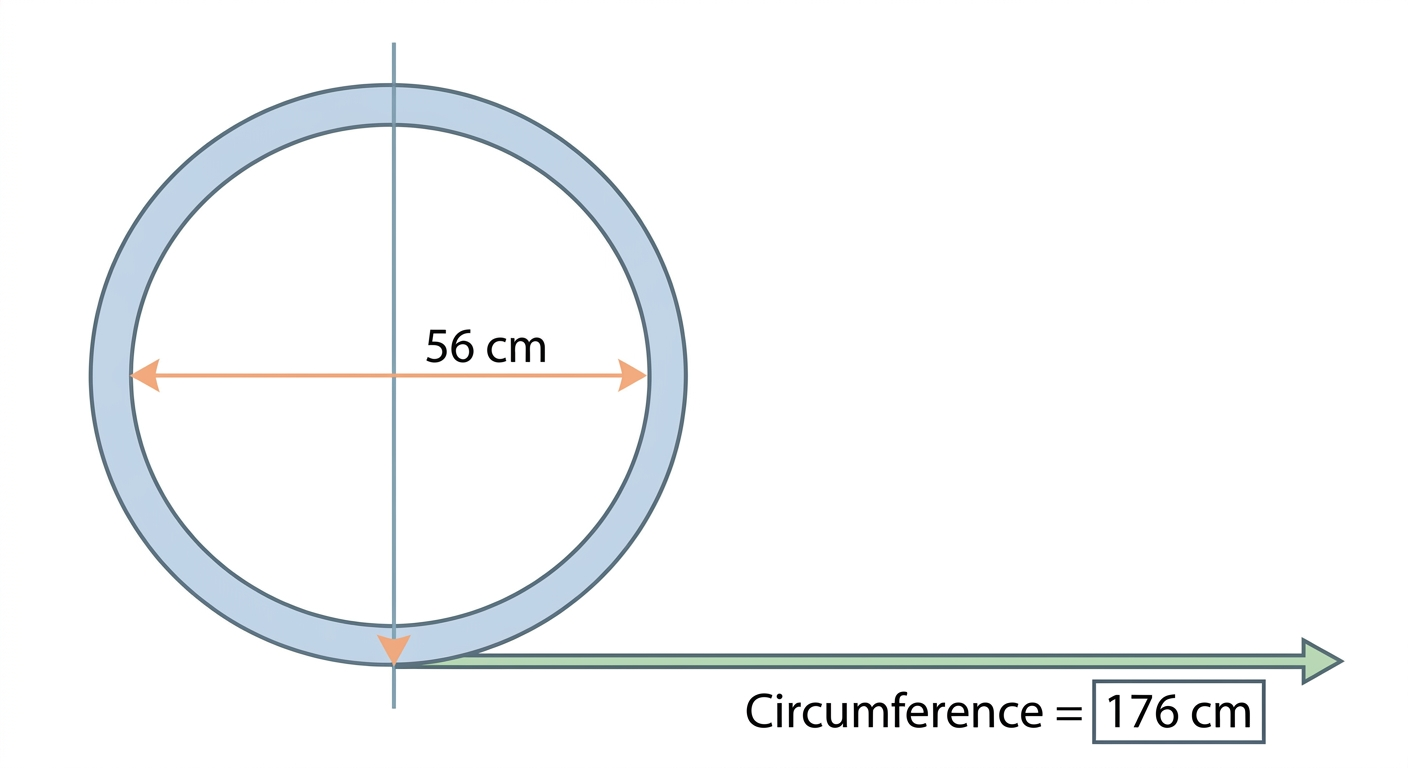
Radius of the tyre:
Distance covered in one revolution is the circumference of the tyre ():
(i)
(ii) How many revolutions does the tyre make if the car travels ?
Step 1 · Convert Distance and Calculate Number of Revolutions
Convert total distance from to ():
Calculate the number of revolutions:
Rounding to the nearest whole number gives revolutions.
(ii) Approximately
- Unit Inconsistency: Failing to convert into centimetres (), leading to an incorrect result.
- Diameter vs. Radius: Using the diameter () instead of the radius () when applying the formula .
More questions in Exercise 6.1
Unless stated otherwise, use the approximation for .
- The perimeter of a circle is 44 cm. What is its radius?
Unless stated otherwise, use the approximation for .
- Calculate, correct to 3 significant figures, the circumference of a circle with: (i) radius 7 cm
(ii) radius 10 cm
(iii) radius 12 cm.
Unless stated otherwise, use the approximation for .
- Calculate the length of the arc of a circle if:
(i) the radius is and the angle at the centre is , and
(ii) the radius is and the angle at the centre is .
Unless stated otherwise, use the approximation for .
- Find the perimeter of a sector (i.e., the curved portion as well as the two straight portions) of a circle of radius and sector angle .
Unless stated otherwise, use the approximation for .
- Find the perimeters of the following shapes (taking the arcs to be quarter or half or three-quarters of a circle, as appropriate) (Fig. 6.14i to 6.14ix):
If the diameter of a car tyre is , then:
(i) How far does the car need to travel for the tyre to complete one revolution?
(ii) How many revolutions does the tyre make if the car travels ?
Find the total perimeter of all the petals in each of the given flowers.
The ratio of the perimeters of two circles is . What is the ratio of their radii?