Question 7
Find the total perimeter of all the petals in each of the given flowers.
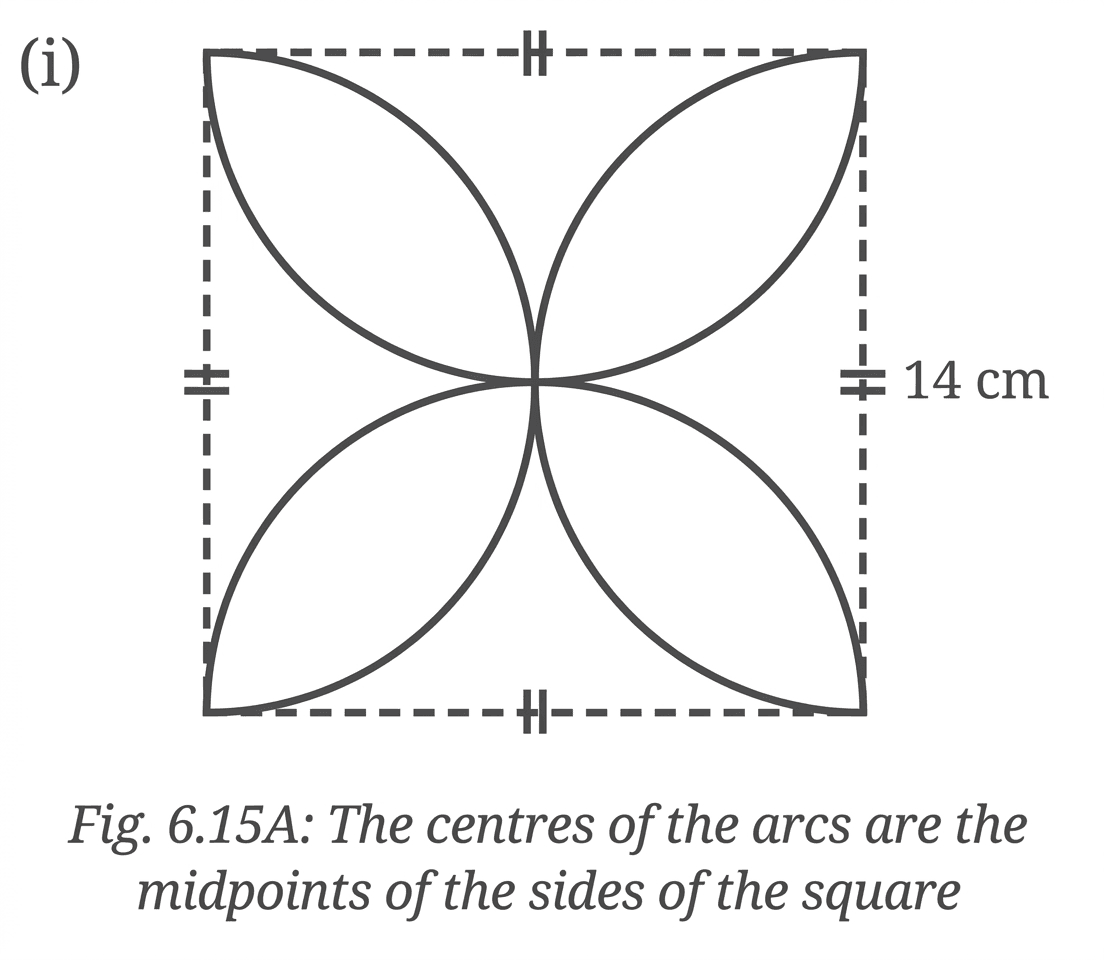
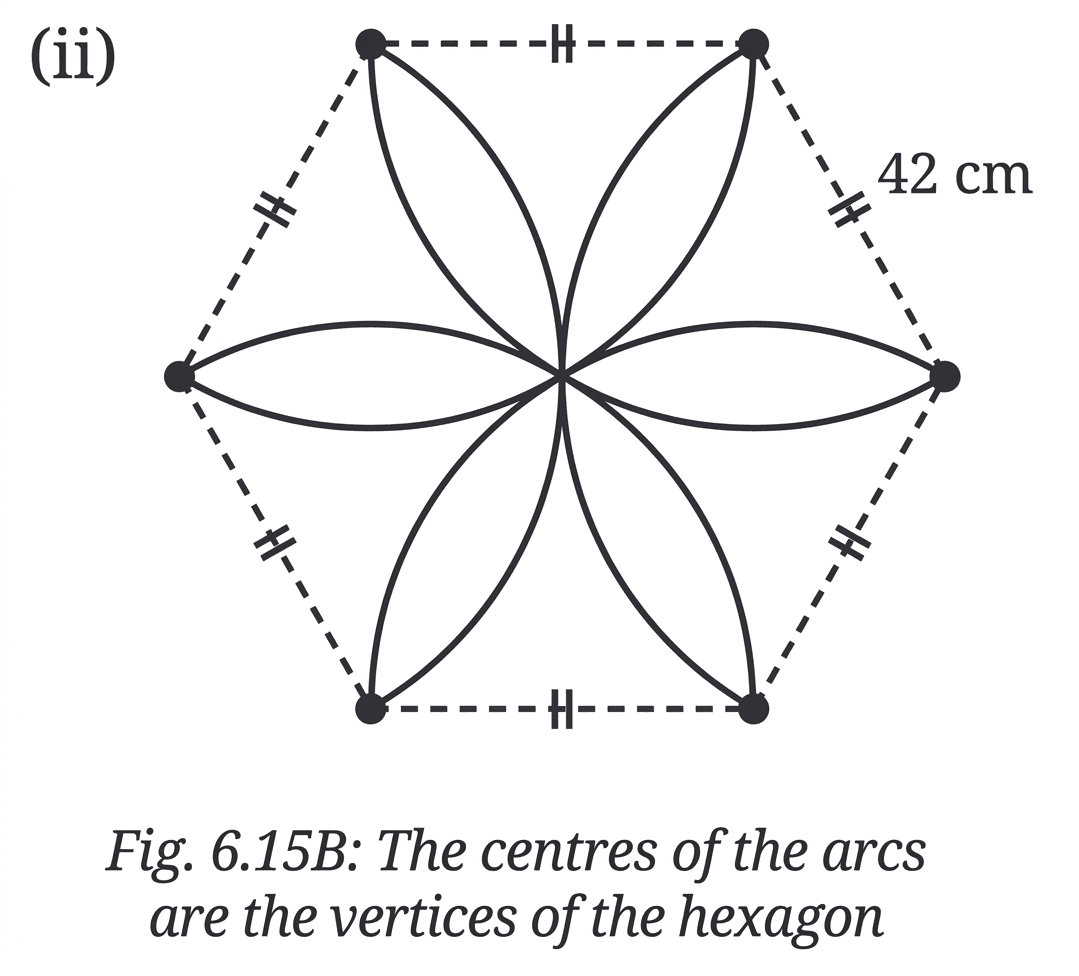
- Each flower petal is bounded by circular arcs.
- The perimeter of a single petal is the sum of the curved lengths of all the arcs forming that petal.
- To find the total perimeter of all the petals in a figure, calculate the total length of all boundary arcs formed across the shape using the arc length formula:
(i) Find the total perimeter of all the petals in Figure (i) (flower in a square of side ).
Step 1 · Calculate the Total Perimeter of the Petals
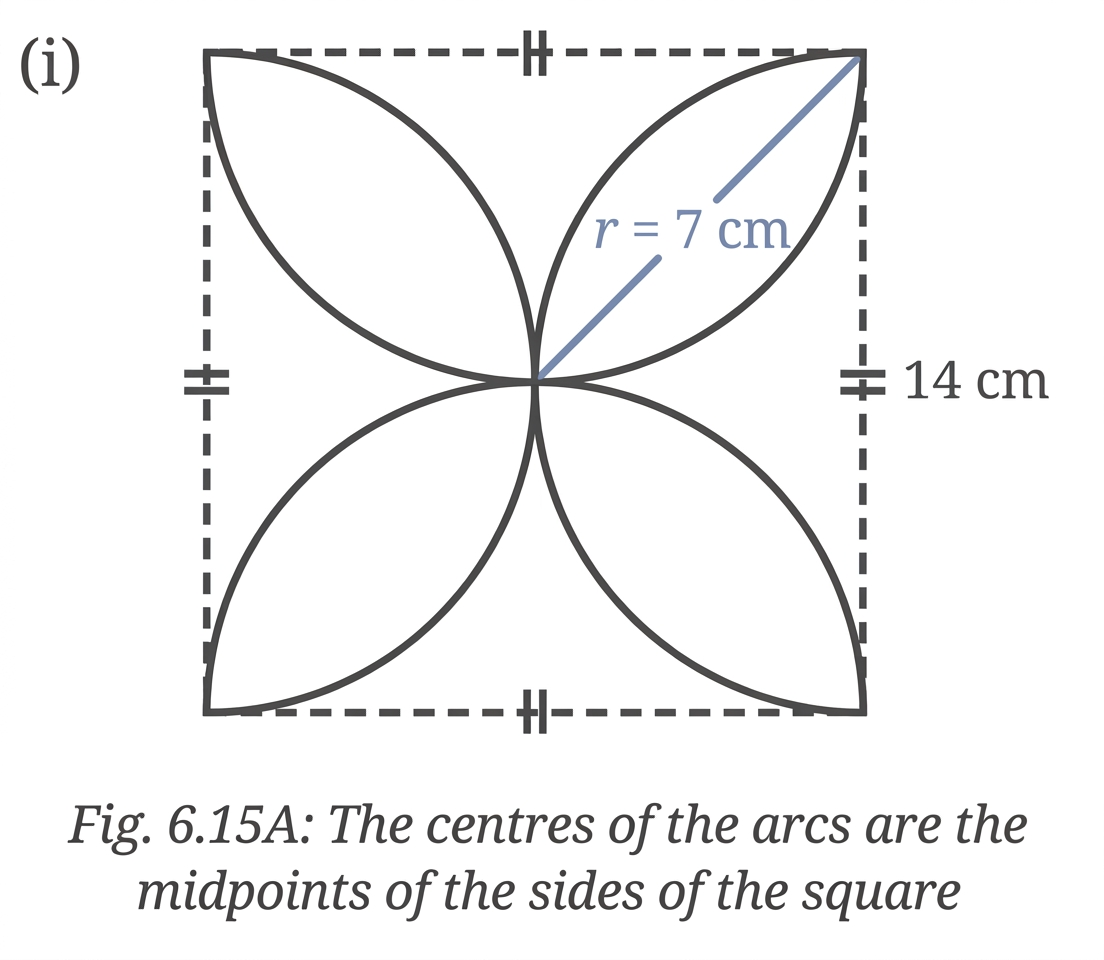
Given the side length of the square is .
The radius of each circular arc is half of the side length:
Each of the petals consists of two quarter-circle arcs, which equals the length of one semicircle:
Total perimeter of all petals:
(i)
(ii) Find the total perimeter of all the petals in Figure (ii) (flower in a regular hexagon of side ).
Step 1 · Calculate the Total Perimeter of the Petals
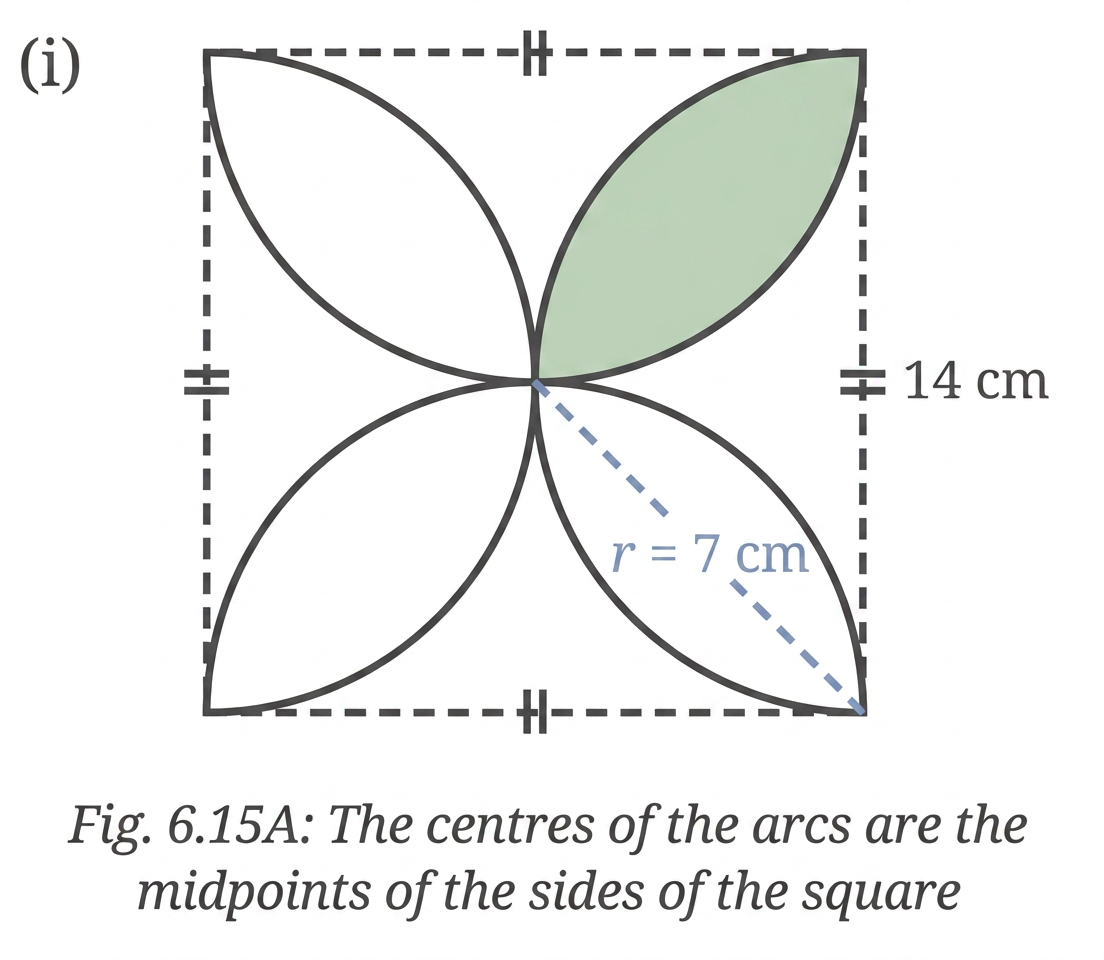
Given the side length of the regular hexagon is , the radius of each arc is:
Each interior arc subtends an angle at the center.
Length of one arc:
Each petal consists of such arcs, giving:
Total perimeter of all petals:
(ii)
- Radius Misidentification: In Figure (i), the radius is half the side (), whereas in Figure (ii), the radius equals the full side length of the hexagon ().
- Counting Arcs: Forgetting that each petal is formed by two curved boundaries/arcs rather than just one.
- Angle at Center: Using (the interior angle of the hexagon) instead of the angle subtended by the arc at the vertex.
More questions in Exercise 6.1
Unless stated otherwise, use the approximation for .
- The perimeter of a circle is 44 cm. What is its radius?
Unless stated otherwise, use the approximation for .
- Calculate, correct to 3 significant figures, the circumference of a circle with: (i) radius 7 cm
(ii) radius 10 cm
(iii) radius 12 cm.
Unless stated otherwise, use the approximation for .
- Calculate the length of the arc of a circle if:
(i) the radius is and the angle at the centre is , and
(ii) the radius is and the angle at the centre is .
Unless stated otherwise, use the approximation for .
- Find the perimeter of a sector (i.e., the curved portion as well as the two straight portions) of a circle of radius and sector angle .
Unless stated otherwise, use the approximation for .
- Find the perimeters of the following shapes (taking the arcs to be quarter or half or three-quarters of a circle, as appropriate) (Fig. 6.14i to 6.14ix):
If the diameter of a car tyre is , then:
(i) How far does the car need to travel for the tyre to complete one revolution?
(ii) How many revolutions does the tyre make if the car travels ?
Find the total perimeter of all the petals in each of the given flowers.
The ratio of the perimeters of two circles is . What is the ratio of their radii?