Question 4
The sides of a triangular plot are in the ratio ; its perimeter is . Find its area.
- The side lengths of the triangle are in the ratio . We represent them as , , and .
- Using the given perimeter of , we solve for to find the actual lengths of all three sides.
- Once the sides are known, we compute the semi-perimeter and apply Heron's formula to find the area:
Step 1 · Find the Side Lengths
Let the sides of the triangular plot be , , and .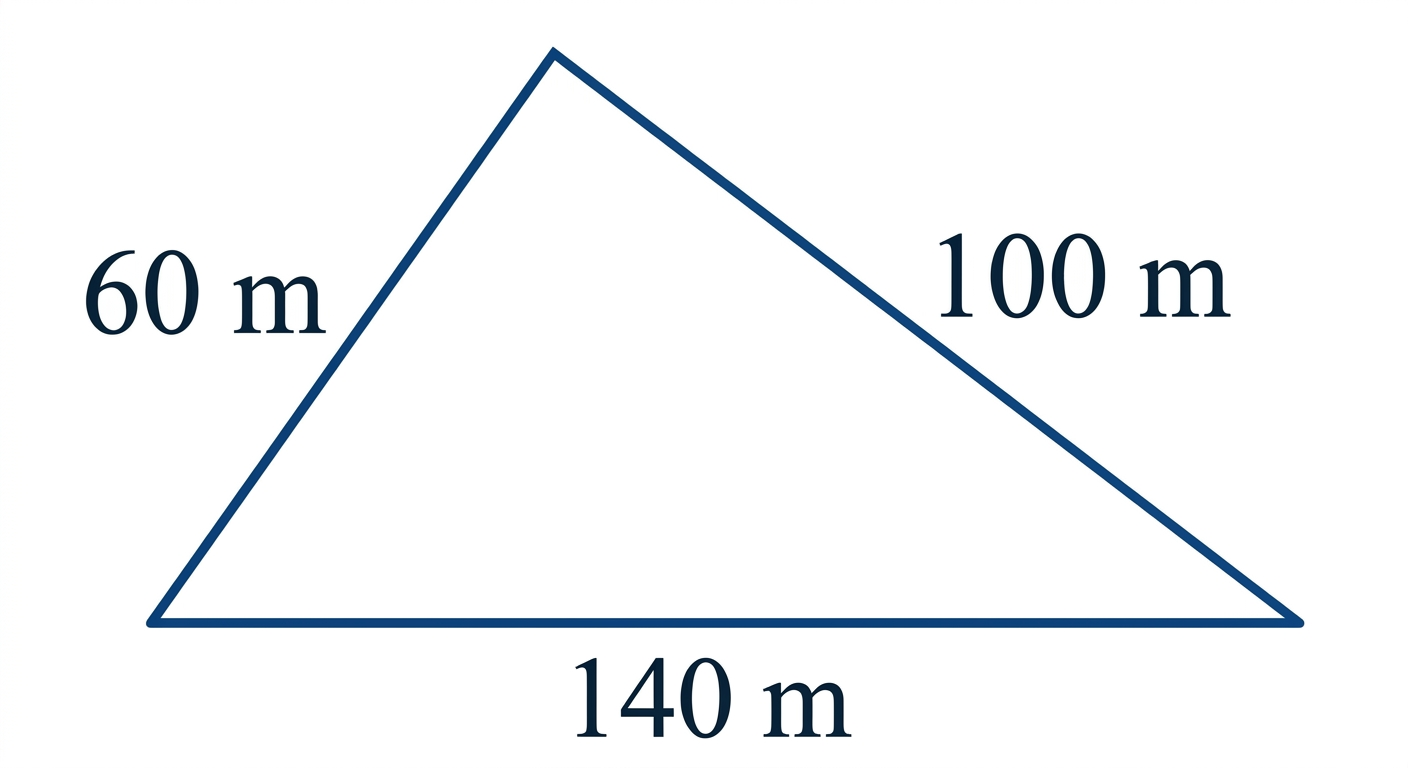
Given that the perimeter is
Calculating each side length:
Step 2 · Calculate the Semi-Perimeter
Semi-perimeter is given by
Step 3 · Calculate Area Using Heron's Formula
By Heron's formula
Substitute , , , and
- Ratio Misinterpretation: Directly substituting the ratio values () into Heron's formula instead of finding the actual side lengths ().
- Using Perimeter instead of Semi-Perimeter: Substituting the perimeter rather than the semi-perimeter into Heron's formula.
- Calculation Errors under Square Root: Multiplying into very large numbers without factoring perfect squares ( and ), which complicates finding the square root.
More questions in Exercise 6.2
Find the area of triangle ADE in Fig. 6.31.
The parallel sides of a trapezium are and . If its non-parallel sides are both equal, each being , find the area of the trapezium.
Find the area of a triangle, given that its sides are and long, and its perimeter is .
The sides of a triangular plot are in the ratio ; its perimeter is . Find its area.
One diagonal of a rhombus is twice as long as the other diagonal. If the rhombus has area , find the length of the shorter diagonal.
is a parallelogram. and are any two points on side . What can you say about the ratio ?
is any point on the diagonal of a parallelogram . Prove that the areas of triangles and are equal.
If the mid-points of the sides of a 4-gon (also known as a quadrilateral, but we prefer to call it a ‘4-gon’) are joined in order, prove that the area of the parallelogram thus formed will be half of the area of the given 4-gon. (You may wonder whether the 4-gon thus formed is always a parallelogram, and if so, why? These questions will be tackled and answered in the chapter on quadrilaterals.)
In , the midpoint of is (Fig. 6.32). Median is drawn. is any point on . Show that .
Given a square , let be a point within it. Join , , , (Fig. 6.33). What is the ratio of the areas of the red region ( and ) and the green region ( and )?
In , is the midpoint of . is any point on , and is a point on such that . is joined (Fig. 6.34). Prove that