Question 9
In , the midpoint of is (Fig. 6.32). Median is drawn. is any point on . Show that .
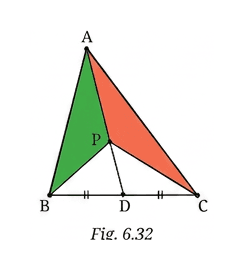
- A median of a triangle connects a vertex to the midpoint of the opposite side, dividing the triangle into two smaller triangles of equal area (since both share the same base length and perpendicular altitude).
- In , is the median, so .
- In , is the median, so .
- Subtracting the area of from and from gives .
Step 1 · Compare Areas of Triangles with Vertex P
In , is the midpoint of , so is the median.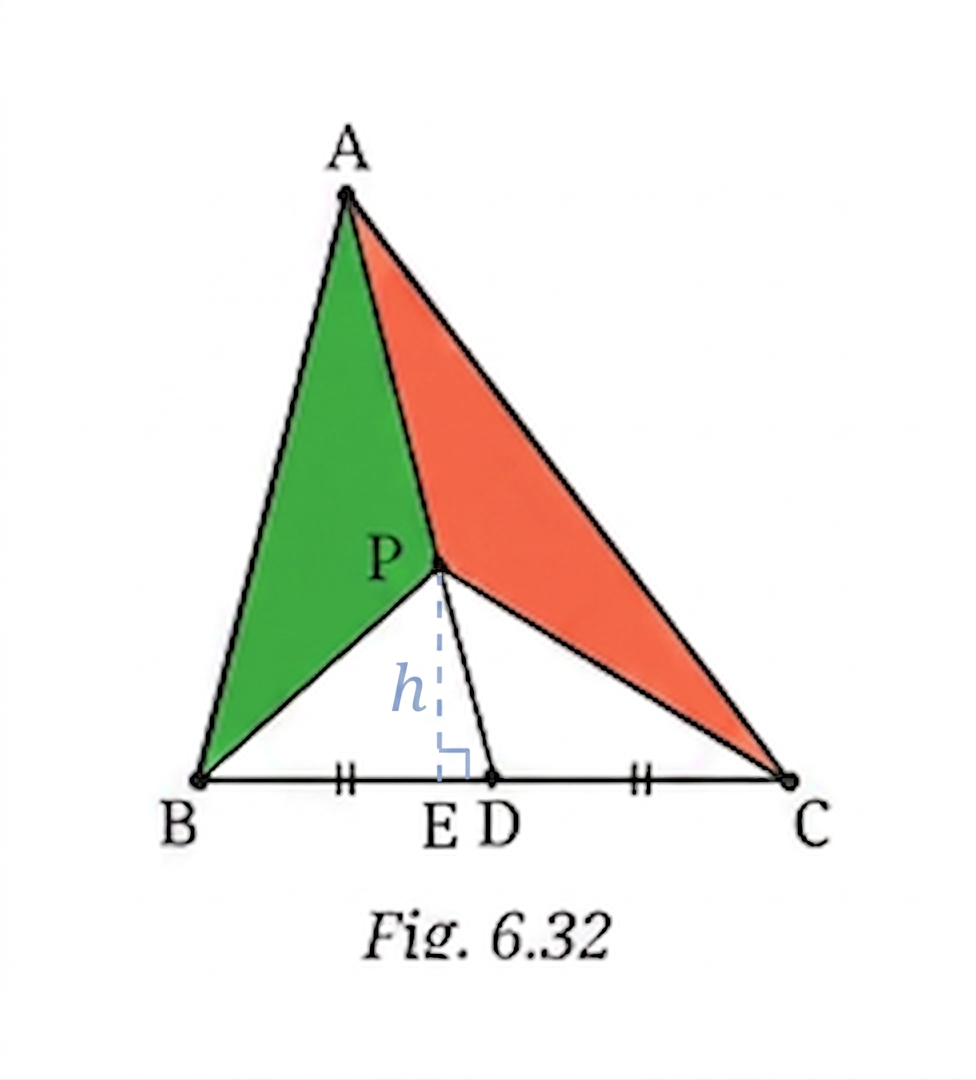
Since a median divides a triangle into two triangles of equal area
Step 2 · Compare Areas of Triangles with Vertex A
In , is the midpoint of , so is the median.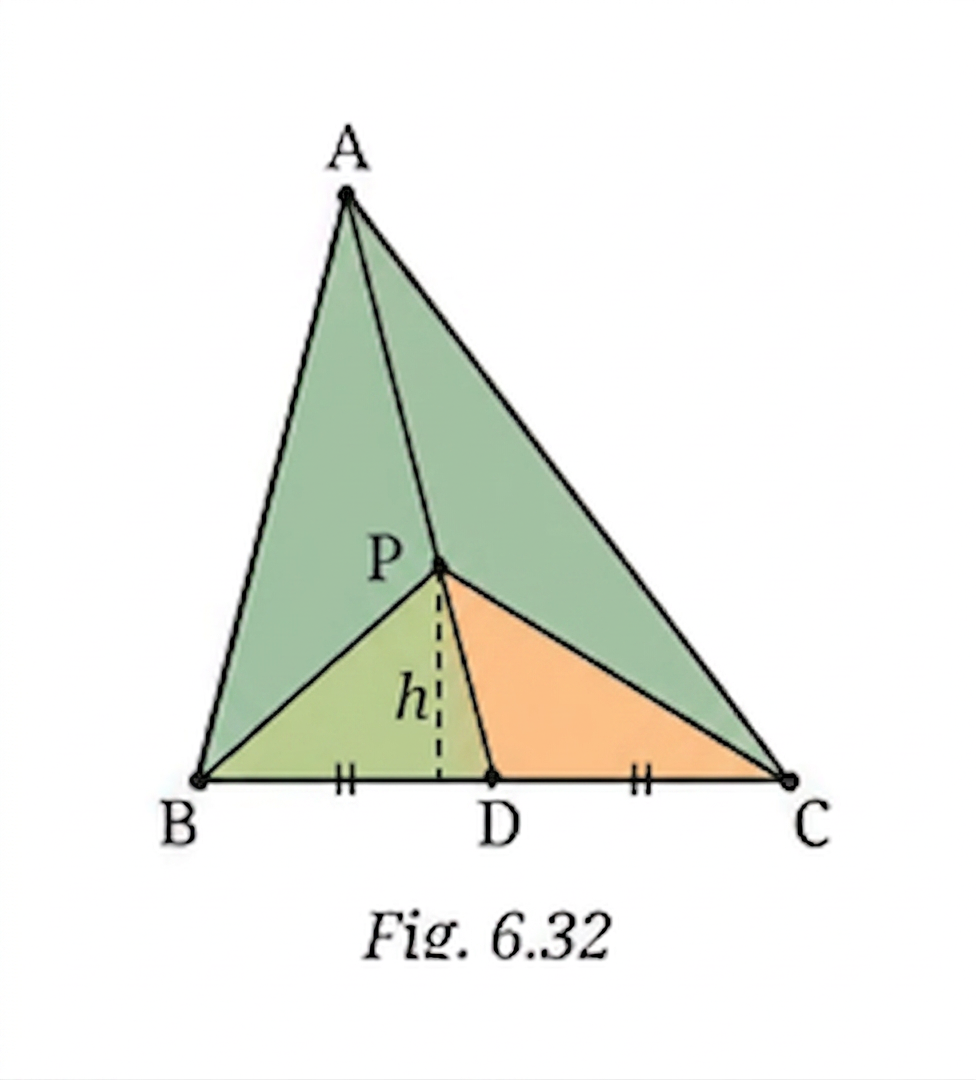
Step 3 · Subtract Area Equations
Subtracting equation from equation
Hence proved.
- Assuming Congruence: Equal area does not imply that the two triangles are congruent. Triangles and have equal areas because they have equal bases () and share the same altitude from vertex .
- Incorrect Subtraction Order: Always subtract the smaller triangle area () from the larger triangle area () consistently on both sides.
More questions in Exercise 6.2
Find the area of triangle ADE in Fig. 6.31.
The parallel sides of a trapezium are and . If its non-parallel sides are both equal, each being , find the area of the trapezium.
Find the area of a triangle, given that its sides are and long, and its perimeter is .
The sides of a triangular plot are in the ratio ; its perimeter is . Find its area.
One diagonal of a rhombus is twice as long as the other diagonal. If the rhombus has area , find the length of the shorter diagonal.
is a parallelogram. and are any two points on side . What can you say about the ratio ?
is any point on the diagonal of a parallelogram . Prove that the areas of triangles and are equal.
If the mid-points of the sides of a 4-gon (also known as a quadrilateral, but we prefer to call it a ‘4-gon’) are joined in order, prove that the area of the parallelogram thus formed will be half of the area of the given 4-gon. (You may wonder whether the 4-gon thus formed is always a parallelogram, and if so, why? These questions will be tackled and answered in the chapter on quadrilaterals.)
In , the midpoint of is (Fig. 6.32). Median is drawn. is any point on . Show that .
Given a square , let be a point within it. Join , , , (Fig. 6.33). What is the ratio of the areas of the red region ( and ) and the green region ( and )?
In , is the midpoint of . is any point on , and is a point on such that . is joined (Fig. 6.34). Prove that