Question 26
In Fig. 6.54, we see three triangles within a rectangle. The areas of the triangles are , as marked. Show that the area of the rectangle is
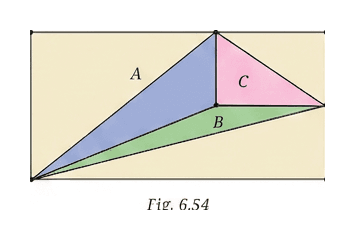
- Any triangle whose base is equal to a side of a rectangle and whose opposite vertex lies on the opposite side has an area equal to half the area of the rectangle:
- When two triangles share the same altitude, the ratio of their areas is equal to the ratio of their bases.
- By expressing the areas of the composite triangles in terms of and , we can set up proportional relationships to determine the total area of the rectangle.
Step 1 · Identify Triangle Areas and Rectangle Properties
Let the total area of the rectangle be denoted as .A triangle sharing a side of the rectangle as its base and having its third vertex on the opposite parallel side has an area equal to half of the rectangle's area:
From the given figure, the two composite triangles have areas:
where is the area of the overlapping region between them.
Step 2 · Establish Proportional Area Relationships
Since triangles with a common vertex and bases along the same straight line share the same altitude, the ratio of their areas is equal to the ratio of their bases.
Applying this property to the segments divided by the intersecting lines:
Similarly, along the other intersecting line:
Step 3 · Solve for the Total Area of the Rectangle
From the proportional relation:
Multiplying both sides by :
Thus, the area of the rectangle is .
- Assuming : The areas and are not necessarily equal unless the configuration is completely symmetric.
- Forgetting the Factor of : Omitting the factor of when relating the half-rectangle area () to the full area of the rectangle ().
- Overcomplicating with Coordinates: Attempting to assign arbitrary side lengths and coordinate geometry instead of using the ratio of areas of triangles between parallel lines.
More questions in EOT
Identities in algebra can sometimes be shown as area relationships. For example:
The figure shown corresponds to the identity
Do you see how?
Draw figures corresponding to the identities and .
An isosceles triangle has perimeter ; the equal sides are each. Find the area of the triangle.
An isosceles triangle has base , and its area is . What are the lengths of the equal sides?
The area of a right-angled triangle is . One of its legs has length . Find its perimeter.
The sides of a triangle are in the ratio , and its perimeter is . Find its area.
The sides of a triangle have lengths , , . Find the area of the triangle in two different ways.
If the wheel of a bicycle has a diameter of , find how far a cyclist will have travelled after the wheel has rotated times.
Find the area of a quadrant of a circle whose circumference is .
The wheel of a car has an outer radius of . Calculate how far the car travels after one complete turn of the wheel, and how many times the wheel turns during a journey of .
Two rectangles have the same area and the same perimeter. Does this mean that they are congruent to each other?
You know that the area of a parallelogram is base height. Using this and the figure, show that the area of a trapezium is half the sum of the parallel sides height, i.e., .
By dividing a trapezium into two triangles show that its area is, half the sum of the parallel sides multiplied by the height (the same formula as the one given above).
Show how we can use two identical copies of a trapezium to make a parallelogram. How will this give us the formula for the area of a trapezium?
Show that the area of a kite is half the product of its diagonals. Show this: (i) using algebra, and (ii) using geometry.
Three problems about fitting congruent shapes together:
(i) Rectangle ABCD has sides , , and rectangle PQRS has sides , . Show that PQRS has 4 times the area of ABCD. Does this mean that 4 copies of rectangle ABCD will fit into rectangle PQRS? Check and see!
(ii) has sides , , , and has sides , , . Show that has 4 times the area of . Does this mean that 4 copies of will fit into ? Check and see!
(iii) has sides , , , and has sides , , . Show that has 9 times the area of . Does this mean that 9 copies of will fit into ? Check and see!
- Find the fraction of the shaded region in each of the following figures:
(i) Fig. 6.43: What fraction of the triangle is shaded? (ii) Fig. 6.44: What fraction of the square is shaded?
Find the fraction of the rectangle covered by the circles in each of the following figures:
(i) Fig. 6.45: What fraction of the rectangle is covered by the circles?
(ii) Fig. 6.46: What fraction of the rectangle is covered by the circles?
Use the above to make a conjecture about the area occupied by circles fitted into a rectangle in the manner shown. Test your conjecture for particular cases: 10 circles; 20 circles; 50 circles. Then prove your conjecture!
*19. The figure shows nine identical rectangles fitted together to make a large rectangle whose area is . Find the perimeter of each small rectangle.
Show that the areas of the shaded blue triangle and the shaded red triangle are equal.
Find a way of cutting up the blue triangle into some number of pieces and rearranging the pieces to cover the red triangle.
The figure shows a quarter circle in a square. Its centre is at one vertex, and it passes through two adjacent vertices. There are two semicircles on two adjacent sides as diameters. They create the shaded regions and .
Show that and have equal area.
In Fig. 6.50, four semicircles have been drawn within the given square whose side is . The centres of these semicircles are the midpoints of the sides. They create a 4-petalled flower (shown in blue). Find the perimeter and the area of this flower.
In Fig. 6.51 we see two concentric circles with a common centre . A chord of the larger circle is drawn, touching the smaller circle at . The length of is . Show that the area of the green region enclosed between the two circles is .
In Fig. 6.52, semicircles have been drawn on all the sides of a right-angled triangle as shown. Show that .
Fig. 6.53 shows two circles passing through each other's centres. Find the area of the region enclosed by the two circles in terms of the common radius .
In Fig. 6.54, we see three triangles within a rectangle. The areas of the triangles are , as marked. Show that the area of the rectangle is
In the figure we see two shaded regions formed by a quarter circle, a semicircle, and a triangle.
Show that the areas of the two shaded regions are equal.