Circles and Geometric Shapes | Exercise 5.4
Question 1
Use the Baudhāyana–Pythagoras theorem to show why Theorem 6 must be true.
Solution
Understand the Question
- Theorem 6: Chords of equal length in a circle are equidistant from the center.
- The perpendicular drawn from the center of a circle to a chord bisects the chord.
- Joining the center to the endpoints of the chords forms right-angled triangles with the radii as hypotenuses.
- Applying the Baudhāyana–Pythagoras theorem to both triangles allows us to prove that the perpendicular distances from the center to the chords are equal.
Step 1 · Set up the Geometry and Relate Chord Halves
Consider a circle with center and two equal chords .
Draw perpendiculars and .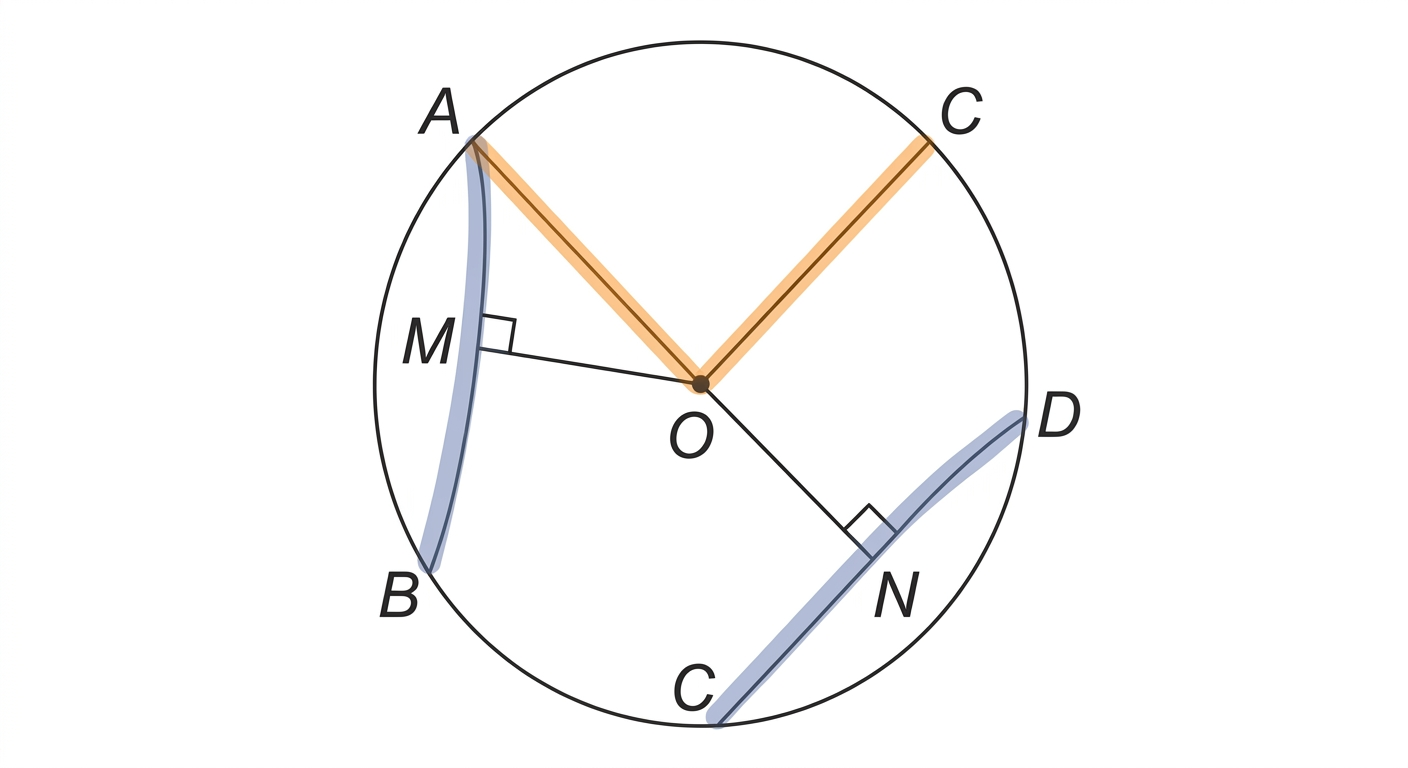
Since the perpendicular from the center bisects a chord:
Given :
Also, and are radii of the same circle:
Step 2 · Apply Baudhāyana–Pythagoras Theorem
In right-angled :
In right-angled :
Since :
Substitute :
Answer
Since , equal chords are equidistant from the center of the circle.
Common Mistakes
- Perpendicular Distance: The distance of a chord from the center is strictly the perpendicular segment from the center to the chord.
- Bisector Property: Forgetting to state that the perpendicular from the center bisects the chord, which is necessary to equate from .