Circles and Geometric Shapes | Exercise 5.4
Question 2
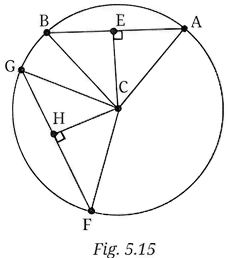
Consider Fig. 5.15. If is perpendicular to , is perpendicular to , and , show that .
Solution
Understand the Question
- The perpendicular drawn from the center of a circle to any chord bisects that chord.
- Using radii drawn to the endpoints of the chords, we form two right-angled triangles ( and ).
- By proving these two right-angled triangles congruent using the RHS congruence criterion, we establish that the half-chords are equal (), which proves that the entire chords are equal ().
Step 1 · Perpendicular from Center Bisects Chord
The perpendicular from the center of a circle to a chord bisects the chord.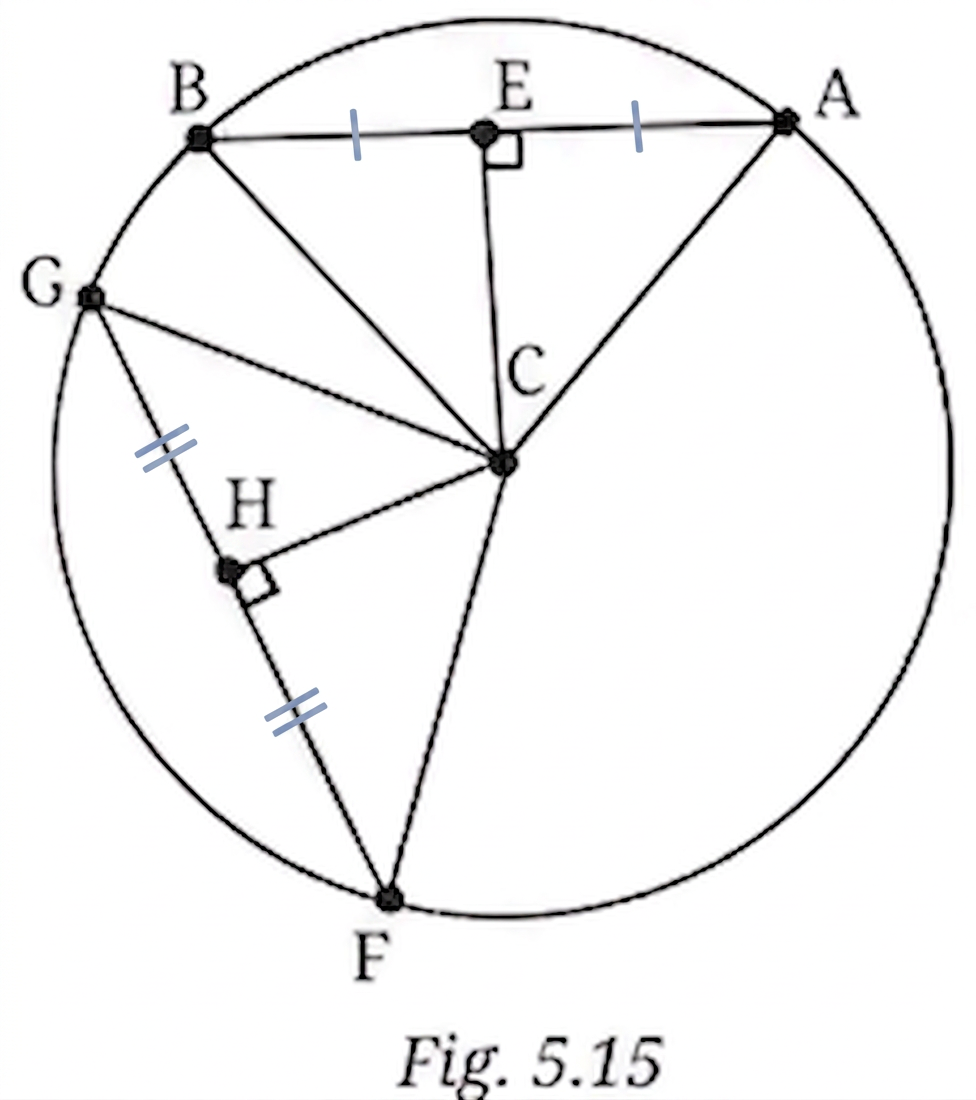
Since , point is the midpoint of :
Since , point is the midpoint of :
Step 2 · Prove Congruence of and
In right-angled triangles and :
- (Given and )
- (Radii of the same circle)
- (Given)
By RHS congruence criterion:
By corresponding parts of congruent triangles (CPCTC):
Step 3 · Show
From Step 1:
Substituting into the expression for :
Answer
Hence proved, .
Common Mistakes
- Missing Chord Bisector Property: Forgetting that implies and .
- Incorrect Congruence Criterion: Stating SAS or SSS instead of the RHS criterion, since the equality relies on the hypotenuse (radius) and one leg (given distance from center).