Question 3
Convert to kilometres.
It is . Verify this.
- To convert a smaller unit of length into a larger unit, we divide:
- We can first convert centimetres to metres by dividing by , and then convert metres to kilometres by dividing by .
Step 1 · Convert Centimetres to Metres
Since :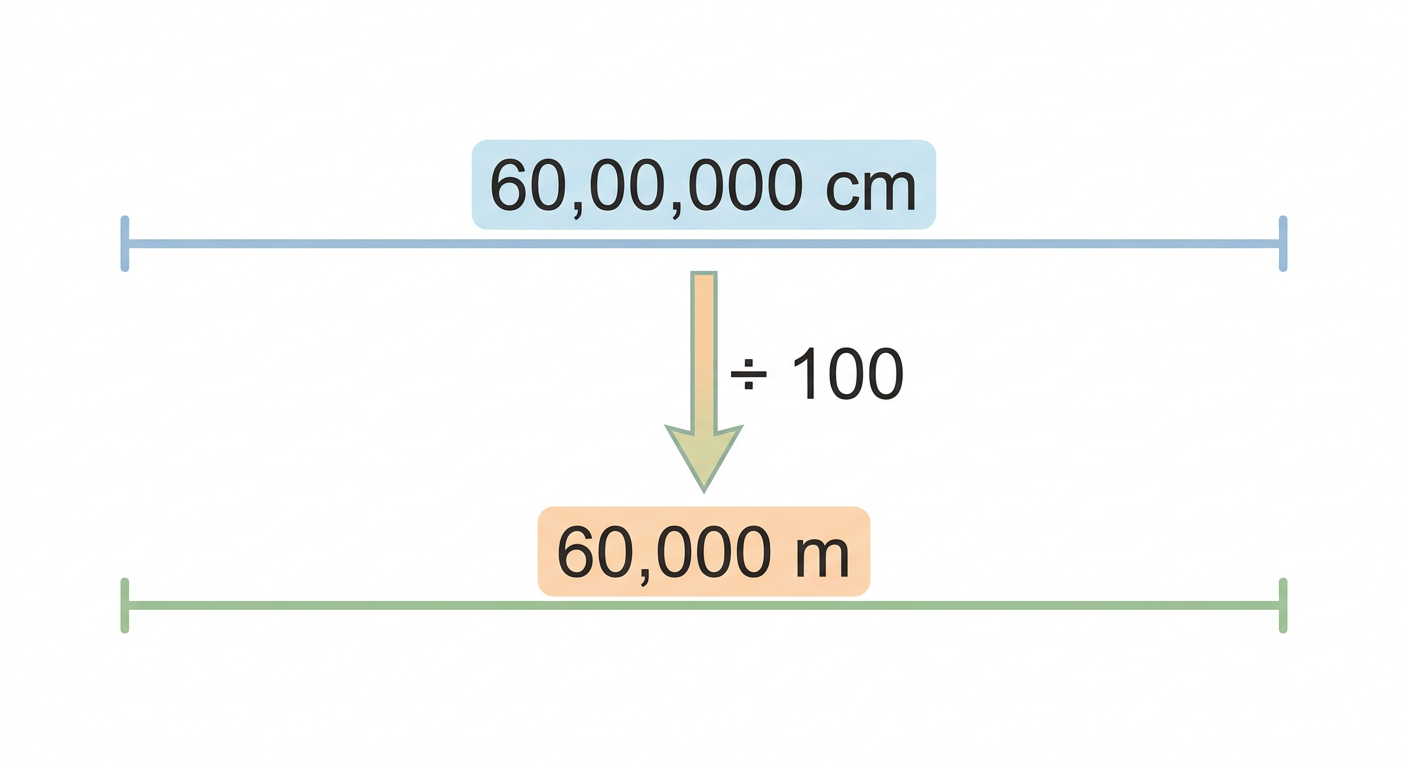
Step 2 · Convert Metres to Kilometres
Since :
Hence, is verified.
(Verified)
- Operation Error: Multiplying by and instead of dividing when converting from a smaller unit () to a larger unit ().
- Counting Zeros: Forgetting that ( zeros total), leading to incorrect decimal point placement.
More questions in IT
Viswanath made idlis by mixing 6 cups of rice with 3 cups of urad dal, while Puneet made idlis by mixing 4 cups of rice with 2 cups of urad dal. If cooked in the same way, would their idlis taste the same?
Have you noticed that in many maps there is a ratio given, usually in the lower right corner of the map? It usually contains and a very large number, such as . What does mean? What does it indicate? Can you guess?
Convert to kilometres.
It is . Verify this.
Using the map above, can you find the geographical distance between Bengaluru and Chennai? Also, find the geographical distance between Mangaluru and Chennai.
[Hint: Use a ruler to find the distance between the cities on the map. Then, use the ratio given on the map to find the actual geographical distance.]
Try to find the distances between the same two pairs of cities with different maps that have different scales (ratios). Do they all give the same geographical distance, approximately?
Context: Puneeth's father went from Lucknow to Kanpur in 3 hours by riding his motorcycle at a speed of 30 km/h. If he takes a car instead and drives at 60 km/h, how long will it take him to reach Kanpur?
Q. Can we represent this problem with the following statement of proportionality — ? Will the travel time increase or decrease as the speed of the motorcycle increases?