Question 6
Context: Puneeth's father went from Lucknow to Kanpur in 3 hours by riding his motorcycle at a speed of 30 km/h. If he takes a car instead and drives at 60 km/h, how long will it take him to reach Kanpur?
Q. Can we represent this problem with the following statement of proportionality — ? Will the travel time increase or decrease as the speed of the motorcycle increases?
- For a fixed distance, speed and time are inversely proportional ().
- This means that as speed increases, the time taken to cover the same distance must decrease.
- A direct proportion statement like incorrectly implies time increases with speed. The correct inverse proportion relation is .
Step 1 · Find Total Distance
Given speed of motorcycle and time taken .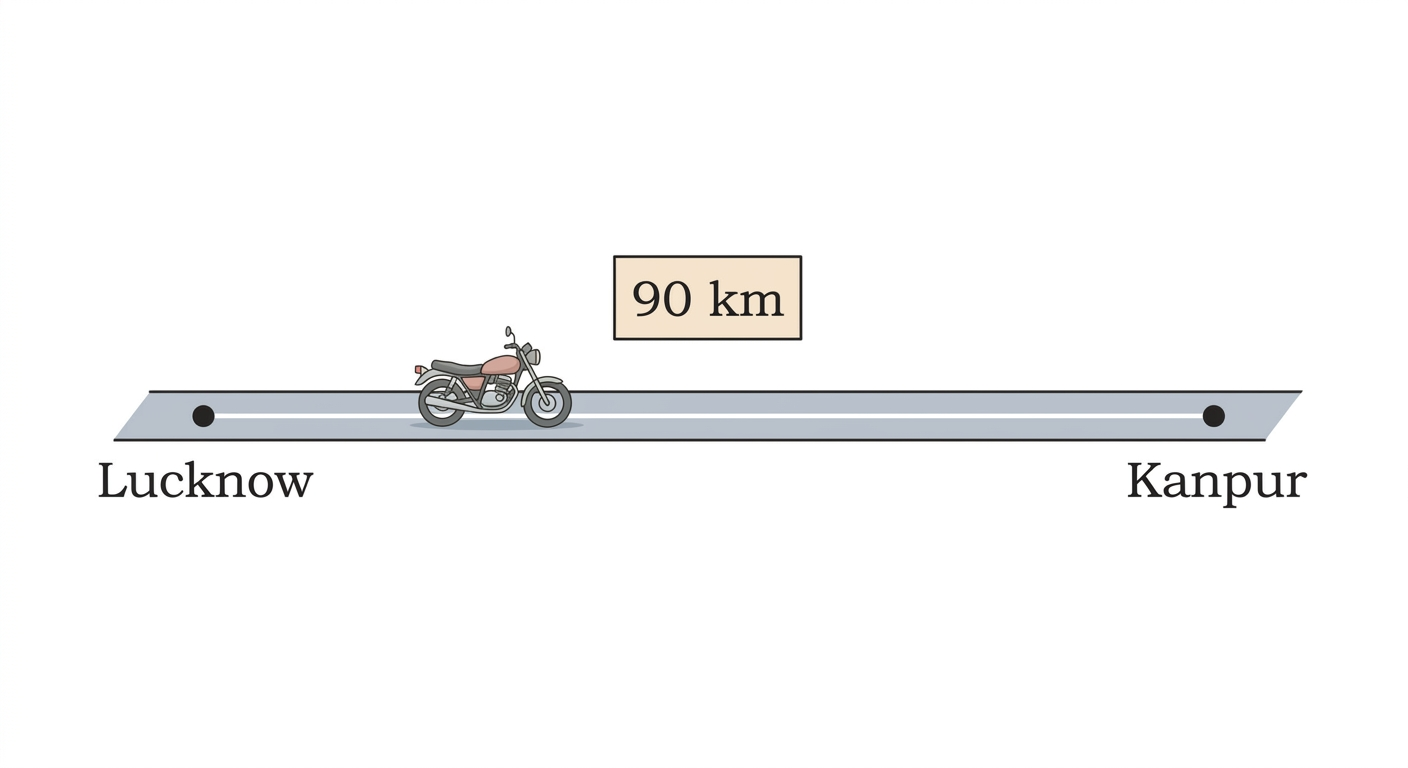
Step 2 · Calculate Actual Travel Time by Car
Distance and car speed .
Let be the time taken by car:
Step 3 · Evaluate the Proportionality Statement
The statement represents direct proportion:
Since , the given statement is incorrect.
Because speed and time vary inversely, the correct proportion is:
Step 4 · Analyze Effect of Increased Speed
When speed increases from to , travel time decreases from to .
Therefore, travel time decreases as speed increases.
(i) No, the problem cannot be represented by .
(ii) The travel time will decrease as the speed increases.
- Direct vs. Inverse Proportion: Writing assumes time increases with speed (direct proportion). For constant distance, the product remains constant, requiring the inverse proportion .
- Intuition Check: Always verify if a higher speed should result in less time. An answer of for doubling speed is physically incorrect.
More questions in IT
Viswanath made idlis by mixing 6 cups of rice with 3 cups of urad dal, while Puneet made idlis by mixing 4 cups of rice with 2 cups of urad dal. If cooked in the same way, would their idlis taste the same?
Have you noticed that in many maps there is a ratio given, usually in the lower right corner of the map? It usually contains and a very large number, such as . What does mean? What does it indicate? Can you guess?
Convert to kilometres.
It is . Verify this.
Using the map above, can you find the geographical distance between Bengaluru and Chennai? Also, find the geographical distance between Mangaluru and Chennai.
[Hint: Use a ruler to find the distance between the cities on the map. Then, use the ratio given on the map to find the actual geographical distance.]
Try to find the distances between the same two pairs of cities with different maps that have different scales (ratios). Do they all give the same geographical distance, approximately?
Context: Puneeth's father went from Lucknow to Kanpur in 3 hours by riding his motorcycle at a speed of 30 km/h. If he takes a car instead and drives at 60 km/h, how long will it take him to reach Kanpur?
Q. Can we represent this problem with the following statement of proportionality — ? Will the travel time increase or decrease as the speed of the motorcycle increases?