Question 44
Were you able to tile this? How can we be sure that this is not tileable? Can you find another unit square that, when removed from a grid, makes it non-tileable?
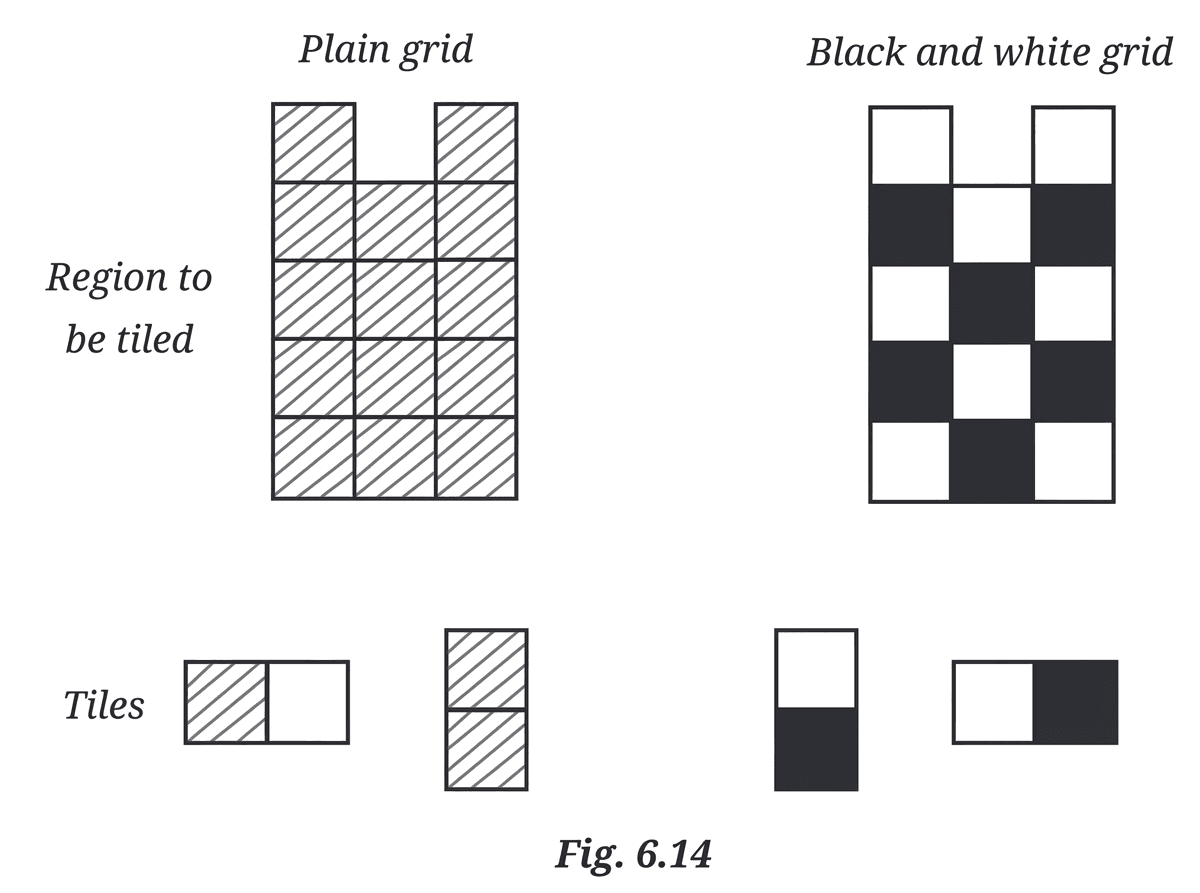
- A domino tile always covers exactly one white square and one black square when placed on a checkerboard pattern.
- Therefore, any region that can be tiled completely by dominoes must have an equal number of white and black squares.
- If the number of white squares is not equal to the number of black squares, tiling is impossible, even if the total number of squares is even.
(i) Were you able to tile this?
(i) No, we were not able to tile this region.
(ii) How can we be sure that this is not tileable?
Step 1 · Count Squares in the Region
The region is a grid with one square removed from the top row.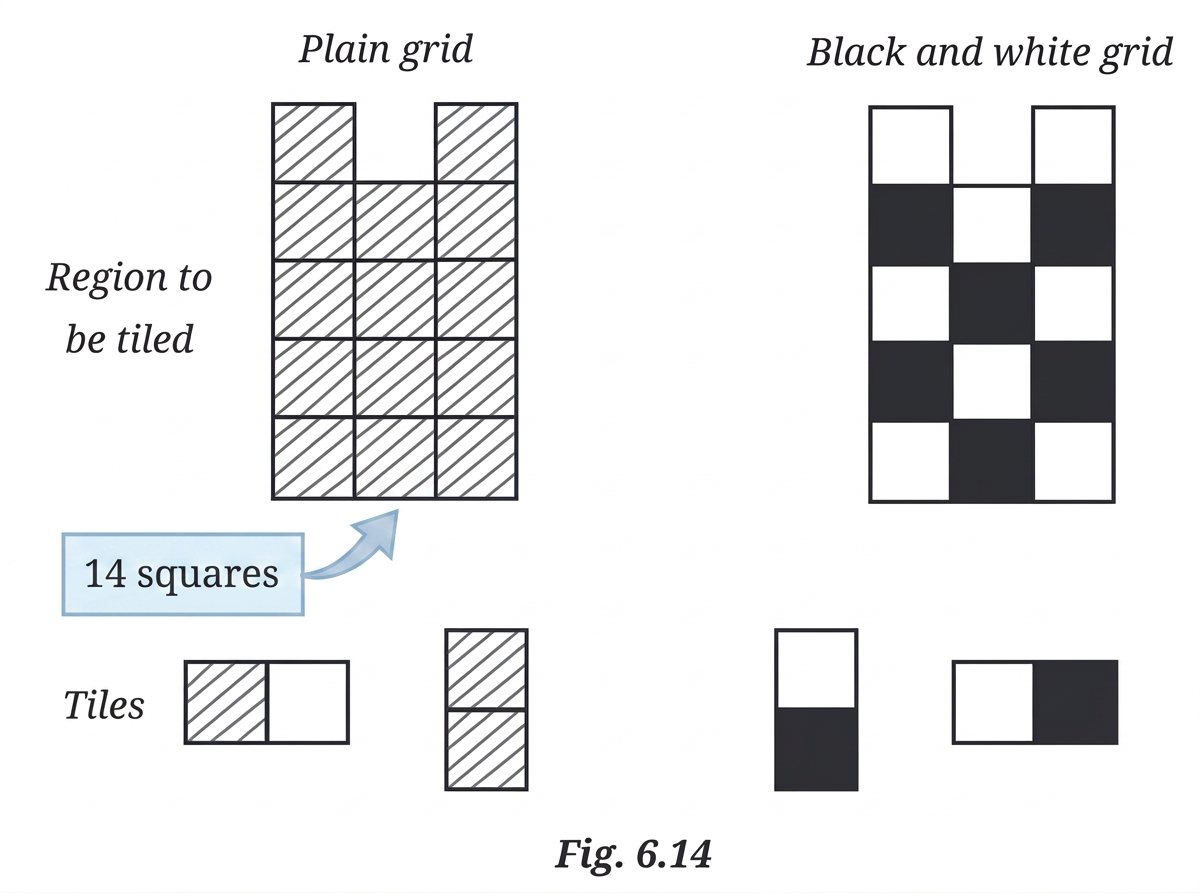
Since each domino covers squares, tiles are needed.
Step 2 · Count Black and White Squares
Color the grid like a checkerboard, starting with white at the top-left.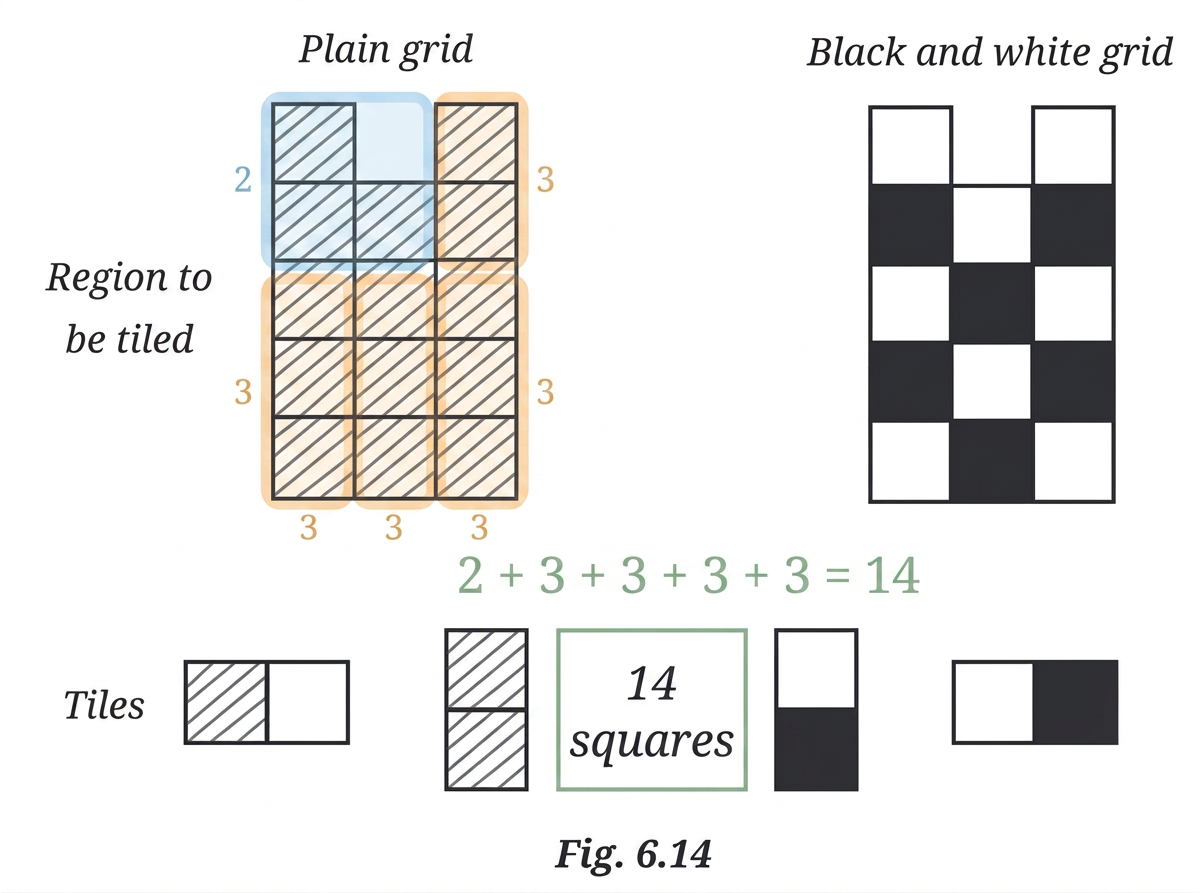
Counting white squares by row:
Counting black squares by row:
Step 3 · Check Tileability Condition
Each domino covers exactly white square and black square.
For the region to be tileable, the number of white squares must equal the number of black squares:
Since the counts are unequal, the region cannot be tiled.
(ii) We can be sure it is not tileable because a checkerboard coloring gives white and black squares. Since each domino covers exactly white and black square, an unequal count makes tiling impossible.
(iii) Can you find another unit square that, when removed from a grid, makes it non-tileable?
Step 1 · Find Another Non-Tileable Removal
A full checkerboard grid (starting with white at ) contains:
- Rows 1, 3, 5: white, black
- Rows 2, 4: white, black
Total squares .
Removing square leaves squares:
- Removing a white square leaves white and black squares (equal counts, potentially tileable).
- Removing a black square leaves white and black squares (unequal counts, non-tileable).
Choosing another black square, such as position (row 2, column 1):
Since , the remaining region is non-tileable.
(iii) Removing the square at position (second row, first column) from a grid leaves white and black squares, making it non-tileable.
- Assuming Even Total Implies Tileable: Having an even number of squares () is necessary, but not sufficient. The color counts must also match.
- Removing a White Square: Removing a white square yields white and black squares, which does not guarantee non-tileability. Only removing a black square guarantees non-tileability by creating an imbalance of white vs black squares.
More questions in IT
How do we find such and ?
From and , draw arcs above and below , with the same radii. The two points at which the arcs meet, above and below , give us and , respectively.
Use this to construct an eye.
In Fig. 6.1, join and with a line. Where does intersect , and what is the angle formed between them?
Will the line joining the two points at which the arcs meet, above and below , always be the perpendicular bisector of , i.e., when is of any length, and the arcs are drawn using a radius of any length?
Which two triangles should be congruent for to be the perpendicular bisector of (that is, is the midpoint of and is perpendicular to )?
How do we get these different shapes? Try!
Will and lie on the perpendicular bisector ?
Justify the following statement using the facts that we have established.
Any point that has the same distance from and lies on the perpendicular bisector of .
Given a line segment , how do we draw its perpendicular bisector using only an unmarked ruler and a compass?
Can we extend the method of constructing the perpendicular bisector to construct a angle at any point on a line? Draw a line and mark a point on it. Construct a angle at point .
Find a segment of this line for which is the midpoint.
How do we construct this figure?
What is the angle between two adjacent lines?
How do we construct a angle using only a ruler and a compass?
Construct the following figure.
Draw an angle. Create a copy of this angle using only a ruler and compass.
How do we implement this idea using a ruler and a compass?
How did they make these arches?
Construct this arch shape on a piece of paper.
Let us think about the support lines this figure will need.
For symmetry, we should have , and . How would you construct these support lines?
Use these support lines to construct an arch. If required, adjust the radii of the arcs to make the arch look more aesthetically pleasing.
How do we construct this shape?
What supporting lines will you use to draw this arch?
Remember 'Wavy Wave' from the Grade 6 Textbook?
The supporting lines are just two line segments of equal length.
If their midpoints are marked, will you be able to construct a pointed arch?
How do we construct a regular pentagon (5-sided figure) and a regular hexagon (6-sided figure)? To begin with, try to construct a pentagon and hexagon with equal sidelengths.
Can we break a regular hexagon into smaller pieces that can be constructed?
Can six congruent equilateral triangles be placed together as in Fig. 6.12? If yes, will it result in a regular hexagon?
Consider this figure. Will the angle fit into the gap? What is the gap angle ?
We have,
Use this to determine whether the angle fits the gap.
In Fig. 6.12 can you explain why , and are straight lines?
Construct a regular hexagon with a sidelength using a ruler and a compass.
Context: We can construct a regular hexagon more directly if we can construct a angle using a ruler and a compass.
Q. How do we do it?
Why is ? Is there an equilateral triangle here?
Construct a regular hexagon of sidelength .
How will you construct and angles?
Construct the following 6-pointed star. Note that it has a rotational symmetry.
Are the six triangles forming the 6 points of the star — , , , , , — equilateral? Why?
[Hint: Find the angles.]
Can a grid be tiled using multiple copies of tiles? We are allowed to rotate a tile and use it.
Can a grid be tiled using tiles?
What about a grid?
Complete the justification.
Is an grid tileable with tiles, if both and are even? If yes, come up with a general strategy to tile it.
Is an grid tileable with tiles, if one of and is even and the other is odd? If yes, come up with a general strategy to tile it.
Is an grid tileable with tiles, if both and are odd? Give reasons.
Here is a grid, with a unit square removed. Now, it has an even number of unit squares. Is it tileable with tiles?
Is the following region tileable with tiles?
Context: We are considering whether a given region can be tiled using tiles.
Q. What about this one?
Were you able to tile this? How can we be sure that this is not tileable? Can you find another unit square that, when removed from a grid, makes it non-tileable?
If the plain grid is tileable, is the black-and-white-grid tileable?
If the black-and-white grid is tileable, is the plain grid tileable?
Use this idea to find another unit square that, when removed from a grid, makes it non-tileable?