Question 9
Whenever Jasoda has to subtract 9 from a number, she subtracts 10 and adds 1 to it. For example, .
(a) Do you think she always gets the correct answer? Why?
(b) Can you think of other similar strategies? Give some examples.
- Jasoda's Strategy: Subtracting is rewritten as subtracting (a friendly number) and then adding back , because .
- For any number :
- This compensation method simplifies mental calculations by working with multiples of and adjusting the difference.
(a) Do you think she always gets the correct answer? Why?
Step 1 · Verify with an Example
Consider the given example :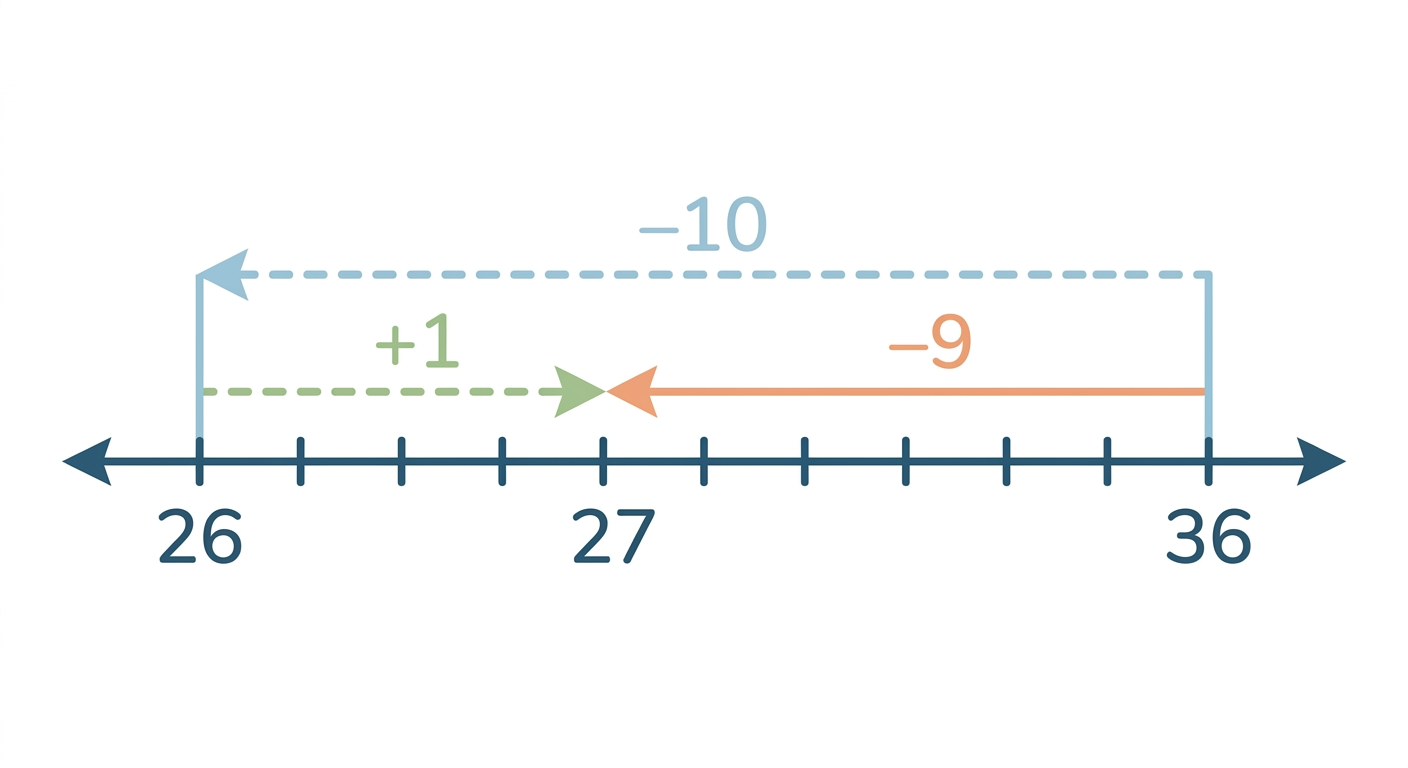
Direct calculation:
Jasoda's method:
Both methods produce the exact same result: .
Step 2 · General Mathematical Proof
Let the number be represented by the variable .
We want to compute .
Jasoda's operation is:
Since , we have:
Because this identity holds for any real number , Jasoda will always get the correct answer.
(a) Yes, she always gets the correct answer because subtracting and adding is algebraically identical to subtracting (since ).
(b) Can you think of other similar strategies? Give some examples.
Step 1 · Develop Similar Compensation Strategies
We can round to the nearest multiple of and adjust with the difference:
1. Subtracting 8 (Subtract 10, Add 2): Since
- Direct:
- Strategy:
2. Adding 9 (Add 10, Subtract 1): Since
- Direct:
- Strategy:
3. Subtracting 19 (Subtract 20, Add 1): Since
- Direct:
- Strategy:
4. Adding 18 (Add 20, Subtract 2): Since
- Direct:
- Strategy:
(b) Similar strategies include:
- Subtracting 8: Subtract and add (e.g., )
- Adding 9: Add and subtract (e.g., )
- Subtracting 19: Subtract and add (e.g., )
- Adding 18: Add and subtract (e.g., )
- Sign Error in Adjustment: Subtracting the adjustment instead of adding it (e.g., computing instead of ).
- Addition vs. Subtraction Confusion: Forgetting to invert the adjustment when adding (e.g., for , one must add and subtract , not add ).
More questions in FIO
Fill in the blanks to make the expressions equal on both sides of the sign:
(a)
(b)
(c)
(d)
Arrange the following expressions in ascending (increasing) order of their values.
(a)
(b)
(c)
(d)
(e)
Find the values of the following expressions by writing the terms in each case.
(a)
(b)
(c)
(d)
(e)
Write a story/situation for each of the following expressions and find their values.
(a)
(b)
(c)
For each of the following situations, write the expression describing the situation, identify its terms and find the value of the expression.
(a) Queen Alia gave 100 gold coins to Princess Elsa and 100 gold coins to Princess Anna last year. Princess Elsa used the coins to start a business and doubled her coins. Princess Anna bought jewellery and has only half of the coins left. Write an expression describing how many gold coins Princess Elsa and Princess Anna together have.
(b) A metro train ticket between two stations is ₹40 for an adult and ₹20 for a child. What is the total cost of tickets:
(i) for four adults and three children?
(ii) for two groups having three adults each?
(c) Find the total height of the window by writing an expression describing the relationship among the measurements shown in the picture.
Add brackets at appropriate places in the expressions such that they lead to the values indicated.
(a)
(b)
(c)
Using only reasoning of how terms change their values, fill the blanks to make the expressions on either side of the equality () equal.
(a)
(b)
Using the numbers 2, 3 and 5, and the operators '+' and '-', and brackets, as necessary, generate expressions to give as many different values as possible. For example, and .
Whenever Jasoda has to subtract 9 from a number, she subtracts 10 and adds 1 to it. For example, .
(a) Do you think she always gets the correct answer? Why?
(b) Can you think of other similar strategies? Give some examples.
Consider the two expressions: a) , b) . For each of these expressions, identify the expressions from the following collection that are equal to it.
(a)
(b)
(c)
(d)
Figure it Out
- Fill in the blanks with numbers, and boxes by signs, so that the expressions on both sides are equal.
(a)
(b)
(c)
(d)
(e)
(f)
(g)
(h)
(i)
(j)
(k)
(l)
(m)
(n)
(o)
(p)
In the boxes below, fill '<', '>' or '=' after analysing the expressions on the LHS and RHS. Use reasoning and understanding of terms and brackets to figure this out and not by evaluating the expressions.
(a)
(b)
(c)
(d)
Here is one way to make 14: . Are there other ways of getting 14? Fill them out below:
(a)
(b)
(c)
(d)
Find out the sum of the numbers given in each picture below in at least two different ways. Describe how you solved it through expressions.
Read the situations given below. Write appropriate expressions for each of them and find their values.
(a) The district market in Begur operates on all seven days of a week. Rahim supplies 9 kg of mangoes each day from his orchard and Shyam supplies 11 kg of mangoes each day from his orchard to this market. Find the amount of mangoes supplied by them in a week to the local district market.
(b) Binu earns ₹20,000 per month. She spends ₹5,000 on rent, ₹5,000 on food, and ₹2,000 on other expenses every month. What is the amount Binu will save by the end of a year?
(c) During the daytime a snail climbs 3 cm up a post, and during the night while asleep, accidentally slips down by 2 cm. The post is 10 cm high, and a delicious treat is on its top. In how many days will the snail get the treat?
Melvin reads a two-page story every day except on Tuesdays and Saturdays. How many stories would he complete reading in 8 weeks? Which of the expressions below describes this scenario?
(a)
(b)
(c)
(d)
(e)
(f)
(g)
(h)
Find different ways of evaluating the following expressions:
(a)
(b)
Compare the following pairs of expressions using '', '' or '' or by reasoning.
(a)
(b)
(c)
(d)
(e)
(f)
(g)
(h)
Identify which of the following expressions are equal to the given expression without computation. You may rewrite the expressions using terms or removing brackets. There can be more than one expression which is equal to the given expression.
(a)
(i)
(ii)
(iii)
(iv)
(b)
(i)
(ii)
(iii)
(iv)
Choose a number and create ten different expressions having that value.