Question 5
What happens to the value of an expression if we increase or decrease the value of one of its terms?
Some expressions are given in following three columns. In each column, one or more terms are changed from the first expression. Go through the example (in the first column) and fill the blanks, doing as little computation as possible.
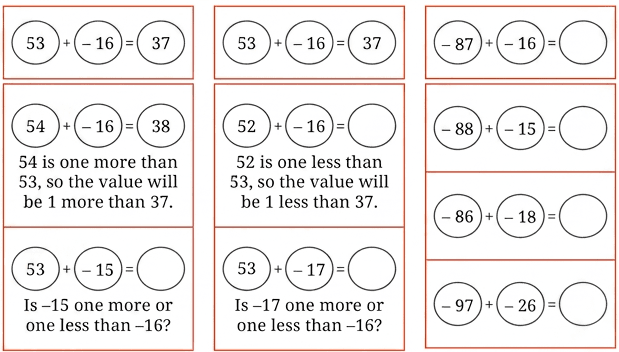
- When we increase or decrease the value of a term in an addition expression, the total sum changes by the exact same amount.
- If a term is increased by , the value of the expression increases by .
- If a term is decreased by , the value of the expression decreases by .
- When multiple terms are altered, the overall value changes by the net sum of the individual changes, allowing us to find new values with minimal computation.
Step 1 · Column 1 Calculations
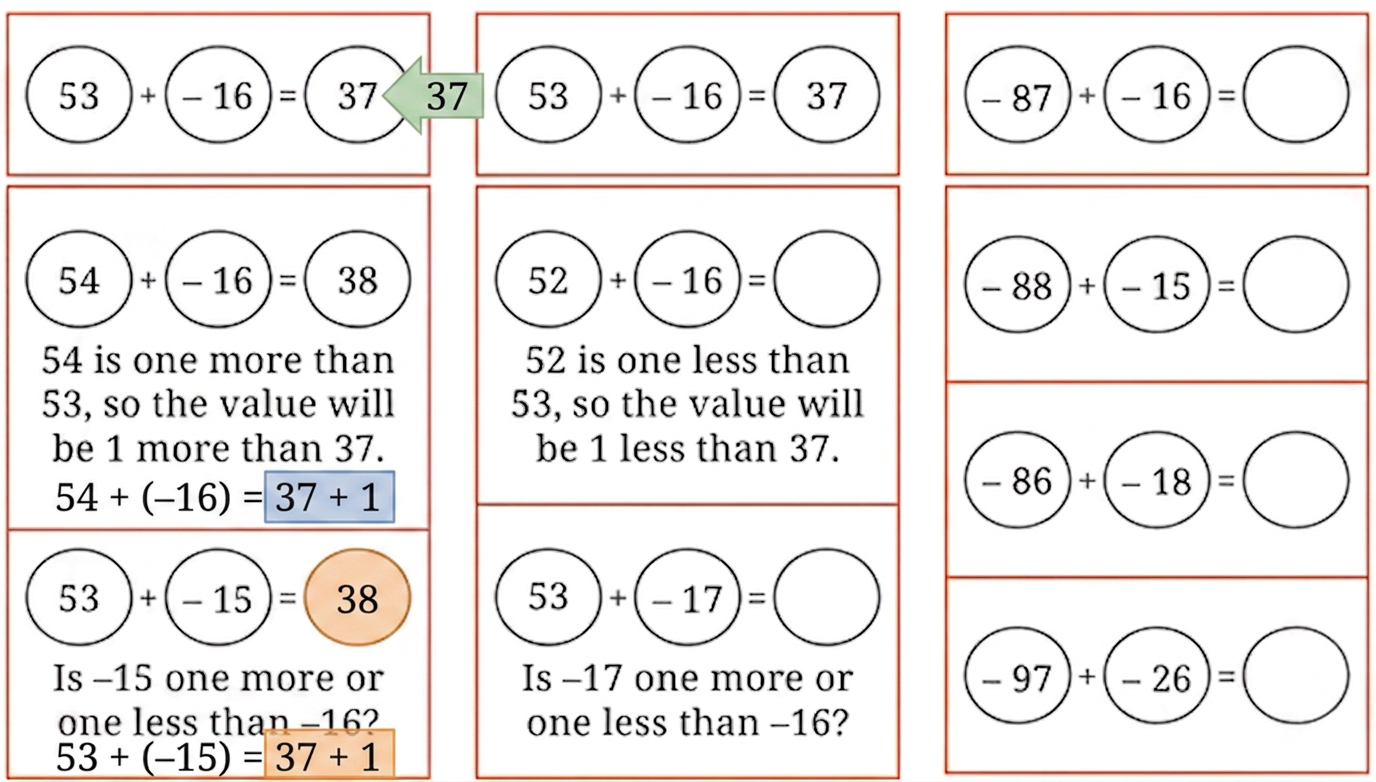
Base expression:
Second expression ( is more than ):
Third expression ( is more than ):
Step 2 · Column 2 Calculations
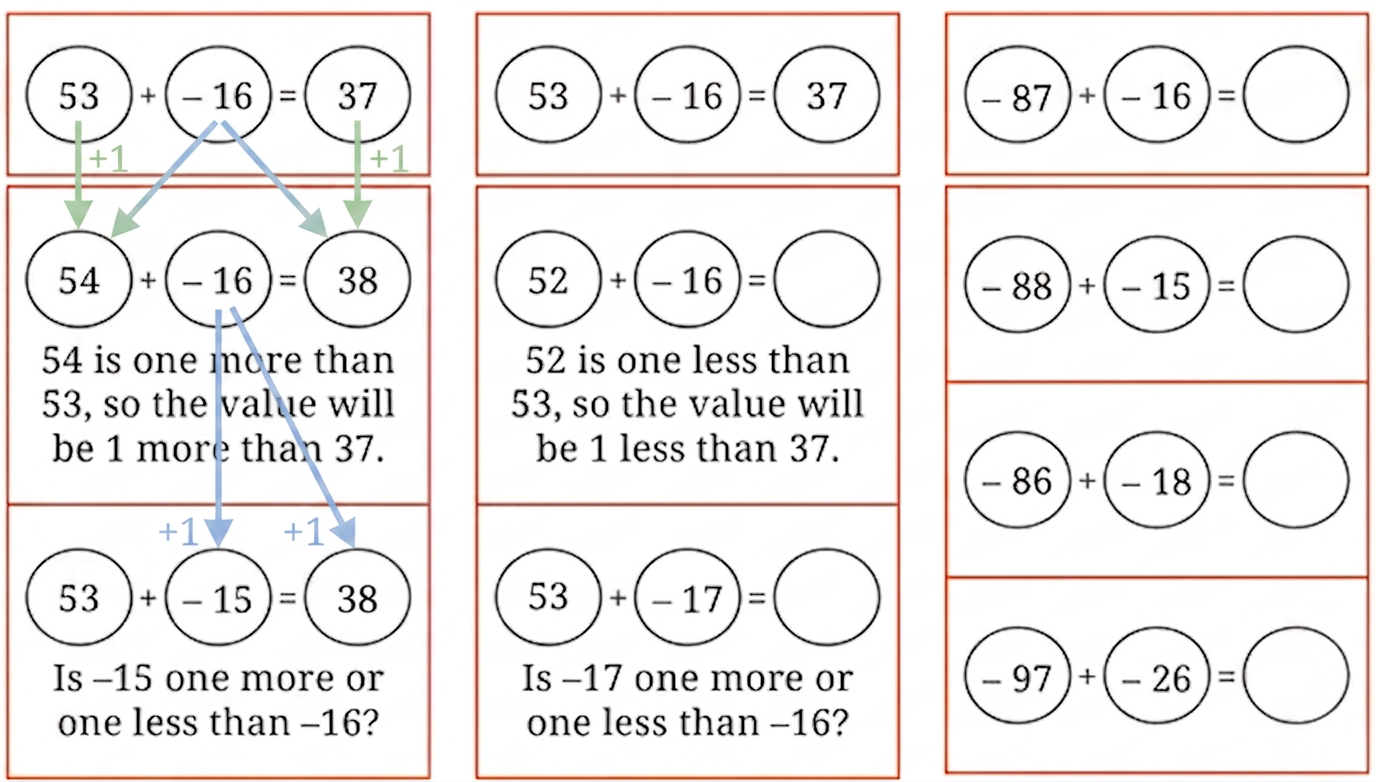
Base expression:
Second expression ( is less than ):
Third expression ( is less than ):
Step 3 · Column 3 Calculations
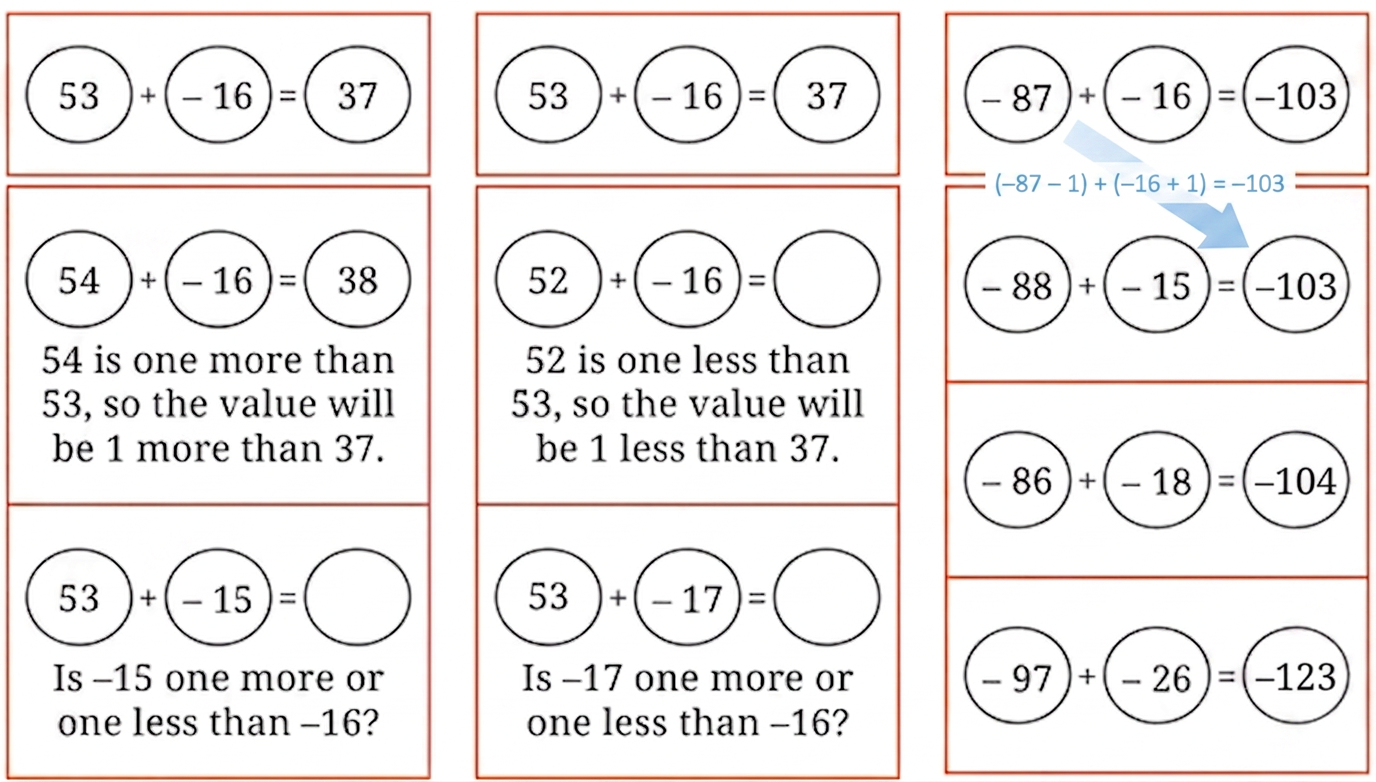
First expression:
Second expression ( is less than , and is more than , net change ):
Third expression ( is more than , and is less than , net change ):
Fourth expression ( is less than , and is less than , net change ):
Column 1:
- Second expression:
- Third expression:
Column 2:
- Second expression:
- Third expression:
Column 3:
- First expression:
- Second expression:
- Third expression:
- Fourth expression:
- Negative Number Direction: Incorrectly assuming that is smaller than . In reality, (an increase of ), while (a decrease of ).
- Recalculating from Scratch: Computing the entire arithmetic sum directly instead of tracking the relative change (, , , etc.) from the reference expression.
More questions in A
Context: In an expression having two terms, swapping them does not change the value:
Q. Can you explain why this is happening using the Token Model of integers that we saw in the Class 6 textbook of mathematics?
Context: Let us consider the expression again. What happens when we change the order and add and first, and then add this sum to ? Will we get the same sum as before? We see that adding the terms of the expression in any order gives the same sum of .
Q. Does adding the terms of an expression in any order give the same value? Take some more expressions and check. Consider expressions with more than 3 terms also.
Context: Does adding the terms of an expression in any order give the same value? Take some more expressions and check. Consider expressions with more than terms also.
Q. Can you explain why this is happening using the Token Model of integers that we saw in the Class 6 textbook of mathematics?
What happens to the value of an expression if we increase or decrease the value of one of its terms?
Some expressions are given in following three columns. In each column, one or more terms are changed from the first expression. Go through the example (in the first column) and fill the blanks, doing as little computation as possible.
Expression Engineer!
Using three 3's along with the four operations (addition, subtraction, multiplication, and division) and brackets as needed we can create several expressions. For example, , , , and so on.
- Using four 4's, create expressions to get all values from 1 to 20.
- Using the numbers 1, 2, 3, 4, and 5 exactly once in any order get as many values as possible between and .
- Using the numbers 0 to 9 exactly once in any order, make an expression with a value 100.
- What other similar interesting questions can you ask?