Question 4
Context: Does adding the terms of an expression in any order give the same value? Take some more expressions and check. Consider expressions with more than terms also.
Q. Can you explain why this is happening using the Token Model of integers that we saw in the Class 6 textbook of mathematics?
- Commutative and Associative Properties: Addition of integers is commutative () and associative (). This means changing the order or grouping of terms in an addition expression does not change the final sum.
- Token Model Concept:
- Positive integers are represented by positive tokens (e.g., yellow).
- Negative integers are represented by negative tokens (e.g., red).
- Adding integers means pooling all tokens together.
- One positive token and one negative token cancel each other out to form a zero pair.
- Because the total pool of positive and negative tokens remains identical no matter which order they are collected or grouped in, the remaining uncancelled tokens—and hence the final sum—will always be the same.
Step 1 · Evaluate an Expression in Different Orders
Consider a 4-term expression: .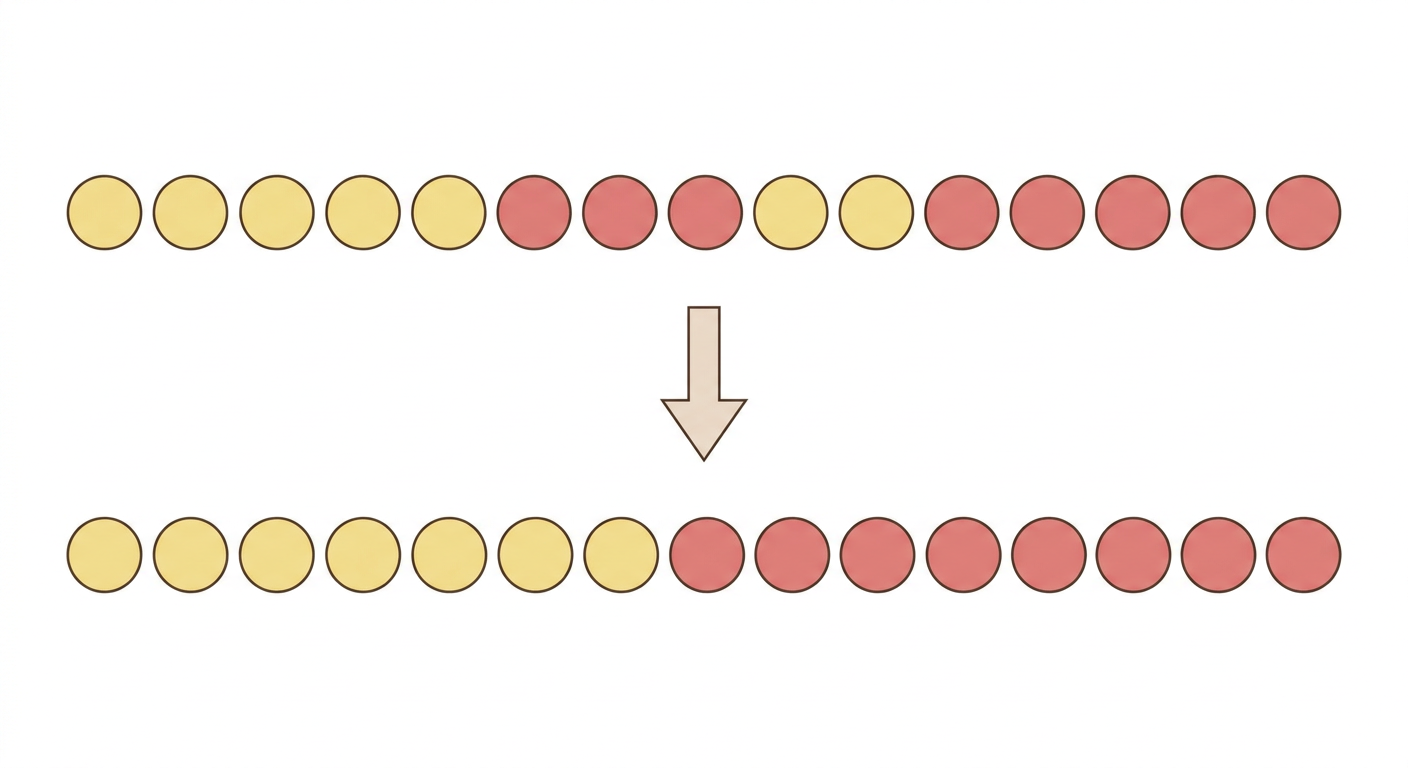
Method 1: Add from left to right
Method 2: Group the middle terms first
Method 3: Group positive and negative numbers together
All three methods yield the same value: .
Step 2 · Explain Using the Token Model
In the Token Model:
- Positive integers are represented by yellow tokens ().
- Negative integers are represented by red tokens ().
- Combining yellow token and red token forms a zero pair ().
For the expression :
- yellow tokens
- red tokens
- yellow tokens
- red tokens
Putting all tokens together:
- Total yellow tokens:
- Total red tokens:
Cancelling out zero pairs:
Since red tokens remain, the value is .
Conclusion: The total count of yellow tokens () and red tokens () in the collection does not change regardless of the order in which we add or group them. Hence, the final sum is always the same.
Yes. Adding terms in any order gives the same value because the total number of positive and negative tokens collected remains constant, resulting in the same net value after cancelling zero pairs.
- Dropping Negative Signs: Dropping or misplacing the negative sign when rearranging terms (e.g., writing instead of ).
- Forgetting Zero Pairs: Forgetting that equal numbers of positive and negative tokens neutralize each other () rather than simply being subtracted without sign tracking.
- Confusing Addition with Subtraction: Assuming that changing order in subtraction works the same way; changing order without preserving the term's sign only applies directly to addition (, but ).
More questions in A
Context: In an expression having two terms, swapping them does not change the value:
Q. Can you explain why this is happening using the Token Model of integers that we saw in the Class 6 textbook of mathematics?
Context: Let us consider the expression again. What happens when we change the order and add and first, and then add this sum to ? Will we get the same sum as before? We see that adding the terms of the expression in any order gives the same sum of .
Q. Does adding the terms of an expression in any order give the same value? Take some more expressions and check. Consider expressions with more than 3 terms also.
Context: Does adding the terms of an expression in any order give the same value? Take some more expressions and check. Consider expressions with more than terms also.
Q. Can you explain why this is happening using the Token Model of integers that we saw in the Class 6 textbook of mathematics?
What happens to the value of an expression if we increase or decrease the value of one of its terms?
Some expressions are given in following three columns. In each column, one or more terms are changed from the first expression. Go through the example (in the first column) and fill the blanks, doing as little computation as possible.
Expression Engineer!
Using three 3's along with the four operations (addition, subtraction, multiplication, and division) and brackets as needed we can create several expressions. For example, , , , and so on.
- Using four 4's, create expressions to get all values from 1 to 20.
- Using the numbers 1, 2, 3, 4, and 5 exactly once in any order get as many values as possible between and .
- Using the numbers 0 to 9 exactly once in any order, make an expression with a value 100.
- What other similar interesting questions can you ask?