Question 6
Here are some questions on paper cutting. Consider a vertical fold. We represent it this way:
Vertical Fold
Similarly, a horizontal fold is represented as follows:
Horizontal Fold
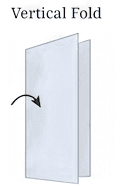
- Vertical fold: A fold along a vertical (up-and-down) crease line, folding the paper from left to right (or right to left). It halves the width of the paper.
- Horizontal fold: A fold along a horizontal (left-to-right) crease line, folding the paper from top to bottom (or bottom to top). It halves the height of the paper.
- Each single fold doubles the number of paper layers (from layer to layers).
Step 1 · Vertical Fold
A vertical fold has a crease line running vertically (top to bottom).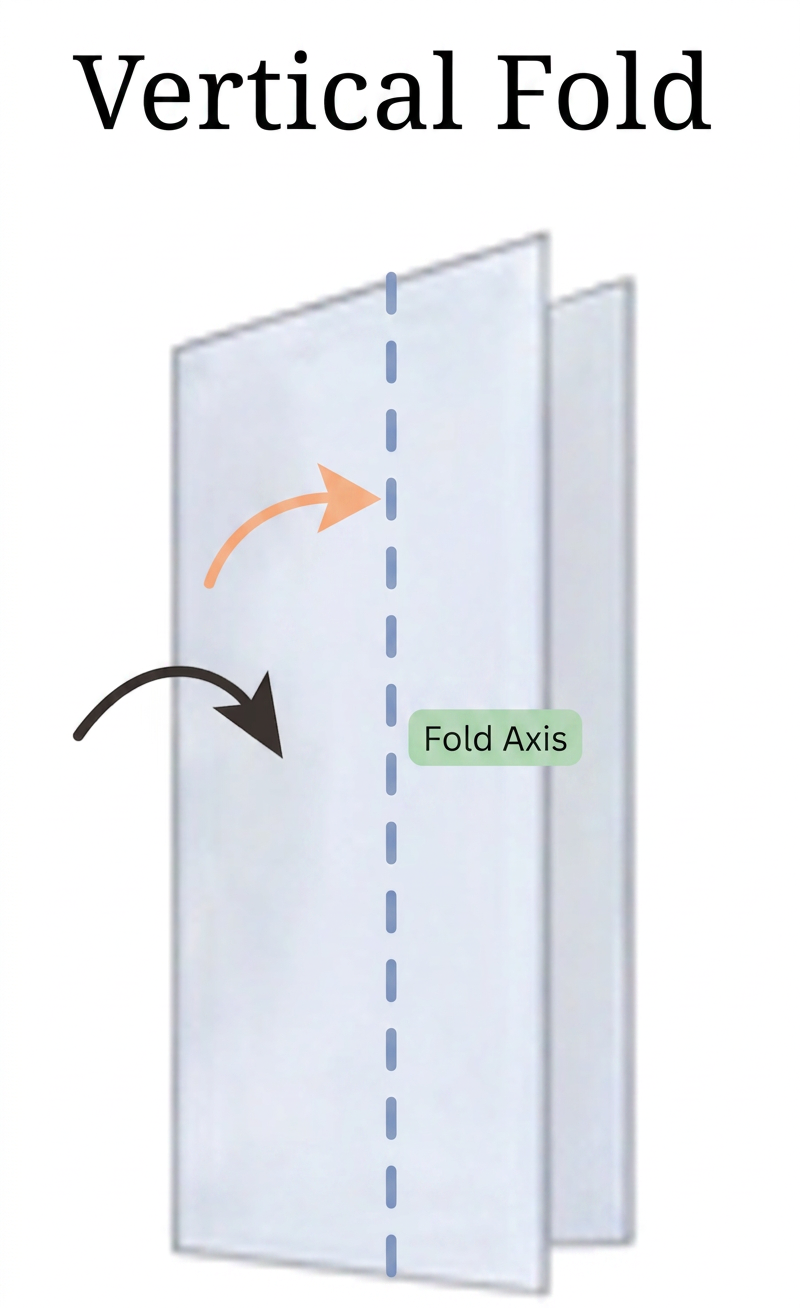
- The fold goes from left to right along a vertical line.
- The paper becomes half as wide and forms layers.
Step 2 · Horizontal Fold
A horizontal fold has a crease line running horizontally (left to right).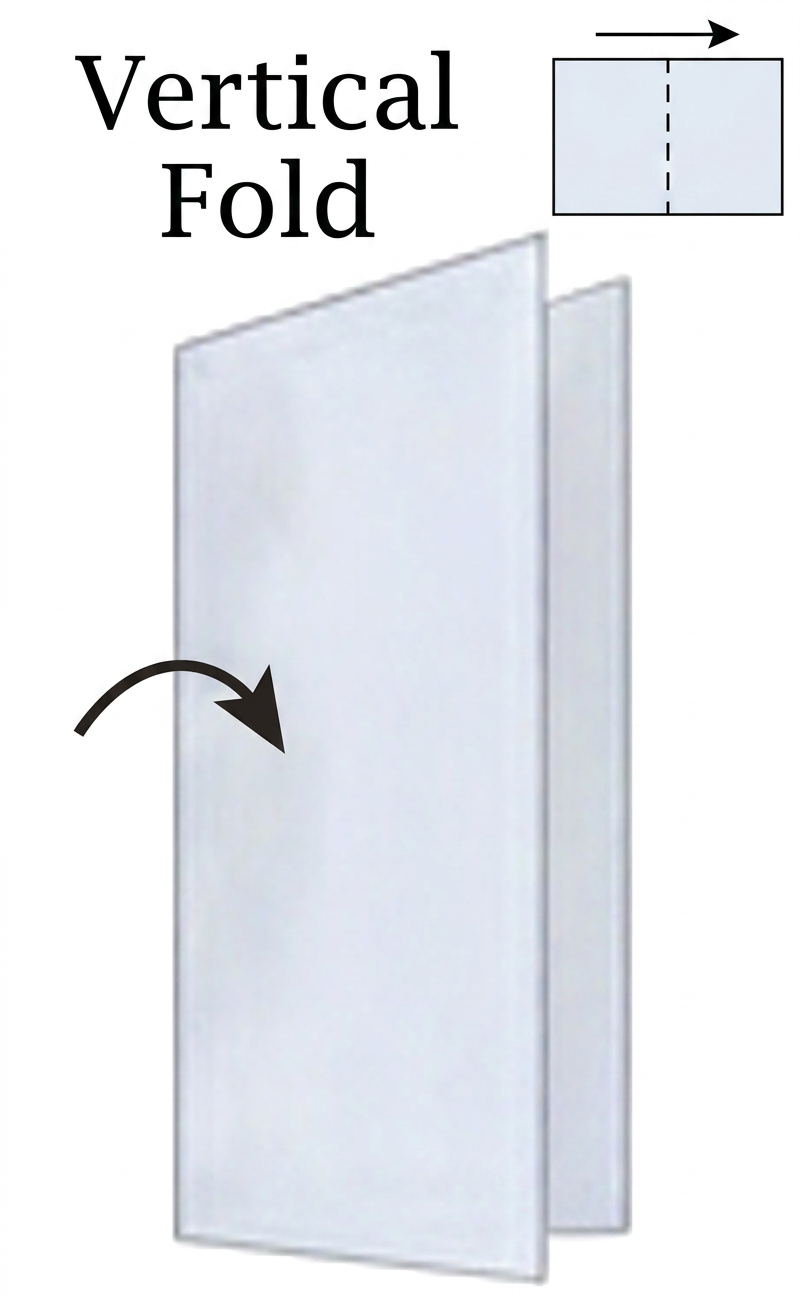
- The fold goes from top to bottom along a horizontal line.
- The paper becomes half as tall and forms layers.
A vertical fold reduces the width by half, while a horizontal fold reduces the height by half. Both folds result in layers of paper.
- Confusing Orientation: Mixing up vertical (up-down line of symmetry) and horizontal (left-right line of symmetry).
- Layer Counting: Forgetting that each fold multiplies the number of overlapping layers by .
More questions in FIO
Do you see any line of symmetry in the figures at the start of the chapter? What about in the picture of the cloud?
For each of the following figures, identify the line(s) of symmetry if it exists.
Punching Game
The fold is a line of symmetry. Punch holes at different locations of a folded square sheet of paper using a punching machine and create different symmetric patterns.
In each of the following figures, a hole was punched in a folded square sheet of paper and then the paper was unfolded. Identify the line along which the paper was folded. Figure (d) was created by punching a single hole. How was the paper folded?
Given the line(s) of symmetry, find the other hole(s):
Here are some questions on paper cutting. Consider a vertical fold. We represent it this way:
Vertical Fold
Similarly, a horizontal fold is represented as follows:
Horizontal Fold
After each of the following cuts, predict the shape of the hole when the paper is opened. After you have made your prediction, make the cutouts and verify your answer.
Trace each figure and draw the lines of symmetry, if any:
Copy the following on a dot grid. For each figure draw two more lines to make a shape that has a line of symmetry.
Find the angles of symmetry for the given figures about the point marked •.
(a) (b) (c)
Which of the following figures have more than one angle of symmetry?
Give the order of rotational symmetry for each figure:
Colour the sectors of the circle below so that the figure has:
(i) 3 angles of symmetry
(ii) 4 angles of symmetry
(iii) What are the possible numbers of angles of symmetry you can obtain by colouring the sectors in different ways?
Draw two figures other than a circle and a square that have both reflection symmetry and rotational symmetry.
Draw, wherever possible, a rough sketch of:
a. A triangle with at least two lines of symmetry and at least two angles of symmetry.
b. A triangle with only one line of symmetry but not having rotational symmetry.
c. A quadrilateral with rotational symmetry but no reflection symmetry.
d. A quadrilateral with reflection symmetry but not having rotational symmetry.
In a figure, is the smallest angle of symmetry. What are the other angles of symmetry of this figure?
In a figure, is an angle of symmetry. The figure has two angles of symmetry less than . What is its smallest angle of symmetry?
Can we have a figure with rotational symmetry whose smallest angle of symmetry is:
a. ?
b. ?