Question 7
Look at the figures below and guess which one of them has a larger area.
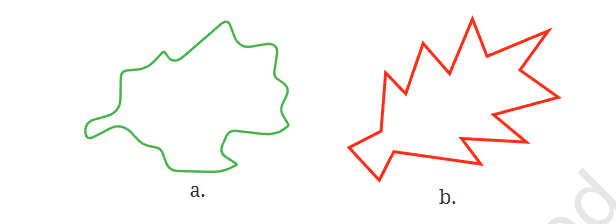
- Area is the measure of the flat two-dimensional space or surface enclosed within the boundary of a closed shape.
- To visually estimate and compare the areas of irregular shapes, we observe the overall region and space covered by each figure.
Step 1 · Analyze Shape (a)
Shape (a) is a compact, irregular figure with smooth curved edges that encloses a concentrated region.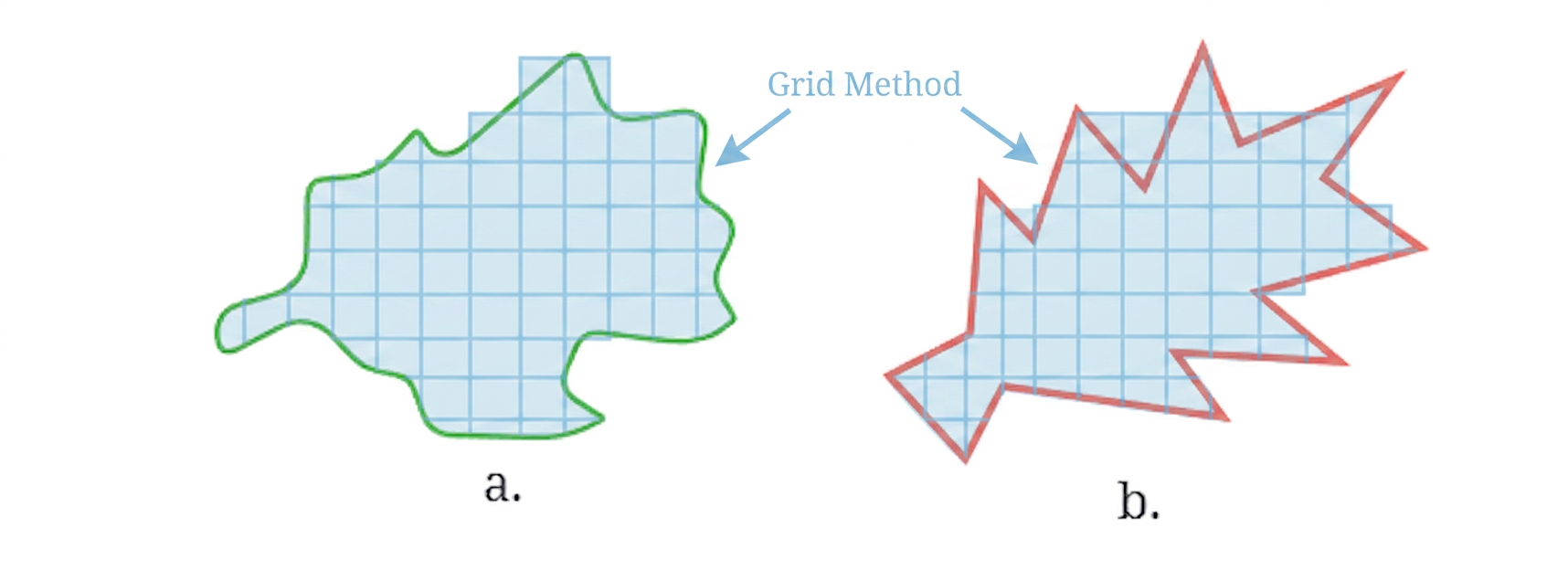
Step 2 · Analyze Shape (b)
Shape (b) is a star-like shape with several pointed parts extending outward in different directions.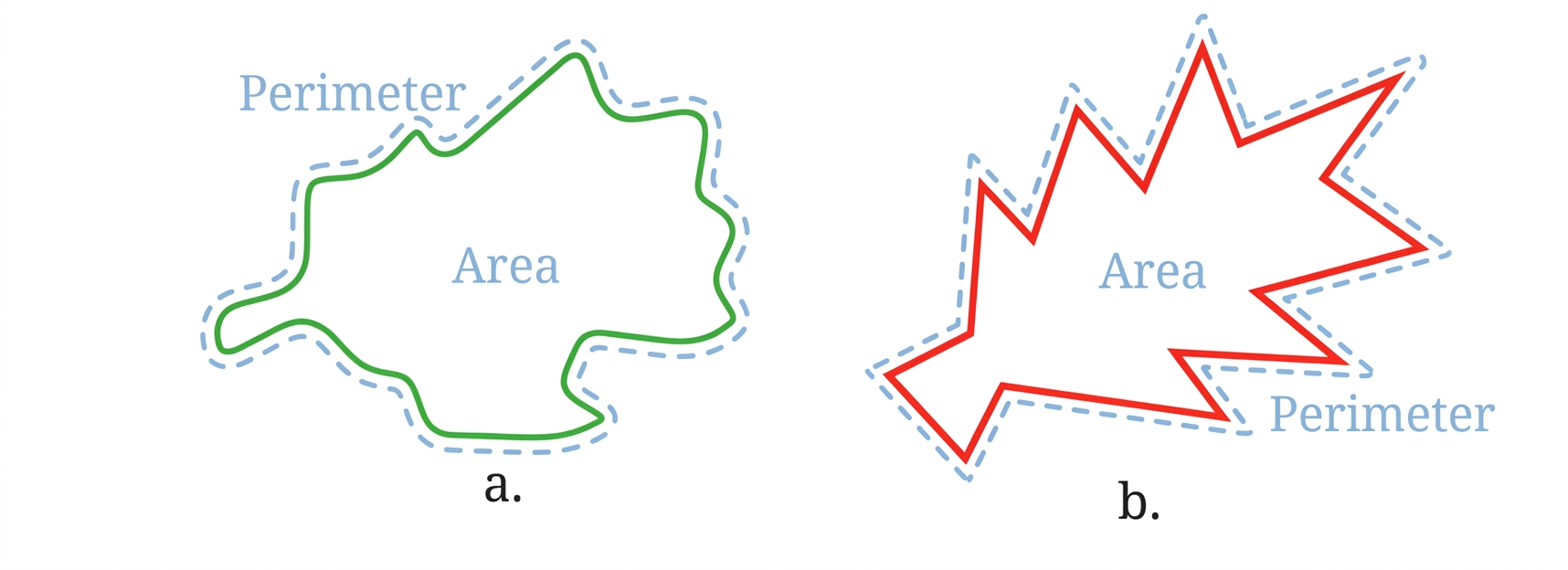
Step 3 · Compare the Enclosed Areas
Comparing the two shapes:
- Shape (b) spreads across a wider region, covering more total surface space with its extended branches.
- Shape (a) occupies a comparatively smaller, more compact area.
Therefore, Shape (b) encloses a larger area than Shape (a).
Shape (b) has a larger area.
- Perimeter vs. Area Confusion: Confusing the length of the outer boundary (perimeter) with the total flat surface enclosed (area).
- Overlooking Shape Spread: Focusing only on the central body of a shape and ignoring the space covered by extended sections or points.
More questions in IT
Akshi says that the perimeter of this triangle shape is 9 units. Toshi says it can’t be 9 units and the perimeter will be more than 9 units. What do you think?
Write the perimeters of the figures below in terms of straight and diagonal units.
What is a similarity between a square and an equilateral triangle?
Split and rejoin
A rectangular paper chit of dimension is cut as shown into two equal pieces. These two pieces are joined in different ways.
Find out the length of the boundary (i.e., the perimeter) of each of the other arrangements below.
Arrange the two pieces to form a figure with a perimeter of 22 cm.
In previous grades, we arrived at the formula for the area of a rectangle and a square using square grid paper. Do you remember?
Look at the figures below and guess which one of them has a larger area.
Find the area of the following figures.
Now, see the figures below. Is the area of the blue rectangle more or less than the area of the yellow triangle? Or is it the same? Why?
- Can you see some relationship between the blue rectangle and the yellow triangle and their areas? Write the relationship here.
Use your understanding from previous grades to calculate the area of any closed figure using grid paper and—
- Find the area of blue triangle BAD.
Use your understanding from previous grades to calculate the area of any closed figure using grid paper and—
- Find the area of red triangle .
Area of rectangle
Using 9 unit squares, solve the following.
- What is the smallest perimeter possible?
- What is the largest perimeter possible?
- Make a figure with a perimeter of 18 units.
- Can you make other shaped figures for each of the above three perimeters, or is there only one shape with that perimeter? What is your reasoning?
Let's do something tricky now! We have a figure below having perimeter 24 units.
Without calculating all over again, observe, think and find out what will be the change in the perimeter if a new square is attached as shown on the right.
Experiment placing this new square at different places and think what the change in perimeter will be. Can you place the square so that the perimeter: a) increases; b) decreases; c) stays the same?
Below is the house plan of Charan. It is in a rectangular plot. Look at the plan. What do you notice?
Some of the measurements are given.
a. Find the missing measurements.
b. Find out the area of his house.
Now, find out the missing dimensions and area of Sharan's home. Below is the plan:
Some of the measurements are given.
a. Find the missing measurements.
b. Find out the area of his house.
What are the dimensions of all the different rooms in Sharan's house? Compare the areas and perimeters of Sharan's house and Charan's house.
Area Maze Puzzles
In each figure, find the missing value of either the length of a side or the area of a region.